
The Three-Sentence Explanation for Any Ticket
Wednesday, 09:25, at Bluewater Bank. Noor, the supervisor at branch 7, is on the phone: "What's going on with the S drive? It vanished at ten past and now it's back and nobody knows if their stuff saved." Amara on the desk knows exactly what happened, in detail, because she has spent the last fifteen minutes finding out. An update failed to apply overnight. The file server restarted itself at 09:10 to recover. The service that shares the drive did not start with it, and she started it by hand at 09:18. She opens her mouth to say all of that and closes it again, because Noor did not ask for a timeline. She asked whether people's work saved.
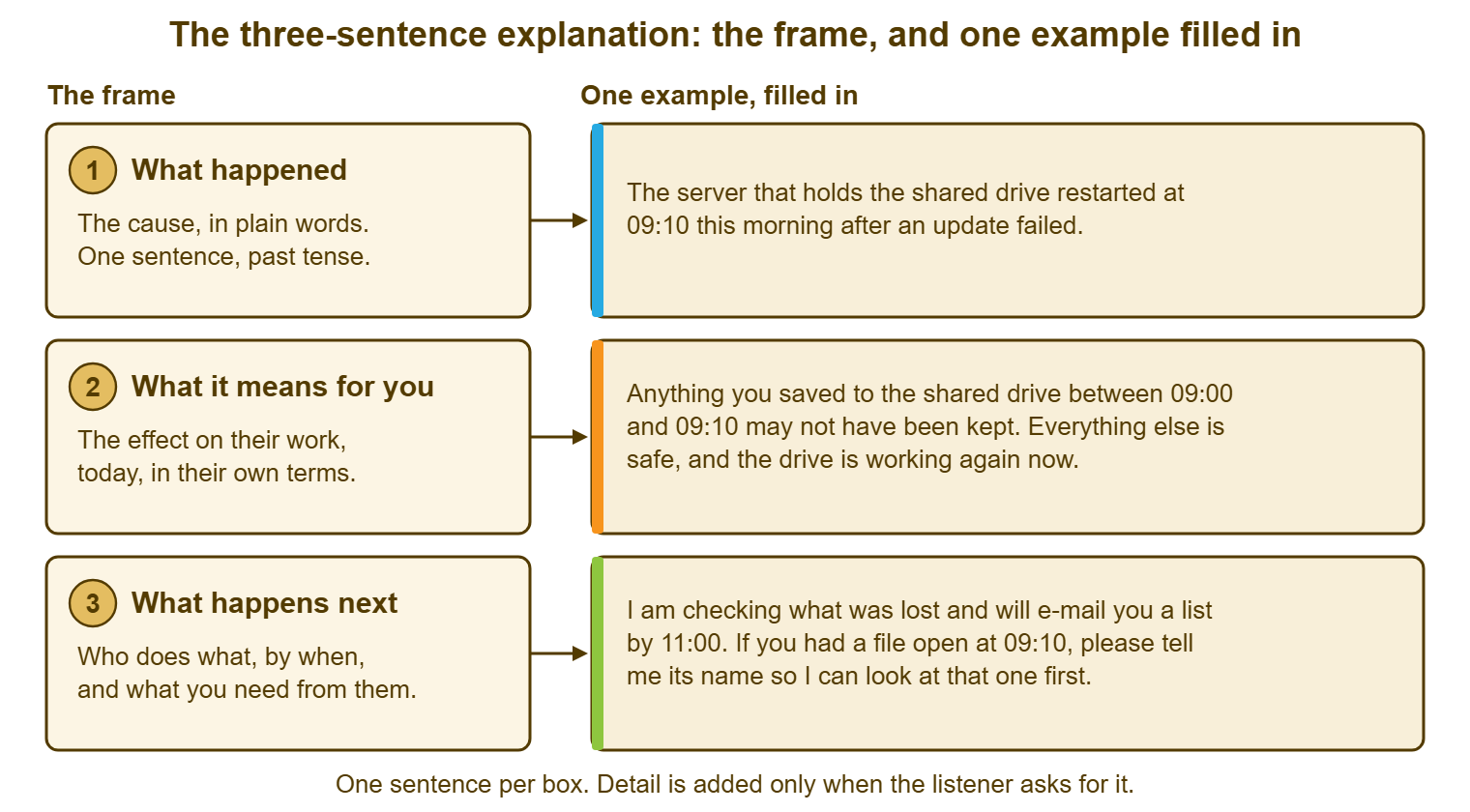
So Amara says three things. "The server that holds the shared drive restarted at ten past nine after an update failed. Anything saved to the S drive between nine and ten past may not have been kept, and everything else is safe and the drive is working now. I'm checking what was lost and I'll e-mail you a list by eleven; if anyone had a file open at ten past, tell me its name and I'll look at that one first." Noor says "Right, I'll tell the team not to re-save anything until I hear from you," and the call is over in under a minute. The timeline went into the ticket's internal note, where it will be read with interest by the person who fixes the update.
The three-sentence explanation is a frame for telling a non-technical person about a technical thing. It has one sentence on what happened, one on what it means for them, one on what happens next. It is not a style or a length limit. It is a check that the three questions every listener is actually asking have each been answered, in the order they are asked, with nothing in between. This article is part of our Explaining Technical Things to Non-Technical People series. It is the frame the rest of the series hangs on.
It covers why three sentences and why these three, and each sentence in turn, with what belongs in it and what does not. Then come six worked examples from the tickets a desk sees most, and when three sentences are not enough and the one thing to add. It ends with the frame in speech and in writing, a short war story, and the three-sentence frame itself to copy, in that order.
Why Three, and Why These Three
Every requester asking about a technical problem is asking three questions, whatever words they use. Was it something I did, and will it happen again? What does this mean for my work, right now? And what happens next, who is doing it, and by when? The three sentences answer those three questions in that order, and nothing else. An explanation that answers all three is complete for the listener, however short it is. One that answers two of them, however long, has a hole in it. The listener will fall through the hole and act on whatever they find at the bottom.
Three is the number because it is what a worried person can hold. A listener who has just lost the shared drive is not at their most retentive. A fourth sentence is where the detail starts to creep in: the service that did not restart, the update that failed, the reason it failed. All of that is true and none of it is theirs. If a fourth sentence is needed, the section later in this article on when three are not enough says what it should be. It is never the mechanism. The mechanism goes in the note.
The order is the listener's order, not the technician's. The technician wants to start with what they are going to do, because that is the part they are proud of. The listener's first worry, under almost every question, is whether they caused it, which only the cause can settle. Their second is what it means for them. Their third is what happens next. Lead with the cause, briefly, and the other two land on a listener who has stopped worrying about blame. There is one exception, and it is when the listener is in the middle of the problem right now. Then sentence two or three goes first, "stop re-saving, the drive is back". The cause follows once they have stopped. Even then, say all three. The frame is a checklist, not a script.
Sentence One: What Happened
Sentence one is the cause, in plain words, in the past tense, with a time if there is one. "The server that holds the shared drive restarted at ten past nine after an update failed." It names one cause, not the chain: the update failed and the server restarted. The service that did not come back on its own stays in the note. It names the thing in words the listener uses ("the shared drive", not "the file server"). It puts the cause on the system, not on the listener, because the listener's first question is whether it was them.
The sentence must say something. "There was an issue with the shared drive" is not sentence one; it is the absence of sentence one with a full stop after it. The listener already knows there was an issue; that is why they rang. What they do not know is what kind of issue, and whether it is the kind that comes back. "An issue" tells them nothing about either. Say what happened in the plainest true words you have. Do that even when those words are "something on our side stopped the drive at ten past nine and I do not yet know what".
If you do not know the cause, say so, with the boundary of what you do know. "The shared drive stopped responding at ten past nine; I don't yet know why, but it was not anything done at the branch." That is a complete sentence one. It answers "was it me" with a no, it gives the time, and it is honest about the gap. A guessed cause stated with confidence is worse than an honest unknown, because when the guess turns out wrong, sentences two and three are no longer trusted either.
Sentence Two: What It Means for You
Sentence two is the one most often missing, and it is the one the listener came for. It says what the event means for this listener's work, in their terms, with the edges marked. "Anything saved to the S drive between nine and ten past may not have been kept, and everything else is safe and the drive is working now." The listener appears in it by name or by their work: their files, their payslips, their appointments, their deadline. If you read your explanation and cannot find the listener in it, sentence two is not there, however many sentences you wrote. The five ways an explanation misses, all of which are ways of leaving this sentence out, are in Why Technical Explanations Fail.
Mark the edges. A listener who hears "some files may be lost" and nothing else will assume all of them are, because fear fills in the gaps. "Between nine and ten past" is an edge. "Everything else is safe" is an edge. "Your own laptop is unaffected" is an edge. The sentence should leave the listener with a bounded problem rather than an open one. Bounding it usually takes fewer words than the listener's imagination would otherwise supply. Say what is not affected as carefully as what is.
Sentence two is also where "nothing" belongs when nothing is the answer. "This does not affect anything you have saved; the drive was slow for ten minutes and is now normal" is a complete and valuable sentence two. Desks skip it because it feels like saying nothing. To the listener, "it means nothing for you" is the best news available, and it is news; they did not know it until you said it. Never leave the listener to infer that they are fine. Tell them.
Sentence Three: What Happens Next
Sentence three is the future, with a name, a time and, where there is one, a request. "I'm checking what was lost and I'll e-mail you a list by eleven; if anyone had a file open at ten past, tell me its name and I'll look at that one first." Who is doing what: I am checking. By when: eleven. What I need from you: the file name. The sentence gives the listener something to do, or tells them that there is nothing to do. Either way, it gives them a time at which they will next hear from the desk. That is the thing that stops them ringing back at ten.
The time is the hard part, and it is the part that cannot be left out. "I'll let you know" is not a time; it is a promise to make a promise later. "By eleven" is a time. If eleven comes and the list is not ready, sentence three is spoken again at eleven with a new time. The craft of choosing a time you can keep, and what to do when you cannot, is the subject of Honest ETAs. For the frame, the rule is only that there is one, and that it is a clock time or a day, not an adjective.
When the fix is already done, sentence three is still needed. It is short: what to watch for and what to do if it comes back. "It should be fine from here; if the drive disappears again, reply to this message and I'll know where to look." That sentence does two jobs. It tells the listener the desk is not simply hoping, and it keeps the route back open. Where a requester's reply reopens a resolved ticket, as it does in QuerySolv, "reply to this message" is a working instruction rather than a courtesy. In that case, the reply brings the same ticket back to the same desk with the history attached. In any tool, the point is that the listener leaves knowing the one thing they would do if sentence one happened again.
The picture below puts the frame and Amara's call side by side. The three boxes on the left are the frame, with what belongs in each. The three on the right are the sentences she said to Noor. Read it top to bottom and notice that the right-hand column contains no mechanism at all. The failed update appears only as the cause; the service that did not restart is nowhere. That is not an omission. It is the frame doing its job.
Six Worked Examples From Common Tickets
The same six tickets arrive at every desk, and the three sentences for each can be worked out once and adapted. The table below does that for a locked account, an e-mail that bounced, and a printer that is offline for a whole floor. It also covers a laptop that is slow after an update, a file that was deleted and restored, and a phishing message that a requester reported. Every cell is a complete sentence a requester could receive as it stands, with the names and times changed.
| The ticket | What happened | What it means for you | What happens next |
|---|---|---|---|
| "I'm locked out" | Your account locked itself at 08:52 after too many wrong password attempts, which usually means a phone or another device was still trying an old password. | Nothing of yours has been lost or changed; the lock is a safety catch, not a sign that anything is wrong with your account. | I have unlocked it now. Please sign in, then check your phone's mail settings for the old password; if it locks again today, reply here and I will find which device is doing it. |
| "My e-mail to the supplier bounced" | The supplier's mail server refused your message at 14:10 because their system did not recognise our new sending address. | Your message did not arrive, and no other e-mail of yours is affected; everything you have sent to anyone else today has gone normally. | I have asked their IT team to allow our address and expect an answer by tomorrow morning. Please do not resend yet; I will tell you the moment it is safe to. |
| "The printer's down for the whole floor" | The printer on the third floor lost its network connection at 10:30 when a switch in the cupboard was restarted. | Anything you sent to print since 10:30 is waiting and has not been lost; it will print on its own when the printer is back. | I am on my way up to reconnect it and expect it to be printing by 11:00. If you need something before then, the second-floor printer is working and you can choose it from the print menu. |
| "My laptop's been slow since the update" | Last night's update is still finishing its work in the background, which is using most of the laptop's attention for the first hour or so after it starts. | Your files and programs are fine; the laptop will feel slow until that background work finishes, and then it will be back to normal. | Leave it on and plugged in through lunch and it should be normal by this afternoon. If it is still slow at 15:00, reply here and I will come and look at it. |
| "I deleted a folder by mistake" | The folder was deleted at 11:40 and, because it was on the shared drive, a copy of it was made in last night's backup. | Everything in the folder as it was at midnight last night can be brought back; anything you added or changed between midnight and 11:40 will need redoing. | I am restoring it now and it will be back in its original place within the hour. I will reply here when it is, so you can check it before you redo anything. |
| "Is this e-mail real?" | The message you sent us is a forgery that was designed to look like it came from the finance team, asking you to enter your password on a fake page. | Because you did not click the link, nothing has happened to your account and nothing needs changing; you did exactly the right thing by asking. | I have blocked the sender and removed the same message from four other mailboxes. If you did click it, or are not sure, tell me now and I will reset your password as a precaution. |
Read down the second column and notice how often sentence two says, in effect, "nothing of yours is lost". That is not softening. In each case it is true and it is the fact the requester most wanted. In each case a technician in a hurry would have left it to be inferred. Read down the third column and notice that every sentence has a time or a condition in it. Notice that four of the six ask the requester to do one small thing. The frame does not make the desk passive. It makes it specific.
Notice also what is absent. No row mentions a lockout threshold, a sender policy record, a switch model, a background indexing process, a retention window or a mail filter rule. Each of those is real and each is in the internal note on the corresponding ticket. The table is the requester's side of six tickets, and the requester's side is three sentences long. The note on the other side can be as long as the next technician needs. How to write it is in Resolution Notes Worth Reading Later.
When Three Sentences Are Not Enough
Sometimes three sentences are not enough, and the rule for what to add is that you add one thing, and it is never the mechanism. The first case is the repeat. The problem has happened before, the listener knows it, and sentence one on its own will be heard as "here we go again". Add a fourth sentence that says what is different this time: "This is the third time since spring, and I am changing how updates are applied to that server so it does not restart on its own again." That sentence belongs to the listener because it answers "will it keep happening", which is the question under the repeat.
The second case is the action list. If the listener must do more than one thing, three sentences cannot carry it. Squeezing four steps into sentence three produces a sentence nobody can follow. Say the three sentences, and then switch to numbered steps: "To get back in: 1. Restart the laptop. 2. Sign in with your usual password. 3. When your phone asks for a password, type the new one." The steps are not a fourth sentence. They are a different kind of thing, after the explanation, and the listener reads them differently.
The third case is the group. When the explanation goes to a floor, a department or the whole organisation, add a sentence saying who is affected. Every reader will otherwise ask "does this mean me?". "This affects everyone who uses the shared drive at branch 7; other branches are not affected." The group version of the frame, with its channels and its timing, is the first notice of an outage. It has its own article in The First Notice. The three sentences are still its spine.
The fourth case is management, and there the thing to add is the decision being asked for, or the statement that none is. "No decision is needed from you; I am telling you so that you have it if the branch manager asks" is a complete fourth sentence for a manager. So is "I need you to approve a restart at six tonight, which will take the drive away for ten minutes". The one-page version for a manager who has to decide something is in Explaining Technical Things to Management. What never gets added, in any of the four cases, is the chain of causes. The listener who wants the chain will ask, and then it is a conversation, not an explanation.
Remember: what happened, what it means for you, what happens next, in that order, one sentence each. If more is needed, add one thing the listener needs, never the mechanism. The mechanism goes in the internal note.
The Frame in Speech and in Writing
In speech, say the three sentences and then stop. The stop is part of the technique. Technicians fill silence with detail. The silence after sentence three is exactly where the listener decides whether they have understood or need to ask something. If they need to ask, they will do so if given two seconds. Noor used her two seconds to say what she would do next, which told Amara that the explanation had landed. Had she said "so... is my stuff gone?", that would have told Amara that sentence two had not. In that case, Amara could have said it again differently. Both outcomes are better than the one where Amara is still talking.
In writing, the three sentences are one short paragraph, and the subject line is sentence two compressed. "S drive: files saved 09:00 to 09:10 may need re-saving, everything else fine" is a subject line a branch supervisor can act on from the preview pane without opening the message. Below the paragraph come the numbered steps, if any, and below those, nothing. A written explanation that runs to a second paragraph has almost always wandered into the mechanism. The second paragraph is where the reader stops reading. Treat the end of the third sentence as the end of the message. Put the full account where it belongs, on the ticket, for the desk.
The frame travels well into templates, and that is where most desks get the most from it. A template built on the three sentences, with blanks for the time and the thing and the next step, produces a usable reply in thirty seconds. It never forgets sentence two. A template built on "we are aware of an issue and are working to resolve it" produces a sentence that could be sent about anything, and often is. (It has been sent about everything, by everyone, and nobody has ever felt better for receiving it.) Build the template on the frame, and the frame does the thinking on the day you have no time to.
A Short War Story: The Scanners at Bellweather Logistics
Bellweather Logistics ran a warehouse where the handheld scanners started restarting themselves every few minutes one Thursday morning. Kwame, the dispatch supervisor, e-mailed the desk at 07:40 asking what was going on. Ines, the technician, knew exactly what was going on and wrote it all down. She wrote four paragraphs on the overnight firmware update, the wireless controller, and the roaming threshold the update had changed. Those paragraphs also covered the setting she was going to alter once the supplier confirmed it was safe. Kwame read it on his phone in the yard and found nothing in it that told him what to do. He concluded that the scanners could not be trusted, and switched the morning shift to paper pick lists. The warehouse had not used those in three years. Fourteen staff spent six hours re-keying four hundred and twelve picks into the system that afternoon. Two outbound lorries left late. The scanners had in fact been working normally again since 08:05, when Ines changed the setting. Her e-mail had contained a thorough sentence one and no sentence two or three at all. So Kwame had supplied his own: it means the scanners are unreliable, and what happens next is that I stop using them. The lesson Bellweather wrote on the desk's wall was that a listener who is not told what it means for them and what to do next will decide both. They will decide them at 07:45 in a yard.
The Three-Sentence Frame
The frame below is the template for this article. It is the three sentences as prompts, with the questions to answer before writing each and a short check at the bottom. Keep it beside the screen until the three questions are automatic, and use it as the skeleton of every status template the desk owns. The prompts are written to be filled in as they stand, for speech or for a reply.
THE THREE-SENTENCE EXPLANATION — FILL IN, THEN STOP
Ticket: ________   Listener: ______________   Spoken [ ]  Written [ ]

1. WHAT HAPPENED (the cause, plain words, past tense, one cause)
   The thing, in their words: _______________________________________
   What it did, and when: ___________________________________________
   Was it anything they did?  [ ] no, say so   [ ] partly, say how kindly
   If the cause is unknown: "stopped at ____; I don't yet know why;
   it was not anything done at ____."
   Sentence 1: ______________________________________________________

2. WHAT IT MEANS FOR YOU (the effect on their work, with edges)
   What of theirs is affected: ______________________________________
   From when to when: _______________________________________________
   What is NOT affected (say it): ___________________________________
   Sentence 2: ______________________________________________________

3. WHAT HAPPENS NEXT (who, what, by when, what is needed from them)
   Who is doing what: _______________________________________________
   By when (a clock time or a day): _________________________________
   What I need from them, if anything: ______________________________
   What to do if it comes back: _____________________________________
   Sentence 3: ______________________________________________________

ADD ONE THING ONLY IF NEEDED (never the mechanism)
   [ ] It has happened before: what is different this time
   [ ] More than one step: numbered steps AFTER the three sentences
   [ ] A group: who is and is not affected
   [ ] A manager: the decision needed, or "no decision needed"

CHECK
   [ ] The listener appears in sentence 2
   [ ] Sentence 3 has a time
   [ ] No technical term the listener will not meet again
   [ ] The mechanism is in the internal note, not here
   [ ] Written: the subject line is sentence 2, compressed
Amara filled this in, in her head, in the fifteen seconds between opening her mouth and speaking. That is how long it takes once the three questions are familiar. The first few times it takes a minute with the sheet in front of you. The minute is worth it, because the alternative is Kwame's morning. The list of lost files went to Noor at 10:52; there were three, all re-saved by lunch. The update that failed went into a change record, and the service that did not restart went into the note. Nobody at branch 7 ever heard about either, which is exactly as much as they needed to.
Frequently Asked Questions
Does each part really have to be exactly one sentence?
What if I do not know what happened yet?
Should sentence two go first when the user is in a hurry?
Isn't three sentences too little for a serious outage?
Can the three sentences be a template?
Where does the technical detail go if not in the reply?
From the QuerySolv team: we build self-hosted help desk software for Windows. QuerySolv runs as one Windows service on your own network. It takes requests by web form, e-mail, live chat, social messages and REST API. It is licensed once per installation rather than per agent per month. The free trial runs the full product for 30 days.