
Running the Ticket Hall of Fame Without a Villain
Monday, 08:55, at Bellweather Logistics. The first huddle of the month is standing around a cork board beside the kettle. Omar is pinning a card under the heading "Longest diagnosis". The card says ticket 2890, "the Tuesday scanner", and underneath, in one line, "Lesson: ask what changed, including the loading-bay door." Chloe started on the desk last Wednesday and has no idea what the Tuesday scanner is. Omar tells her, in forty seconds. A pallet scanner dropped off the network every Tuesday afternoon. Three weeks of log-reading led to a discovery. Tuesday was when the loading-bay door was propped open for the recycling collection and the scanner's cradle sat in direct sun. The desk laughs, mostly at the three weeks. Chloe will remember the scanner for the rest of her career, and she has been on the desk for three working days.
A ticket hall of fame is a board, on a wall or on a page, where the desk records the tickets worth remembering. It uses a small set of categories that reward the lesson rather than the volume. Anyone can nominate a ticket during the month. The tickets are chosen in ten minutes at the first huddle of the next one. It is the war story given a frame and a ritual, so that the stories accumulate instead of evaporating. This article is part of our Helpdesk War Stories & the Ticket Hall of Fame series. Every story in it is fictional, as the series says.
It covers what the board is for, then the five categories and why there is no sixth. Next comes the nomination, which is a card with a lesson on it. Then come the monthly pick, the blameless rule, and why the board is never a leaderboard. It covers inducting the new starter by stories, then the board itself, whether cork, wall or page. It follows with keeping it alive after the first enthusiasm, a short war story, and the hall-of-fame nomination card to copy.
What the Board Is For
The board does three jobs at once, and it does them for the price of a cork board and ten minutes a month. It is the desk's memory in a form that can be seen from the door. It holds the twelve or twenty tickets that taught the desk the most, each with its lesson on the card. It is a training tool, because a new starter can be walked along it in half an hour and come away with the desk's whole folk history. And it is a culture statement, because what a desk chooses to celebrate is the clearest signal it sends about what it values. A board that celebrates the longest diagnosis and the user who helped most says something no poster could.
What the board is not is a performance tool. This has to be decided on the first day. The slide from one to the other is gentle and nobody notices until it has happened. A card that says "fastest fix: ticket 3104, the plug, cheapest check first" celebrates a lesson. A card that says "most tickets closed this month: Omar, 212" celebrates a number. The moment a number appears on a board, people start working for the number. The hall of fame holds stories. The dashboard holds numbers, and dashboards that motivate instead of surveil explains why even those are handled with care.
The previous articles in this series set the rules for the stories themselves. The stories are fictional in this library and blameless on every desk. The requester is never the butt, and the lesson is in one sentence. The board inherits all of them. It adds a frame, five categories and a monthly rhythm, and that is all it adds. A desk that already tells its stories at the huddle will find the board is mostly a matter of writing them down.
The Five Categories
Five categories are enough, and each one exists because it rewards something the desk wants more of. Fastest fix rewards the cheap check and the phone call that saved a van. Longest diagnosis rewards persistence and the written note, because a three-week diagnosis with notes is a runbook and one without is a legend. Most mysterious rewards curiosity and the question nobody thought to ask. The user who helped most rewards the honest report and the pattern a requester spotted first. It is the category that does most for the desk's reputation outside the desk. The desk's own mistake rewards honesty, and it is the one that makes the other four safe.
| Category | What qualifies | What it teaches the desk | What it must never become |
|---|---|---|---|
| Fastest fix | A ticket closed by the cheapest check, the right question, or the phone call that saved a visit | Cheapest check first; ask what changed | A count of quick closes |
| Longest diagnosis | A ticket that took days or weeks to understand, with notes good enough that the next one takes an hour | Persistence; the working note; the runbook written at the end | A prize for slowness |
| Most mysterious | A ticket whose cause nobody would have guessed, found by a question nobody had asked | Curiosity; who else uses the desk; what else is nearby | A joke about the requester |
| The user who helped most | A requester who reported quickly and honestly, logged a pattern, or asked the question that solved it | Users notice things; the desk should ask and say thank you | A card without the requester's consent |
| The desk's own mistake | A ticket the desk got wrong, told by the desk, with the cost and the change it made | This desk tells the truth about itself | A card that names a technician who did not agree |
There is no sixth category, and the two that get proposed most often are the ones to refuse. "Most tickets closed" is a count, and counts belong on the dashboard where they can be read with the care they need. "Funniest" has no lesson in it, and a category without a lesson drifts, within a quarter, towards laughing at people. If the desk wants a sixth, the safe one is "best written note", which rewards the habit every other category depends on. The desk that proposes "biggest disaster" should be gently reminded what the fifth category is for.
The Nomination
Anyone on the desk can nominate any ticket at any time during the month, and the nomination is a card, not a conversation. The card carries the ticket number, the category, the five parts of the story in a line each, the lesson in one sentence, and the nominator's name. The ticket number is not optional, because the card is a pointer and the ticket is the record. A card for a story whose ticket cannot be found is a card for a legend. The lesson is not optional either, because a card with no lesson is a nomination for the "funniest" category that the desk declined to have.
Technicians nominate their own tickets, and should be encouraged to, especially for the fifth category. A technician who nominates their own forty-minute drive under "the desk's own mistake" has done something braver and more useful than any manager could do for them. The lead's job is to make sure that card goes up with the same ceremony as the fastest fix. Requesters can nominate too, if the desk tells them the board exists. Some of the best cards for "the user who helped most" arrive from the department that was helped.
The card for "the user who helped most" has an extra line: the requester's consent to be named. It is the only line on the board that can delay a card. Ask them, show them the card, and tick the box only when they have said yes. Most say yes immediately and several ask for a photograph of the board. The ones who say no are named by role, "the warehouse supervisor". The card goes up anyway, because the lesson does not depend on the name.
The Monthly Pick
The pick happens at the first huddle of the month and takes ten minutes, which is a third of the huddle and about right. The lead reads out each nomination card, and the nominator tells the story in forty seconds. The desk chooses one card per category by a show of hands or by the lead's decision, whichever the desk prefers. What matters is that it is quick and that nobody argues about it. The chosen cards go on the board. The others go in a folder for next month if they are still worth it. The huddle moves on to the ticket of the week. The mechanics of the huddle itself are in the weekly huddle; the hall of fame simply borrows its first ten minutes once a month.
Some months have no nominations in a category, and that is fine. Leave the slot empty with a dashed outline and the words "next month's winner", which is both honest and a small nudge. Some months have five nominations for fastest fix and none for the desk's own mistake. That is a sign to be read rather than ignored. A desk that cannot find one mistake a month to tell a story about is a desk that is not looking. The lead can fix that by nominating one of their own.
Keep the pick light. The hall of fame is the most enjoyable ten minutes in the desk's month. The moment it acquires a scoring rubric or a nomination deadline enforced to the minute, it stops being that. One card per category, chosen quickly, told well, pinned up. The ceremony is in the telling, not the choosing.
The Blameless Rule
No card on the board makes anyone the villain, and the rule applies to requesters, technicians, other departments and vendors alike. A card that says "finance didn't check the plug" comes down. A card that says "we sent a van before anyone checked the plug" goes up. The two cards describe the same ticket. The rule is enforced at nomination. The nominator reads their card and asks whether the person in it could stand beside the board and nod along. It is enforced again at the pick, by the lead, who has the last word and uses it.
The fifth category is the proof that the rule is real. A desk that only ever tells stories in which someone else was wrong has a blameless rule on paper. A desk whose board carries a card every month about something the desk itself got wrong has a blameless culture. That card includes the cost and the change. The difference is visible to any new starter from the door. The same mechanism makes security without blame work. People report what they did when they have seen that reporting is rewarded and ridicule is not. The board is where the desk shows which of those it does.
The rule has one more edge, which is that the board is not a place to settle scores with vendors or other teams. "The vendor took three weeks to answer" is a fact that belongs in the ticket and the monthly report. On the board it becomes a grievance with a pin in it, and grievances teach nothing except who the desk resents. Tell the story about what the desk did while it waited.
Remember: the board holds stories, never counts. Every card names a ticket and a lesson. No card has a villain. A requester is named only with their consent. The desk's own mistakes go up with the same ceremony as its best fixes.
Never a Leaderboard
A leaderboard is a ranked list of people by a number. The hall of fame must never become one. The moment it does it stops teaching lessons and starts teaching the number. The slide is always well-intentioned. A manager sees the board, likes it, and suggests a card for "most tickets closed", or "best satisfaction score", or "fewest reopens". Each suggestion sounds like recognition. Within two months the technicians have noticed which tickets are quick. The reopen rate has crept up, and the longest-open ticket is older than anyone wants to say aloud. The board did not do that. The number did, and the board gave it a frame.
Numbers about people are read with care, in private, with a minimum sample and for coaching. The rules for that are in metric gaming and its cures and in the dashboards article above. The hall of fame is the opposite kind of object: public, celebratory, and about tickets rather than people. Keep the two apart physically as well as in principle. If the board and the wall screen share a wall, someone will eventually suggest combining them, and the right answer is a polite no with this paragraph attached.
The test for any proposed card is whether it names a ticket and a lesson. "Fastest fix: ticket 3104, the plug, cheapest check first" does. "Fastest average resolution: Omar" does not, and no amount of goodwill behind it changes what it will do to the queue. A board can celebrate a person for a story they told, a question they asked, or a mistake they owned. It cannot celebrate a person for a number without turning every other person on the desk into a runner-up.
Inducting the New Starter by Stories
A new starter's first walk along the board is the best half hour of their induction. It should happen in the first week, with someone who was there for the stories. Each card gets its forty-second telling, in the order the cards hang. The new starter hears the desk's whole folk history: the plug, the Tuesday scanner, the haunted keyboard, the honest coffee report. They also hear about the silent close that cost a department's trust. They come away knowing the three lessons behind the classics and the desk's standard for a note. They know that this desk tells stories about its own mistakes, which is the thing most likely to make them stay. The structured version of the first weeks is in the new technician's first thirty days; the board is where the structure gets its stories.
Then give the new starter a job on the board, which is to nominate something in their second month. It can be any category, and it is usually fastest fix, because the new technician's first plug story arrives on schedule. Telling it at the huddle, in front of the desk, with the ticket number and the lesson, is the moment the new starter stops being new. Chloe nominated her first card in week six, for a label printer whose wall socket had been switched off by a new chiller. The desk laughed in the right place, which was at the van she had not, in the end, booked.
The Board Itself: Cork, Wall or Page
The physical board beats the page for a desk that sits together. It can be seen from the door and walked along with a new starter. Pinning a card is a small ceremony that clicking is not. A cork board, five printed headings, index cards and a box of pins is the whole kit. Put it where the desk gathers, which is usually near the kettle, and where visitors to the desk pass it. The "user who helped most" cards are read by more requesters than any newsletter.
The page is the board's memory and its remote half. Every card that goes up is also written on a page the desk keeps with its runbooks. The page holds the full five-part story, the ticket number and the lesson linked to the runbook or article that owns it. When a card comes down after its year the page is where it goes. If you run QuerySolv, the page can be a knowledge base article visible to agents only, sitting beside the runbooks. Each entry points at a ticket whose complete event history holds the facts the story summarises. In any tool, the pair is the same: a board for the ceremony, a page for the record, and a ticket number joining each card to the truth.
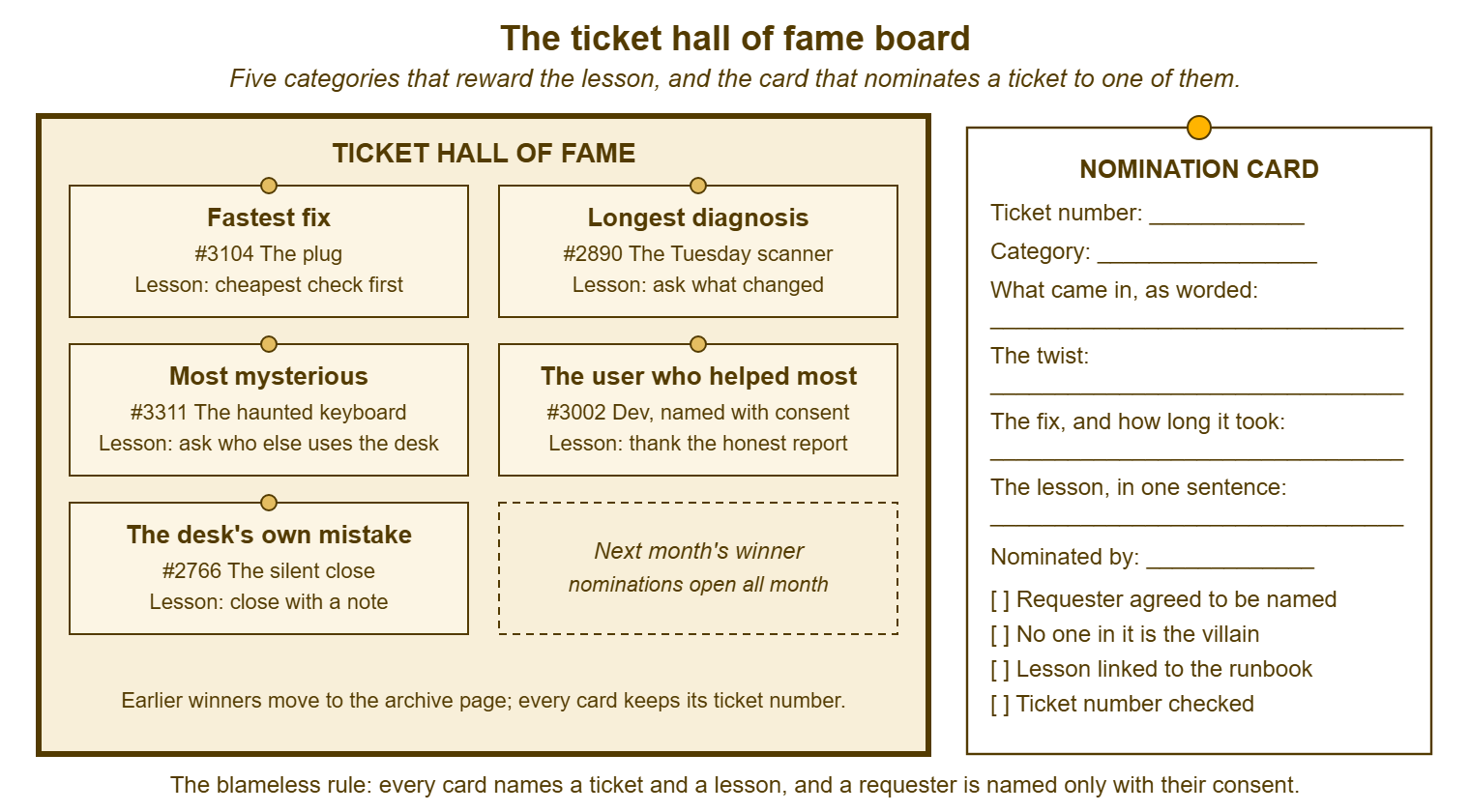
The picture below shows the board as Bellweather's desk keeps it. Five category cards have a ticket number, a short title and a one-line lesson on each. There is a dashed slot for next month. The nomination card is pinned beside it with its blanks and its three checks. The nomination card is deliberately small. If it took longer than five minutes to fill in, nobody would.
A desk split across two sites or working partly from home runs the page as the board and holds the pick on the call. The cards are read aloud exactly as they would be in the room. It loses the pin and keeps everything else. One desk I knew photographed its cork board every month and pasted the photograph at the top of the page. That is not a method so much as an affection. It worked.
Keeping It Alive
Boards die of neglect in the second quarter, when the first enthusiasm has passed and nobody has been named its owner. Name an owner. The owner's job is small: remind the desk in the last week of the month that nominations are open. Bring the cards to the first huddle, pin the winners, and write them on the page. Once a year take down the cards older than twelve months. Move them to the archive section of the page with a short retelling at the huddle. Twenty minutes a month and an hour a year, and the board outlives the owner's time on the desk if the role is handed on.
Thin months are normal and are not a failure. A desk of three in a quiet month may have one nomination. One card pinned with its story told is a month the board did its job. The signal to watch is not the count but the fifth category. If three months pass without a desk's-own-mistake card, the owner nominates one. The blameless rule is only as real as the last time it was demonstrated. The lead's own mistakes make the best cards, for reasons that need no explaining.
Retire cards with a story, not a bin. In the annual retelling, the year's cards come down one at a time and each gets its forty seconds one last time. It is the best huddle of the year and the one most likely to be mentioned by someone leaving. The cards go to the page, the page keeps the ticket numbers, and the board starts the year with empty slots and dashed outlines. Boards, unlike queues, are allowed to be empty on purpose.
A Short War Story: The Count That Crept Onto the Board at Westfold Timber
Westfold Timber's desk ran a good hall of fame for a year, five categories and a cork board by the kettle. Then a new operations manager, who liked it, suggested a sixth card for "most tickets closed this month". The lead, not wanting to seem ungrateful, pinned a heading for it. Within six weeks the two technicians who sat nearest the queue had learned which ticket types closed in under five minutes. They were claiming those first. A third technician who did the long diagnoses had stopped nominating anything. The reopen count for the quarter was the highest the desk had recorded, because quick closes with thin notes came back. The longest-open ticket was a warehouse scanner fault that nobody wanted because it would take days. It reached forty-one days before the operations manager, who had suggested the card, asked why the scanner was still broken. The lead took the sixth heading down that afternoon and apologised to the desk for having put it up. The lead nominated the whole episode under "the desk's own mistake", with the forty-one days as the cost. The card stayed up for a year. A board that counts anything becomes a leaderboard, and a leaderboard teaches the number instead of the lesson. The reasons are in dashboards that motivate instead of surveil.
The Hall-of-Fame Nomination Card
The card below is the one pinned beside the board. It is meant to be filled in standing up in under five minutes from the ticket, not from memory. The five story lines are one line each; the full written story goes on the page after the pick, not on the card. The four checks at the bottom are the blameless rule in copyable form. A card with an unticked box is held, not refused, until the box can be ticked.
HALL-OF-FAME NOMINATION CARD — ONE TICKET, ONE LESSON
Ticket number: ________    Nominated by: ______________    Month: ________

Category (tick one):
  [ ] Fastest fix          [ ] Longest diagnosis     [ ] Most mysterious
  [ ] The user who helped most                        [ ] The desk's own mistake

What came in (as the requester worded it):
  "________________________________________________________________"

The twist (what was really going on, and who noticed):
  __________________________________________________________________

The fix, and how long it took / what it cost before then:
  __________________________________________________________________

The lesson, in one sentence:
  __________________________________________________________________
  Where the rule lives (runbook / article / standard): ______________

CHECKS
  [ ] Nobody in this story is the villain; the person who asked could nod along
  [ ] If a requester is named, they have seen this card and agreed
  [ ] The ticket number has been checked against the ticket
  [ ] The lesson is one sentence and points somewhere
Chloe's card for the label printer went up in her sixth week. Under it, in Omar's handwriting, someone had added "see also: the Tuesday scanner". That is the kind of thing that happens to a board that is working. The desk had twenty-three cards on the page by the end of the year, and a dashed slot waiting under every heading. A new starter was due in the spring and would be walked along it by Chloe. The board had cost a cork board and a box of pins. The stories had cost nothing at all, because the desk had already paid for them.
Frequently Asked Questions
Our desk is three people. Is a hall of fame overkill?
Can we add a category for most tickets closed, just as recognition?
What if nobody nominates anything for a month?
Should requesters be able to see the board?
How do we run it with a remote or split desk?
Who owns the board, and how much time does it take?
From the QuerySolv team: we build self-hosted help desk software for Windows. QuerySolv runs as one Windows service on your own network. It takes requests by web form, e-mail, live chat, social messages and REST API. It is licensed once per installation rather than per agent per month. The free trial runs the full product for 30 days.