
Peripheral Stock Management for a Small Desk
Friday, 15:50, at Tollgate Foods. Marta runs the desk of two at a food distributor. A new starter arrives on Monday, and she has just opened the stock cupboard to build the kit. It holds eleven mice, which is more mice than the company has desks without one. It holds no headsets at all, which is a problem, because the starter is in customer orders and will be on the phone from nine. It holds one dock, with a connector bent at an angle that suggests a story. It also holds a cardboard box with "CABLES (MISC)" written on it in three different hands. The order she placed last month, after the previous starter, was for mice. Nobody wrote down why.
Stock is the set of peripherals the desk holds on a shelf, ready to issue. It makes a request a walk rather than a wait. Stock management is the small discipline that keeps the shelf honest. It uses three numbers per item, a count once a month, and a line on a sheet every time something leaves. It also uses an honest word for what vanished. It is not inventory in the warehouse sense and it needs no system to run. This article is part of our Peripherals & Equipment Requests series. The request that the shelf exists to fulfil is in The Equipment Request Workflow From Form to Fulfilment. And this article is about the shelf.
It covers why a small desk needs stock at all. Next come the cupboard, then minimum, reorder point and maximum in plain words, with a worked example, and the shelf drawn as a picture. The reorder rule, the monthly count, loan against issue, and the honest shrinkage line follow. Then come the spreadsheet that is enough, a short war story, and the stock sheet to copy, in that order.
Why a Small Desk Needs Stock at All
The alternative to stock is ordering each item when it is asked for. The cost of that is measured in the requester's hours, not the desk's. A headset ordered on Monday arrives the following week. The person who needed it spends five working days on a handset with a crick in their neck, or does not take calls. Or they borrow a colleague's, which means two people are now short. A dock ordered when the old one dies leaves someone working from a laptop screen for a week. Multiply by the twenty or thirty requests a month that a desk of two sees. Ordering-on-demand is a standing tax of a week per request. It is paid by people who are not on the desk and do not know they are paying it.
Stock turns the week into a walk. The item is on the shelf. The technician collects it, and the person has it within the hour. And the only cost is that the item sat on the shelf for a few weeks before it was needed. For a mouse that cost is nothing worth counting. For a monitor it is shelf space and some money tied up, which is why the quantities are small and written down. A small desk does not need a stockroom. It needs a cupboard with a door, a sheet, and three numbers it believes.
There is a second reason, and it is the one that moves budget holders: stock is what lets the desk keep promises. "Standard items by the end of the next working day" is a promise a desk can make only if the items are in the building. Without stock, every turnaround figure in the workflow has a supplier's delivery time inside it, and the desk is promising on someone else's behalf. The starter kit is the sharpest case: a desk that has the kit on the shelf can build it the afternoon the request arrives. And a desk that does not is explaining on Monday morning why the new person has a laptop and no way to plug it in. The article on getting the onboarding request before the start date says what to do when the request arrives two days out. The honest answer is "spares", and spares are stock with a different name.
The Cupboard: A Place With a Door
The cupboard is a physical thing, and its physical properties matter more than any spreadsheet. It has a door that locks, because an open shelf of mice is a shelf that empties on its own. It has one shelf, or one labelled section of a shelf, per standard item. The item's name and its three numbers are on a card at the front. A technician in a hurry can then see at a glance whether there are enough. It has two bins that are not stock. One is labelled "returned, to test", for items that came back from a user and have not yet been checked. One is labelled "retire", for items that failed and are waiting to be disposed of. Neither bin is counted as stock. A returned dock is not a spare until someone has plugged it in and watched it work.
The key, or the code, is held by everyone on the desk and nobody else. Marta's predecessor had the only key and took it on leave twice. Both times the desk issued things from a drawer in the office instead. That is how the drawer became a second cupboard with no sheet. One cupboard, every technician can open it, and nothing is issued from anywhere else. A manager who wants to "just grab a mouse for the team" is shown the form, kindly. The mouse arrives within the hour from the proper place. The cupboard is the only shop, and the shop has a till.
Two more things live in the cupboard and nowhere else. The known-good spares are used for diagnosis and never issued, labelled as such. The fourth article in this series describes them. The pre-built starter kits are boxed and labelled by role. They are counted as stock in their own row rather than as their parts. A kit on the shelf is one unit of "kit, office role", and the mice inside it are not also on the mouse row. Counting them twice is how a cupboard with eleven mice turns out to have five.
Minimum, Reorder Point and Maximum in Plain Words
Each item on the shelf has three numbers, and the three numbers are the whole of stock management. The minimum is the count the shelf must never fall below. It is the buffer that covers a bad week, a batch of three starters at once, or a dock that dies on a Friday. The reorder point is the count at which the order is placed. It is set so that the delivery arrives before the shelf reaches the minimum. It is the minimum plus however many units will be issued while the order is in transit. The maximum is the count at which ordering stops. It exists because shelf space and money are finite and a cupboard with forty mice in it is a cupboard that has stopped thinking. Minimum protects the user. Reorder point protects the minimum. Maximum protects the budget.
Setting them takes two facts per item, which the desk already has. How many are issued in a typical month? The ticket history gives that. How long does the supplier take to deliver? The last three orders give that. The arithmetic is plain. The reorder point is the minimum plus the issue rate multiplied by the lead time, with both in the same units. That means a month's issues times a lead time in months. The maximum is the reorder point plus one normal order's worth, so that each order brings the shelf back to the top. The minimum itself is a judgement about how bad a bad week gets. For most peripherals a bad week is two or three units beyond normal, which is where the number comes from.
Tollgate's headsets, worked through, look like this. The tickets show about four headsets issued a month: starters, failures, the occasional second one for a hot desk. The supplier delivers in about two weeks, which is half a month, so about two will be issued while an order is on its way. Marta set the minimum at four, a bad week being a batch of starters. The reorder point is four plus two, so six. An order brings six at a time, so the maximum is twelve. The sheet says: headsets, minimum 4, reorder at 6, maximum 12. On the day she counted, there were nine on the shelf, above the reorder point, no action. The figures are Tollgate's, for a desk of two supporting about a hundred and twenty people. And they are an example rather than a standard; yours come from your own tickets and your own supplier, and they will be different.
Mice at the same desk run faster: about six a month, because they are the thing that breaks, walks, and gets borrowed. The minimum is five, reorder at eight, maximum sixteen. On count day there were seven, which is below the reorder point and means an order goes in that afternoon. Docks run slow, about two a month, with a minimum of two, reorder at three and maximum six. On count day there was one, the bent one, which is below the minimum. That means an order today and a phone call to the supplier asking for the fastest delivery they offer. Three items, three numbers each, three different actions on the same afternoon, none of them a judgement call. That is what the numbers are for: so that Friday afternoon does not need anyone's judgement.
The Shelf, Drawn
The picture below draws Tollgate's shelf on count day, one bar per item. The number on hand is filled in amber against a scale from zero to twenty. Three lines are drawn across each bar: red for the minimum, orange for the reorder point, green for the maximum. Reading it is a matter of seeing where the fill ends relative to the lines. Headsets, keyboards and monitors end past the orange line and need nothing. Mice and laptop chargers end at or short of the orange line and need an order placed. Docks end short of the red line, which means the shelf has already failed its own rule and the order is urgent. A technician who has never seen the sheet can read the picture, which is the test of whether the numbers are any good.
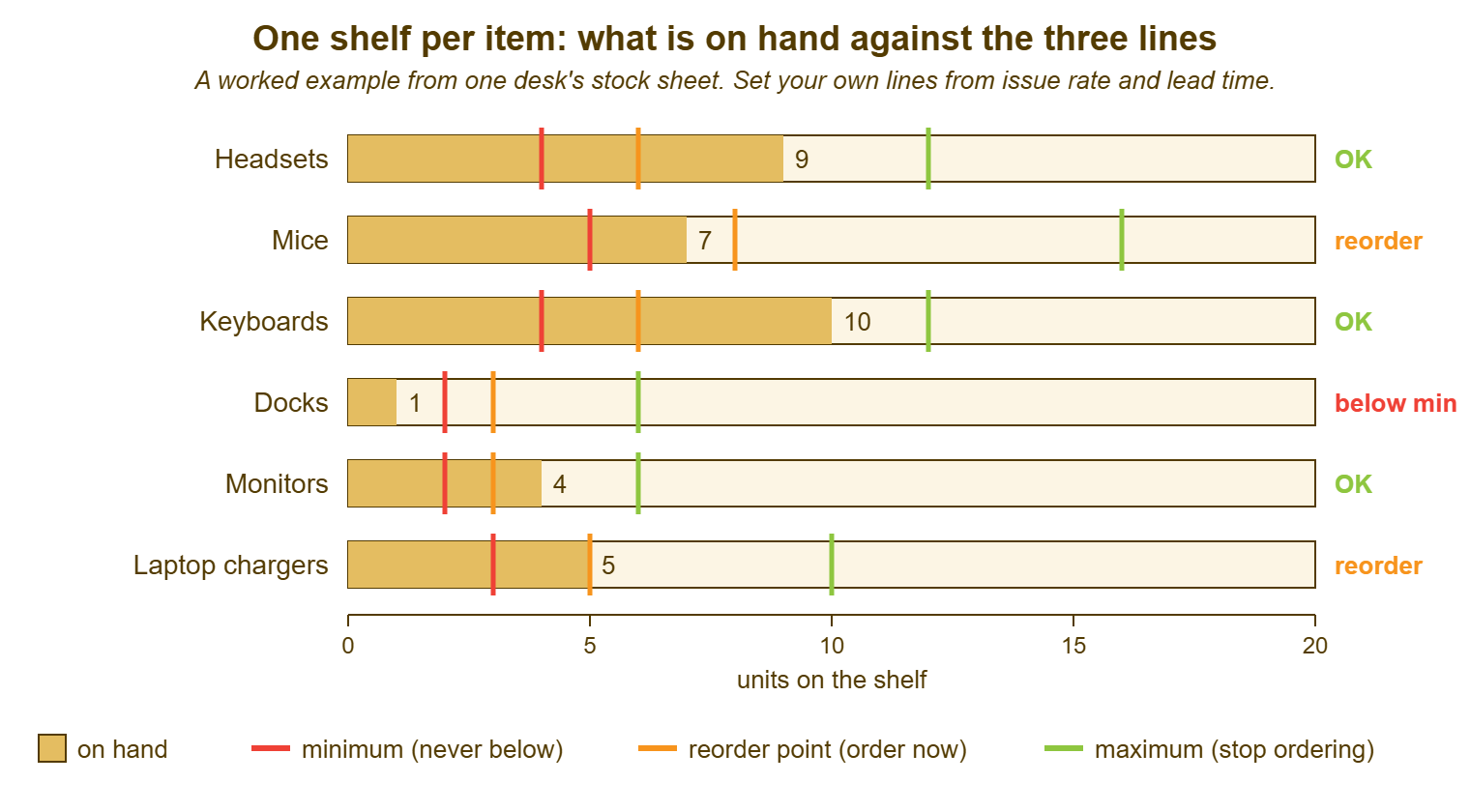
The picture also shows why the maximum matters. Mice have a maximum of sixteen because they go quickly and an order of eight is sensible. Docks have a maximum of six because they are bulky, slower to issue, and six on a shelf is a quarter's worth. The lines are not in the same place for every item, and they should not be. An item's three numbers are a description of how that item behaves on that desk. And a desk that gives every item the same numbers has written a rule rather than looked at a shelf.
The Reorder Rule
The reorder rule is that the order is placed the day the count crosses the reorder point. It does not wait until the end of the month, until someone remembers, or until the shelf is empty. The crossing happens at the moment of an issue, since an issue is the only thing that lowers the count. So the technician writing the issue line on the sheet is the person who notices, and the sheet should make noticing easy. A column that turns the row a colour when the count is at or below the reorder point is enough. The order is a ticket of its own, raised by the technician. It gives the item, the quantity that brings the shelf to maximum, the supplier reference when it exists, and the promised date. It sits in a waiting-on-vendor state until the parcel arrives.
Batching is the honest exception. A desk of two does not want to raise four purchase orders in a week, and finance does not want to receive them. So the rule can say that any item at or below its reorder point goes on the next order. And the next order goes out on a fixed day each week. The reorder points then need to allow for the wait until order day. That means setting them a little higher: a week's issues more, on a weekly order cycle. What the rule must not say is "order at the end of the month". An item that crosses its reorder point on the second of the month will be at zero by the twentieth. The minimum will have protected nobody.
Requests that are waiting on the order should be linked to it. That way, the parcel's arrival tells the desk who gets what without a search. If you run QuerySolv, the order ticket is linked to each request waiting on it. The technician who opens the box then opens one ticket and finds the list of people to walk to, in the order they asked. Most tools can link tickets in some fashion. Where yours cannot, the order ticket carries the list in a note. A parcel that arrives with nobody knowing who was waiting for it goes on the shelf. And the people who were waiting go on waiting, which is the one outcome the whole system exists to prevent.
The Monthly Count
Once a month, on a fixed day, one technician counts every shelf against the sheet. The count takes about fifteen minutes for a cupboard of ten items. The purpose is not to find out how many mice there are, although it does. It is to find out whether the sheet still agrees with the shelf, because the sheet is what every reorder decision is made from. A sheet that has drifted from the shelf makes confident decisions about a cupboard that does not exist. The count writes two numbers per item: what the sheet said, and what the shelf held. The difference goes on the shrinkage line, which has its own section below.
The count day is also when the two bins are emptied. Items in "returned, to test" are tested and either go back on the shelf, adding to the count, or into "retire". The sheet records which. Items in "retire" are disposed of according to whatever the organisation does with dead electronics, with the asset tags struck off the inventory. The count day is the only day the bins are touched, which means they are touched. They do not grow quietly in a corner until the cupboard is mostly bin. An untested dock in the test bin for three months is not a spare and not retired; it is a question nobody has asked.
Count day ends with the sheet corrected to the shelf and the reorder column read once more. A count that finds fewer than the sheet thought may push an item under its reorder point. Fifteen minutes, once a month, by whoever is quietest, with the cupboard key and a pen. I have watched desks skip it for a quarter because nothing seemed wrong. Nothing seemed wrong because the sheet said so. And the sheet was describing a cupboard from three months ago. The shelf does not lie. The sheet can, if nobody asks it.
Loan Against Issue
An issue is an item leaving stock for good. It goes to a named person, becomes their equipment, and is recorded against them until it comes back broken or they leave. A loan is an item leaving stock with an expected return. It might be a headset for a visitor for a week or a monitor for a project room for a month. It might be a charger for someone who left theirs at home today. The two are different transactions and the sheet keeps them apart, because an issue lowers the count permanently and a loan lowers it temporarily. A shelf that treats them the same will reorder things it is about to get back.
Loans have a date and a name, and a line on the sheet that stays open until the item returns. The desk chases on the date, politely and once, then weekly. After a month without a return the loan becomes an issue. The sheet is then corrected, the item is recorded against the person, and the shelf reorders. That is not a punishment; it is the sheet telling the truth about where the item is. The chase is more comfortable when the loan was written down at the start, with the date said aloud to the borrower. It is far less comfortable when the first the borrower hears of a return date is the chase. The loaner process for laptops, which has its own log and its own chasing routine, is in The Loaner and Spares Strategy. For peripherals the same logic fits on a line of the stock sheet.
The Honest Shrinkage Line
Shrinkage is the difference between what the sheet said and what the shelf held. It applies when the difference is not explained by an issue or a loan that was recorded. The honest thing to do with it is write it down as a number, item by item, every count. Cables shrink. Mice shrink. Chargers shrink faster than anything. A charger that is borrowed "just for the meeting" is a charger that has started a new life in a laptop bag. The sheet carries a shrinkage column and the count fills it in. Nobody is asked to explain where the missing mouse went, because nobody knows. Asking produces a story rather than a mouse.
The line is honest because it is small and expected, and it becomes useful when it is not. A desk that loses a mouse or two a month to the drawer culture has a normal shrinkage line. It should raise its minimum by one and move on. A desk that loses four docks in a quarter has a cupboard that is not locked, or a key that is not where it should be. Or it has a technician issuing from stock and not writing it down. And the shrinkage line is the first and sometimes only evidence. Read it at each count, compare it with last quarter's, and investigate the item, not the person, when it jumps. The investigation usually ends at a door that was propped open.
Shrinkage goes on the reorder arithmetic too. If the desk reliably loses one charger a month to the bag economy, the issue rate for chargers is one higher than the tickets say. The reorder point then moves up by one to match. A sheet that pretends shrinkage is zero will be a charger short every month, forever, and will never know why. Honest numbers are cheaper than surprised ones.
The Spreadsheet That Is Enough
The whole system is one spreadsheet with a row per item and a dozen columns. And it is enough for a desk of a few people supporting a few hundred users. The moment it stops being enough is written about further down. The columns start with the item, as named on the standard sheet, then the model, and the minimum, reorder point and maximum. Next come the count on hand, the number out on loan, the number on order and the promised date, and the issue rate per month. The supplier lead time, last count date and the count found, and the shrinkage this quarter complete the list. One more column does the thinking. A flag reads "order" when the count on hand is at or below the reorder point. It reads "order today" when the count is at or below the minimum. That way, nobody has to compare two numbers in their head on a Friday afternoon.
Beside the item rows, a second sheet holds the issue and loan log, one line per movement. Each line gives the date, item, tag or serial if the item has one, the ticket number, and the person. It gives issue or loan, return due if loan, and the technician. The count on hand on the first sheet should be derivable from the log. When the monthly count disagrees with both, the log is where the missing issue is found. Usually, a technician walked a mouse out at four o'clock and meant to write it down. Most small-team help desks have no stock module, QuerySolv included, and the pair of sheets plus the issue note on the ticket is the system. It is a modest system. It also works, which is more than can be said for the box marked "misc".
The sheet stops being enough when the desk is issuing hundreds of items a month. The same applies when several people at several sites are issuing from several cupboards, or when audit or licensing needs a reconciled register. The same applies when the organisation has reached the size where the asset register is a compliance document rather than a convenience. Those signals, and what a real system adds when they arrive, are in When You Need a Real Asset System. Until then, the spreadsheet with the flag column is the right tool, and the right tool should not be apologised for.
Remember: set three numbers per item from the desk's own issue rate and the supplier's lead time. The order goes in the day the count crosses the reorder point. One person counts the shelf against the sheet once a month and writes the difference on the shrinkage line. Loans and issues are different lines. Nothing is issued from anywhere but the cupboard.
A Short War Story: The Headset Order at Harbourview Clinic
Harbourview Clinic's desk ordered headsets the way most desks do, which is when someone asked and there were none. For a year it worked because the receptionists were long-serving and headsets lasted. Then the clinic opened a second reception and hired six people in one week. Ruth, the one technician, discovered on their first morning that the cupboard held two headsets and the supplier's delivery time was eight working days. Six receptionists spent eight days taking calls on handsets, two of them with a colleague's headset passed across the desk between calls. The new booking line went live four days late because the trainer could not run the headset-based training. Ruth estimated afterwards that the clinic lost about forty hours of reception time to fumbling and a further day of her own to apologising. The cost of eight headsets on a shelf would have been a few weeks of shelf space. The reorder point, she wrote on the cupboard door afterwards, is the supplier's lead time written down as a number. And a desk that has not written it down is a desk that has decided to be surprised.
The Stock Sheet
The sheet below is the one Marta built the week after the Friday with eleven mice. And it is two tables on one page: the item rows with their three numbers and the flag, and the movement log underneath. Fill the item rows from your standard sheet, one row per standard item plus one per pre-built kit. Set the three numbers from your own issue rate and lead time rather than copying Tollgate's, which are there only to show the shape. The flag column is the one piece of arithmetic. In a spreadsheet it is a formula that compares on hand with the reorder point and the minimum. On paper it is a pen. The log is written at the moment of the movement, by the person moving the item, with the ticket number, or it is not a log.
PERIPHERAL STOCK SHEET — ONE PAGE
Cupboard: ______________   Counted by: ______________   Count date: ____________   Next count: ____________

ITEM ROWS (one per standard item and per pre-built kit)
Item            Model         Min  Reorder  Max  On hand  On loan  On order (due)   Issues/month  Lead time  Shrink/qtr  Flag
Headset, wired  ___________   4    6        12   ___      ___      ___  (______)    4             2 weeks    ___         ______
Mouse, wired    ___________   5    8        16   ___      ___      ___  (______)    6             2 weeks    ___         ______
Keyboard        ___________   4    6        12   ___      ___      ___  (______)    ___           ___        ___         ______
Dock            ___________   2    3        6    ___      ___      ___  (______)    2             2 weeks    ___         ______
Monitor         ___________   2    3        6    ___      ___      ___  (______)    ___           ___        ___         ______
Laptop charger  ___________   3    5        10   ___      ___      ___  (______)    ___           ___        ___         ______
Kit, ________   (contents)    1    2        3    ___      ___      ___  (______)    ___           ___        ___         ______
________________ ___________  ___  ___      ___  ___      ___      ___  (______)    ___           ___        ___         ______

Flag:  "order" when on hand is at or below Reorder;  "order today" when at or below Min;  blank otherwise.
Reorder = Min + (Issues/month x lead time in months).   Max = Reorder + one normal order quantity.
Known-good diagnostic spares and the two bins (returned-to-test, retire) are NOT counted in On hand.

MOVEMENT LOG (one line per movement, written at the moment it happens)
Date      Item            Tag/serial     Ticket   Person              Issue/Loan   Return due   By
________  ______________  ____________   ______   __________________  __________   __________   ______
________  ______________  ____________   ______   __________________  __________   __________   ______
________  ______________  ____________   ______   __________________  __________   __________   ______

COUNT DAY
  [ ] every shelf counted against On hand; difference written to Shrink/qtr
  [ ] returned-to-test bin emptied: tested items back to shelf or to retire; sheet updated
  [ ] retire bin disposed of; tags struck off the inventory
  [ ] open loans past their return date chased; loans over a month converted to issues
  [ ] Flag column re-read; orders raised as tickets with quantity to Max and promised date
Marta's Monday starter got a headset, because Marta drove to a shop on Saturday morning. That is not a process and is mentioned here only because it is what desks without stock do. By the following month the sheet existed, the dock order had arrived, and the mice had stopped being ordered. The box marked "misc" had become three labelled shelves of cables with a number on each. The first monthly count took twenty minutes and found the sheet two mice optimistic, which went on the shrinkage line without comment. The second found it right. Nobody at Tollgate has driven to a shop since, and Marta describes the sheet, without irony, as the most restful document she owns.
Frequently Asked Questions
We do not know our issue rate yet. How do we set the three numbers?
Finance says holding stock ties up money. How do we answer that?
Should we count the known-good spares used for diagnosis as stock?
How do we stop people helping themselves from the cupboard?
What do we do with returned equipment that still works?
Is a spreadsheet really enough, or should we buy an asset tool?
From the QuerySolv team: we build self-hosted help desk software for Windows. QuerySolv runs as one Windows service on your own network. It takes requests by web form, e-mail, live chat, social messages and REST API. It is licensed once per installation rather than per agent per month. The free trial runs the full product for 30 days.