
When the Expert Leaves: The Handover in the Notice Period
Monday, 09:05, at Bluewater Bank. Elin puts a letter on Ruth's desk, says she has loved it here, and that her last day is four weeks on Friday. Ruth says the right things, means them, and then sits for a minute with the branch network in her head. That is because Elin built the tunnels to all fourteen branches. Elin runs the nightly statement-print job that nobody else has ever touched. And Elin is the person the core-banking vendor phones when they want to talk to "someone technical". Ruth's first instinct is to ask Elin to write everything down before she goes. It is a kind instinct, and it is the wrong one. Most of this article is about what to do instead.
Four weeks sounds like a long time and is about eighty working hours. The queue will try to take all of them, because Elin is good and the queue knows it. What leaves with Elin is not the things she wrote down, which the desk can read, but the things she never did. Those were obvious to her: the order the tunnels come up in, the setting on the print server that must be changed before the month-end run, and the vendor engineer who actually answers. None of that is in a document, and none of it will be if the next four weeks are spent on tickets.
The expert handover is the planned transfer, inside the notice period, of what a leaving technician alone knows to named successors, with evidence that it arrived. It is not the leaver's offboarding, which is the security and equipment ticket that disables accounts and recovers the laptop and is owned by Employee Offboarding. It is not the handover of their open tickets, which is the ordinary transfer in Transferring a Ticket Between People or Departments. Both of those happen too. This article is part of our Team Knowledge Sharing series. It is about the third thing, the knowledge, which has no process of its own on most desks and four weeks in which to get one.
It covers the first day of notice, when the leaver's column on the grid becomes the list. Next come why "write everything down" fails, the brain-dump structure, and the handover week by week. Then it covers the shadow weeks in reverse, the questions to ask before the last day, and passwords, accounts and vendor contacts. The last day and the fortnight after come next, followed by what to do when the notice is short or there is none. A short war story and the expert handover plan to copy finish the article.
The First Day of Notice: Their Column Is the List
The handover list is the leaver's column on the bus-factor grid, ranked, and it should exist by the end of the first day. If the desk has run the audit in The Bus-Factor Audit, the column is already drawn. Every row where Elin's "alone" is the only "alone" is a system that leaves with her. Two questions put those systems in order: how often each needs her hands and how bad a day without it would be. If the desk has never drawn the grid, draw Elin's column now, in an hour, with Elin in the room. In that case, the first question to her is "what do people come to you for that nobody else does?" The answer will be longer than the server list. It always is.
Rank the list and then cut it, on the first day, in writing, because four weeks will not carry everything. A plan that pretends otherwise delivers the top of the list badly and the bottom not at all. Three to five systems is what a notice period can move to a second owner with evidence. A longer list gets the where-things-are card and a recording and no more. Decide now which are which, say so to the successors and to the manager, and put the decision in the plan. The thing that gets dropped should be the thing with the most interesting architecture and the fewest tickets, which is usually the one the leaver would most like to talk about.
Shrink the leaver's queue the same day, because the leaver's hours are the scarcest resource on the desk for the next four weeks and the queue does not know that. Reassign their ordinary tickets to the rest of the desk, using the ticket transfer the handoffs series describes. Keep for Elin only the tickets on the systems being handed over. Those become the successor's training material with Elin watching. A leaver who is still carrying a full queue in week three has had no notice period at all, only four more weeks of the job. The desk will be slower for a month. That is the price, and it is cheaper than the alternative by a margin nobody who has paid the alternative disputes.
Why "Write Everything Down" Fails
The leaver cannot write down what they do not know they know, and that is most of what the desk needs. An expert's document is a list of the steps the expert would have remembered to mention. The steps that will stop a stranger at night are precisely the ones the expert stopped noticing years ago. Those steps include which of the two consoles, which account, and the fact that the printer must be on before the kiosk. Ask Elin to write everything down and she will write, honestly and at length, about the branch network's design. That is because it is what she knows she knows. The order the tunnels come up in will not be in it, because to Elin that is not knowledge; it is just how it is.
Writing is also slow, and a leaver who spends four weeks writing has spent four weeks not being asked questions. A sixty-page document takes most of a notice period to produce and is read, afterwards, by nobody. That is because the person who needs it at 02:00 wants one page about one symptom and does not know which of the sixty it is on. The craft of a usable procedure and who should write it, which is the learner rather than the expert, is in Documentation as the Sharing Medium. The rule there applies to the notice period with extra force: the leaver talks, the successor writes, and the leaver corrects. The document comes out shorter, truer, and in the words of someone who did not already know.
There is a quieter reason too. A person who has resigned and is asked to produce a document is being asked to work alone, on a thing nobody will thank them for, in their last month. A person who is asked to sit with a colleague for an hour a day and explain what they built is being asked to be an expert, which is what they were. The second request gets a better month from the leaver and a better handover from the desk. Most leavers want to leave things tidy. Make the tidying a conversation and they will.
The Brain-Dump Structure
A brain-dump session is an hour on one system, with the leaver talking, the successor writing, and the session recorded. It uses the same seven questions every time so that nothing depends on the successor knowing what to ask. What is this system for, in one sentence? What breaks, and how often? How do you tell which failure it is? What do you do first, and what do you do if that does not work? What have you never written down? What would you be worried about if you were me? Who do you call, and what do you say to them? The questions are fixed because the successor does not yet know the system well enough to improvise. They are also fixed because the fifth and sixth questions are the ones that find the payroll export, and nobody asks them unprompted.
Record the session, with the leaver's agreement, and keep the recording where the desk keeps its internal documents. The recording is the backstop for everything the successor's notes miss. A recorded hour costs nothing to make. It is the only form of the leaver's knowledge that is complete, in the leaver's words. It includes the asides and the "oh, and one more thing" that never reach a document. Nobody will watch a recorded hour for pleasure. Someone will search one at 02:00 in six months for the word "certificate", and find the minute where Elin mentions the one that expires in the spring.
The successor writes the where-things-are card and the first-aid runbook from the session the same afternoon, while it is warm. The leaver corrects them the next morning in ten minutes. That is the whole writing output of a session: one page of names and places, one page of the most common recovery with its checks, and a link to the recording. If the system has a scheduled job, the job gets its own page. Four weeks of one session a day on the top five systems produces twenty hours of recording and fifteen or so short pages. Those pages are written by the person who will use them, corrected by the person who knew. That beats sixty pages by the leaver in every way that matters, and it leaves the leaver's afternoons for the next section.
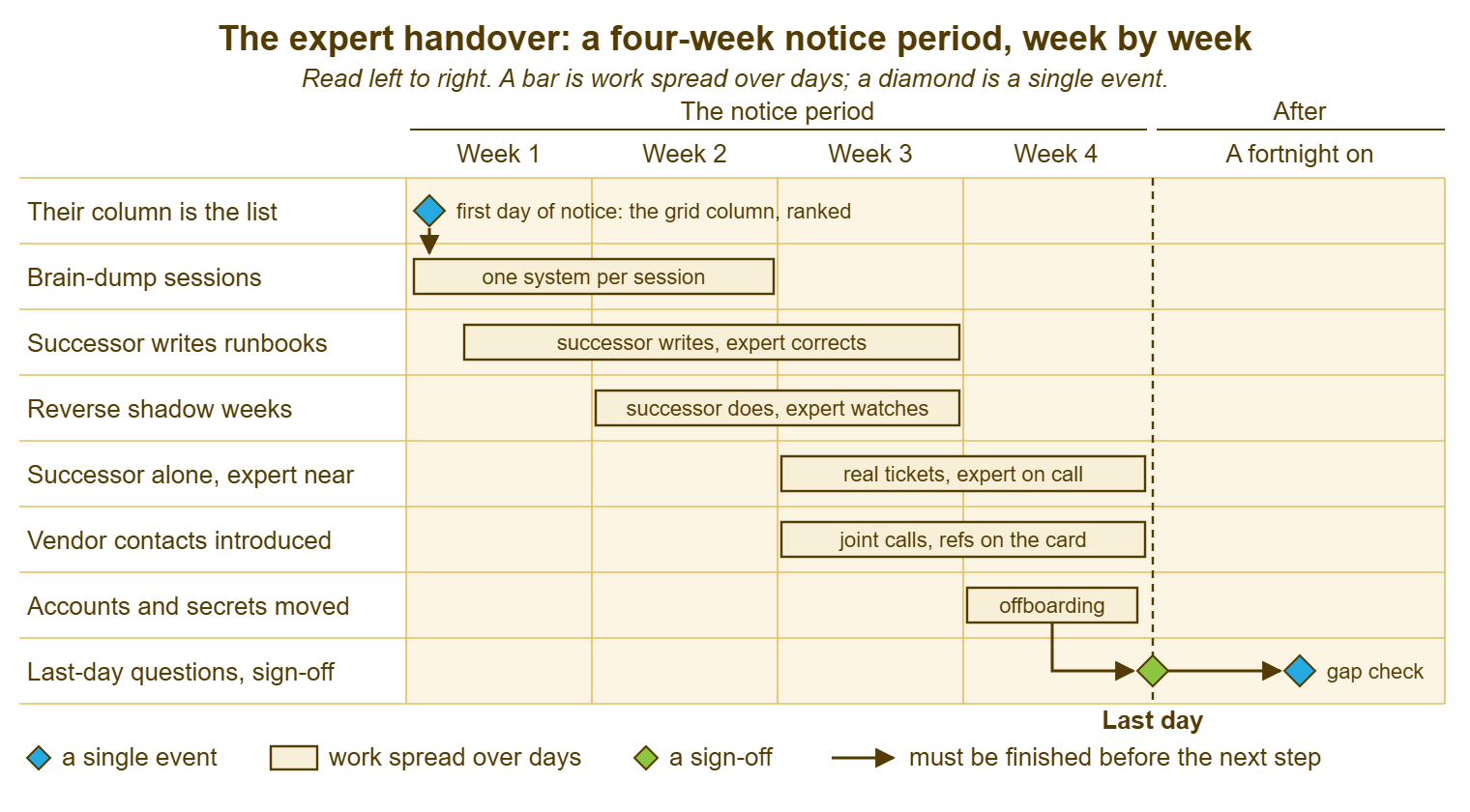
The picture below lays the handover out across a four-week notice period. The brain-dump sessions are in the first fortnight, with the successor's writing running alongside and a week behind. The reverse shadow is in the middle fortnight, the successor is alone in the last, and the accounts, vendors and sign-off are at the end. The bars overlap on purpose: the successor starts doing before the sessions are finished, because doing is what shows which session was incomplete. Read it as a shape to adapt rather than a schedule to obey. A three-week notice compresses every bar, and a six-week one stretches the solo weeks, not the sessions.
The Shadow Weeks in Reverse
From the second week the successor does the work and the leaver watches, which is the shadow in reverse. It is the part of the handover that produces evidence. The ordinary shadow, learner beside expert, is the right shape when there is a year. In a notice period there is not. A successor who spends two weeks watching Elin has two weeks of memories and nothing on the grid. Instead the branch-network tickets go to the successor from week two. Elin sits beside them with her hands in her pockets, and she speaks only when asked or when something is about to break. Every place the successor stops and looks round is a gap in the card or the runbook, and it gets fixed that afternoon. The method of watching without taking over is owned by Shadowing That Actually Teaches. The notice period simply runs it backwards and fast.
In the last fortnight the successor works alone, with the leaver on call in the building and not at the next desk. That is because the test of a handover is whether the successor can do the thing when the expert is not watching. The only safe time to run that test is while the expert can still be fetched. A successor who has done three real tickets on the branch network alone, with Elin reachable and not consulted, has a grid cell that can honestly change to "alone". A successor who has watched Elin do ten does not. The difference will show on the first Thursday after Elin leaves, and it is better to find it on a Thursday when she is still at the far end of the room.
Use the real tickets, and the scheduled jobs, on their real dates where the calendar allows. If the month-end statement run falls inside the notice period, the successor runs it with Elin watching. If it falls the week after, the successor runs a rehearsal against the test system and Elin watches that. The job that runs once a quarter and falls outside both is the one that gets the most careful page and the most detailed recording. That is because it will be run for real by someone who has never seen it, and the page is all they will have. Say so on the page. "First run by the successor: not yet. Rehearsed on: ______ with Elin." Honesty about what was not practised is part of the handover.
The Questions to Ask Before the Last Day
Some things do not belong to any system and are missed by every system-by-system plan. They are found by a fixed list of questions asked in the third week, when the successor knows enough to understand the answers. Ask them in a sitting, write the answers on the plan, and treat anything surprising as a new row on the list. The questions below are joke-free and copyable, and the one that most often produces a long silence is the fourth.
- What runs on a schedule, where does it run, and when is each one next due?
- What is going to expire in the next year: certificates, licences, domain registrations, support contracts, the account you set up with your own e-mail address?
- What do you do by hand that everyone else thinks is automatic?
- Who outside IT relies on you personally, and for what?
- What is half-finished, and where are the pieces?
- What do you know about each vendor that is not in the contract: who actually answers, what to say, what not to accept?
- Which failure would you be most worried about in your first month if you were your successor?
- Where are your notes: personal folders, your own mailbox, chat history, a notebook, a text file on the desktop?
- Which of your passwords or accounts does anything run under, and which shared ones do you know?
- What did you mean to write down and never did?
The last question is the one the whole handover is for. It is asked last because by the third week the leaver trusts that the answer will be used rather than held against them. The answer is usually three or four things. Each would have been a bad day for the desk in the first quarter after they left. Each takes twenty minutes to record once named. Nobody answers that question in week one. By week three, with the successor already running their tickets and the recordings already made, most leavers answer it in full and add two more.
Passwords, Accounts and Vendor Contacts
Do not collect the leaver's passwords. Move ownership instead, and let the offboarding process rotate whatever the leaver knew. Every shared secret Elin has in her head must change on her last day regardless of how trustworthy she is. That includes the admin account on the print server, the vendor portal, and the registrar. That is what a leaver process is for, and the mechanics of it belong to Employee Offboarding. The handover's job is different and earlier. It must find every account that is in Elin's own name but does something for the desk. It must move those accounts to a role or a shared mailbox in week three, while Elin can still sign in to make the change. The vendor portal registered to her e-mail address. The service that runs under an account called "elin-svc". The certificate renewal reminders that go to her inbox. The domain registrar whose only contact is her mobile number. Each of those is a system with a bus factor of one that nobody has ever drawn on a grid.
Vendor relationships are handed over on a call, not in a document. That is because what Elin knows about the core-banking vendor is who answers, what they need to hear, and what to refuse. None of that survives being written down by someone who has not been on the call. Book a joint call with each important vendor in week three. Elin introduces the successor. The successor asks the vendor to update the named contact on the account. The where-things-are card gets the contract reference, the support line, and the name of the engineer who actually fixes things. One call per vendor, twenty minutes each, and the successor is a person the vendor has spoken to rather than a name on a form. Vendors, like everyone else, are quicker for people they have met.
Find the tickets only the leaver ever resolved, because they are the honest list of what the desk will miss. Search the last year of closed tickets for ones Elin resolved and nobody else touched, group them by system, and compare the list with the grid column. The systems that appear in the tickets and not on the grid are the ones nobody thought of as systems. If you run QuerySolv, the complete event history on each ticket shows who claimed it and whether anyone else ever held it. In that case, the search is a filter rather than a memory. In any tool, the resolver's name on a year of tickets is the one record of the leaver's knowledge that was kept without anybody trying.
Remember: the leaver talks and the successor writes. From week two the successor does and the leaver watches. From week three the successor works alone with the leaver on call. A system is handed over when the successor has done it alone at least once while the leaver was still in the building, and the plan says so with a date.
The Last Day, and the Fortnight After
The last day is for signing off, not for learning. The sign-off is a walk down the plan with three honest states per row. Handed over means the successor has done it alone. Documented means there is a card and a runbook and a recording but no solo run. Gap means the desk knows it does not know. Write the state against each row, with Elin, and give the manager the three counts. "Five systems handed over, three documented, two gaps, and here is what the gaps are" is a handover report. "Elin's done a handover" is not. The gaps are not a failure of the plan. They are the plan's most useful output, because they are the things the desk will watch for in the first month.
A fortnight after the last day, hold the gap check: fifteen minutes, the plan on the screen, and one question, "what have we hit that nobody could do?" The answer feeds the bus-factor grid, which gets re-drawn without Elin's column the same week. It also feeds the cross-training calendar, where the gaps become the next quarter's half hours. Most desks find one or two things in the first fortnight that the handover missed, usually a thing that runs on a schedule nobody knew about. That is normal, and a desk that held the gap check finds them in a meeting rather than in an outage.
Whether the desk can phone the leaver afterwards is a favour and not a right. The honest planning assumption is that it cannot. Whether a former employee may be contacted about work, and on what terms, varies by place and by contract. Check both, and build the plan as if the answer is no. A leaver who has been treated well in their notice period will often take one call in their first month at the new job. The desk should spend that call on the single worst gap and nothing else. Spending it on something the recording already answers is how the second call never gets picked up.
When the Notice Is Short, or There Is None
A one-week notice period gets the list, the brain-dump sessions and the cards, and nothing else. The plan should say so rather than pretend. Hold five sessions in five afternoons on the top five systems, recorded, with the successor writing the where-things-are card from each. Ask the questions-before-the-last-day on the fourth day. There is no reverse shadow and no solo week. Every row ends in "documented" at best. The gap check a fortnight later is the first time anything is tested. It is still worth doing, and it is worth doing in that order. The card and the recording are the two things a stranger can use. The architecture conversation is the thing the leaver would prefer to have.
When there is no notice at all, because the exit was immediate or the person is suddenly unavailable, the bus-factor grid is the only handover the desk will get. That is the strongest argument in this series for drawing it before it is needed. The same-day exit, with its disable-first order, is the subject of the offboarding series. The knowledge side has no steps, only a reading of the grid column and a plain report upward: "these three systems now have no owner; here is what we have for each; here is what we do not." A desk that has been running the audit for a year reads that column in ten minutes and starts cross-training the next day. A desk that has not spends the next quarter finding out what the column would have said, one outage at a time.
A Short War Story: The Weighbridge at Fenwick Timber
Fenwick Timber ran a sawmill and a yard where every lorry in and out crossed a weighbridge whose readings fed the stock and invoicing system. Piotr, who had been on the three-person desk for nine years, gave four weeks' notice and was asked to document everything. He did, conscientiously: sixty-one pages on the network, the servers, the backup design and the mill's control system, with diagrams. The document was delivered on his last Thursday and praised. Nobody asked what ran on a schedule. So nobody learned that the weighbridge readings reached the stock system through a script Piotr had written years earlier. It ran every ten minutes on his own workstation, because that was where he had been sitting when the vendor's integration broke. On the Monday after he left, his workstation was wiped under the leaver process, correctly. The weighbridge went on weighing lorries into a file that nothing read. The yard weighed by hand and re-keyed for eight working days while a contractor reconstructed the script from the stock system's logs and Piotr's sixty-one pages, which did not mention it. The review costed it at eight days of two yard staff on paper, the contractor, and a fortnight of invoicing corrections. The cost also included a mill manager who now asks every leaver one question on their first day of notice: "what do you do that everyone thinks is automatic?" The handover is a conversation about what breaks, not a document about how it works.
The Expert Handover Plan
The plan below is the notice period on one page, as plain text. It includes the ranked list, the session log, the week-by-week shape, the questions, the accounts and vendors, and the sign-off states. Fill the list on the first day from the leaver's grid column. One line per session as it happens. The sign-off block is filled in with the leaver on the last day and read again at the gap check.
EXPERT HANDOVER PLAN — ONE PAGE
Leaver: ________   Last day: ________   Weeks of notice: ___   Plan owner: ________
Leaver's ordinary tickets reassigned on: ________   Kept: only tickets on the systems below

THE LIST (the leaver's grid column, ranked by how often and how bad)
  #  System                   Successor   Target: [H]anded over / [D]ocumented only
  1  _____________________    ________    [ ] H  [ ] D
  2  _____________________    ________    [ ] H  [ ] D
  3  _____________________    ________    [ ] H  [ ] D
  4  _____________________    ________    [ ] H  [ ] D
  5  _____________________    ________    [ ] H  [ ] D
  Dropped on purpose (card and recording only): ______________________________

BRAIN-DUMP SESSIONS (one system, one hour, recorded; successor writes the same day)
  Date ______  System ________  Recording at ________  Card [ ]  Runbook [ ]  Corrected [ ]
  Date ______  System ________  Recording at ________  Card [ ]  Runbook [ ]  Corrected [ ]
  Date ______  System ________  Recording at ________  Card [ ]  Runbook [ ]  Corrected [ ]
  Date ______  System ________  Recording at ________  Card [ ]  Runbook [ ]  Corrected [ ]
  Date ______  System ________  Recording at ________  Card [ ]  Runbook [ ]  Corrected [ ]

THE SHAPE
  Week 1: sessions daily; successor writes cards and first-aid runbooks
  Week 2: sessions finish; successor takes the systems' tickets, leaver watches
  Week 3: successor alone, leaver on call; questions list asked; accounts and vendors moved
  Week 4: solo tickets continue; scheduled jobs run or rehearsed; sign-off on the last day

QUESTIONS ASKED (week 3)   Date: ________
  Runs on a schedule: ________________________   Expires within a year: ________________
  Done by hand, looks automatic: ______________   Relies on the leaver personally: ________
  Half-finished: _____________________________   Notes kept at: ________________________
  Most worried about: ________________________   Meant to write down: ___________________

ACCOUNTS IN THE LEAVER'S NAME THAT RUN THINGS      Moved to        Date
  ___________________________________________     ____________    ______
  ___________________________________________     ____________    ______
  Shared secrets the leaver knows: list given to offboarding on ________ for rotation

VENDORS (joint call, contact updated, card completed)
  Vendor ____________  Call on ______  Contact changed [ ]  Engineer who answers: ________
  Vendor ____________  Call on ______  Contact changed [ ]  Engineer who answers: ________

SCHEDULED JOBS
  Job ____________  Next due ______  Run by successor on ______ / rehearsed on ______

SIGN-OFF (last day, with the leaver)
  #1 [ ] handed over  [ ] documented  [ ] gap     #4 [ ] handed over  [ ] documented  [ ] gap
  #2 [ ] handed over  [ ] documented  [ ] gap     #5 [ ] handed over  [ ] documented  [ ] gap
  #3 [ ] handed over  [ ] documented  [ ] gap     Gaps, in words: ______________________
  Reported to ________ on ________

GAP CHECK (a fortnight after)   Date: ________
  Hit that nobody could do: ______________________  -> grid redrawn [ ]  half hours booked [ ]
Frequently Asked Questions
The leaver is unhappy and not cooperating. What can we do?
Should the successor be one person or several?
Is a recorded session really worth keeping?
What if the leaver is the manager or the only senior person?
How do we handle accounts registered to the leaver's personal e-mail?
Can we skip the gap check if the handover went well?
From the QuerySolv team: we build self-hosted help desk software for Windows. QuerySolv runs as one Windows service on your own network. It takes requests by web form, e-mail, live chat, social messages and REST API. It is licensed once per installation rather than per agent per month. The free trial runs the full product for 30 days.