
Compensation and Recovery Time: Principles That Keep a Rota Staffed
Thursday, 08:05, at Harbourview Clinic. Theo is at his desk with the colour of a man who has not slept. At 02:10 the appointment system's overnight job locked itself and the evening urgent-care unit's handover notes could not be printed. He spent two hours on the phone with the night sister and the vendor's out-of-hours line getting it unlocked. He is in at eight because eight is when the desk opens. Imogen, who runs the desk of three, says "go home at lunch", and Theo says "it's fine". It is the third time in two months he has said it. The first two times Imogen believed him. Nobody has yet written down what the clinic owes Theo for the night. So what it owes him is nothing, and he knows it.
Compensation is what a person receives for being available outside hours and for being called. And recovery time is the time given back to them afterwards. This article is about both, as principles, and it is important to say in the first paragraph what it is not. It is not advice about pay rates, overtime, allowances or what the law requires. Those vary by place and by contract. The right answer for Harbourview Clinic is not the right answer for a desk in another country or under another agreement. The organisation's own HR or management function owns those rules. Check them, and check the contract. What this article owns is the craft. That means the four principles that make a rota fair enough to stay staffed, and the agreement that writes them down. It is part of our After-Hours & On-Call Support series.
It covers why fairness is the thing that keeps the rota staffed. The four principles follow in turn: paid for being available, paid more for being called, time back after a night and the next morning protected. The week is drawn as a picture. Then come what is not compensation, agreeing it in writing and who signs, and where the rules vary and what to ask. A short war story and the on-call agreement outline to copy come last.
Fairness Is What Keeps the Rota Staffed
An on-call rota is a standing request to a small number of people to give up evenings and weekends. People decide whether to keep saying yes to it about once a quarter, usually without telling anyone. The rota that is fair gets a yes that nobody notices. The rota that is not gets a yes for a while, from people who need the job, and then a no from the first person who finds another one. That person is almost always the most experienced person on the desk, because experienced people are the easiest to hire away. Fairness is not a kindness the desk extends to its technicians. It is the retention policy of the only part of the desk that cannot be covered by a temp.
The cost of getting it wrong is counted in hours and in knowledge, not in money, and both are large. A senior technician who leaves takes with them the knowledge of what breaks at night and how it was fixed. That is exactly the knowledge the rota depends on. The desk then runs the rota one person short, which raises the frequency for everyone else. That is the condition under which the next person starts looking. Replacing them takes months and the new person cannot carry the phone alone for several cycles. The manager's broader duty to the team's load is in The Manager's Responsibilities. The on-call part of that duty is this article, and it is the part most often left to goodwill.
Goodwill is a real resource and it is a non-renewable one. Theo's "it's fine" is goodwill being spent. It will run out on a night nobody can predict. At that point the clinic will discover that it has been running its out-of-hours cover on a resource it never budgeted for. The four principles below replace goodwill with rules. People are often surprised by how little the rules ask. They are rarely surprised by what happens without them.
Principle One: Paid for Being Available
The first principle is that being available is work, and is compensated whether or not the phone rings. A person holding the phone cannot go to the cinema, cannot have a second drink, cannot be out of signal. They cannot take the children somewhere without a car, and cannot plan an evening without a clause in it. That restriction is the organisation's, imposed for the organisation's benefit. It exists every hour of the week whether the phone is silent or not. The test is simple: would the person have done this with their evening if the organisation had not asked them to hold a phone? If not, the organisation is using the evening, and what it uses it pays for in some form.
The form varies, and the article does not say what it should be. A standby allowance, a payment per week held, or an addition to salary for being on the rota are all forms a desk might use. So is time in lieu. Which are available depends on the place and the contract. The principle is only that the form exists and is not zero. "We only pay if it rings" is the common alternative. It fails in a specific way. It tells the person that a silent week, in which they gave up seven evenings and were never needed, was worth nothing. People hear that message clearly, and they draw the obvious conclusion about what their evenings are worth to the organisation. A silent week is the rota working. It should not feel like a week wasted.
The availability principle also sets the boundary of what the person owes in return, and that boundary belongs in the agreement. A person being paid to be available is reachable within an agreed time, able to work within another, and sober enough to do so. They are not required to sit by a laptop, stay in the building, or answer within thirty seconds. The restriction is real and bounded. A rota that pays for availability and then expects the person to behave as if they were at their desk has bought one thing. It is trying to use another.
Principle Two: Paid More for Being Called
The second principle is that a call is a different thing from standby and is compensated separately, on top. Being available is a restriction; being called is work, often at the worst hour of the day, often with a worried person on the line. The two are not the same. A scheme may treat them as the same, paying a flat amount for the week regardless of whether it rang once or nine times. In that scheme, the loud week and the silent week are worth the same to the organisation. They are very much not worth the same to the person. Every call is paid for as work, in whatever form the place and contract allow. The loud week costs the organisation more than the quiet one. That is not a flaw in the scheme. It is the scheme pointing at the problem.
Two refinements make the call principle fair in practice. First, a call has a floor. A four-minute call at three in the morning is not four minutes of work. The person was woken, worked, and will not sleep properly again. Most fair schemes count a call as at least some minimum length for that reason. Second, calls are counted from the log, not from memory, and the log is the ticket. Every call becomes a ticket, raised at the time or first thing after, with its start and finish written down. The month's compensation is read from the tickets rather than from a separate sheet the tired person is expected to fill in. If you run QuerySolv, the ticket's event history already carries when it was opened, claimed and resolved. In that case, the record of the night is kept by the act of doing the work. In any tool, the rule is that the ticket is the timesheet and nobody keeps a second one.
Paying more for being called also produces the number that reduces the calls. Suppose the clinic paid for nine night calls in a month, seven of them for the same overnight job. That is a month with an invoice attached to a recurring fault. Invoices get fixed faster than complaints. The measuring article later in this series turns that count into a review. Here it is enough that the call is paid, the ticket is the record, and the loud month is visibly more expensive than the quiet one.
Principle Three: Time Back After a Night
The third principle is that the hours worked at night come back, soon, and that the person does not have to ask. Whether the hours are also paid is a question for the place and the contract. Whether they come back as time is a question for the desk, and the answer is yes. A person who worked two hours at two in the morning has two hours fewer in their week than their colleagues. The week should be rebalanced within days, not "when it's quiet". On a help desk it is never quiet, and a debt with no due date is a debt that is never paid.
The lead schedules the time back, and announces it, rather than waiting for the person to claim it. This matters more than it sounds. The person who has been up at night is the person least likely to ask for anything. Asking feels like weakness and the desk is busy and they can see the queue. Imogen saying "you're off at three today, I've moved your afternoon tickets" costs her a minute. That sentence tells Theo that the clinic saw the night. "Take some time when you can" tells him the opposite, kindly. Time back is not leave and is not booked as leave, and it is not deducted from anything. It is the week being put back the way it was.
Where a week has several night calls the time back may add up to a day. Then it collides with the desk's own staffing. A three-person desk giving one person a day back is a two-person desk for a day. That is a real cost and the right response is to plan for it rather than to quietly not give the time. A lead who knows that an on-call week will cost the day desk some hours the following week can arrange the lighter tickets for it. That is exactly as Sustainable Pacing describes for the daytime load. The time back is part of the cost of having a rota at all. It was always part of the cost. The only question is whether the organisation pays it in planned hours or in people.
Principle Four: The Next Morning Protected
The fourth principle is that after a night call of any real length the next morning is protected, by rule. After such a call, the person starts no earlier than an agreed time, usually around noon. They do not have to ask, and the lead does not have to decide anything on the morning. The rule has a threshold written in the agreement. For example, it might be any call that ended after midnight or lasted more than an hour. When the threshold is met the protected morning is automatic. Theo at his desk at 08:05 after a two-hour call that ended at four is a failure of the rule, not of Theo. And "it's fine" is the sound of a person covering for a rule that does not exist. "It's fine" is the most expensive sentence on a help desk. It is always said by the person who will pay for it.
The protected morning is distinct from the time back, and the two together are what a fair night looks like. The time back repays the hours worked. The protected morning repays the sleep. Sleep is not measured in hours worked and is the thing that actually determines whether the person is any use on Thursday. A technician who starts at noon after a night call does a half-day of good work. A technician who starts at eight does a day of poor work and a worse night's sleep after it. The second night of poor sleep is how one bad night becomes a bad week. The rota rule for the week after a bad week, in The On-Call Rota People Accept, is the same principle at the scale of weeks.
The picture below draws one on-call week with all four principles in it. The desk day runs along the top. The amber bar is the phone, held from Monday evening to the following Monday morning. Two calls land on it, an evening one on Tuesday and a night one on Thursday. The Thursday morning is protected, so the desk day starts at noon. The two hours are given back on Friday afternoon. The phone passes on Monday with a handover rather than drifting. The notes under the grid are the four principles in one line each.
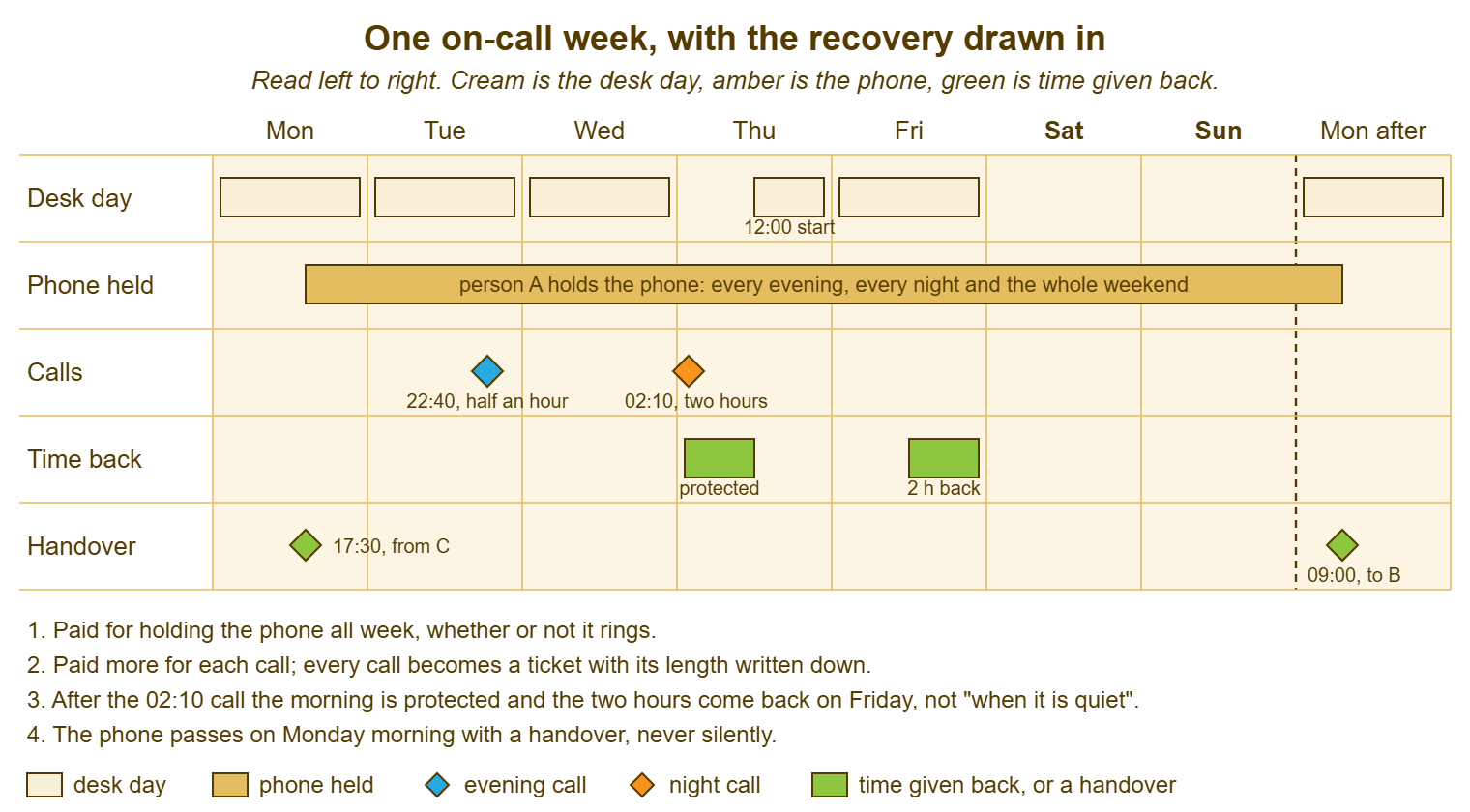
The table puts the four principles beside what each looks like on a real desk and what goes wrong without it. The middle column is deliberately free of figures, because the figures are the organisation's to set. The right-hand column is where most desks will recognise themselves.
| Principle | What it looks like in practice | What goes wrong without it |
|---|---|---|
| Paid for being available | Something is received for every week the phone is held, silent or not, in a form the place and contract allow; the bounds of the restriction are written down | The silent week feels worthless; people start to resent the phone before it rings; the restriction creeps toward "be at your desk" |
| Paid more for being called | Every call is a ticket with its start and finish; calls are compensated as work, with a floor per call; the month's count is read from the tickets | The loud week and the quiet week are worth the same; calls go unlogged because logging gains nothing; the recurring fault has no invoice |
| Time back after a night | Hours worked at night are returned within days, scheduled and announced by the lead, not booked as leave and not asked for | "Take it when it's quiet" is never; the person stops expecting it; the week after a night is a long week |
| The next morning protected | A written threshold, after which the person starts no earlier than an agreed time, automatically | "It's fine"; a half-day of poor work and a second bad night; one night becomes a bad week |
What Is Not Compensation
A number of things are offered to on-call technicians in the sincere belief that they are compensation. The technicians accept them politely while continuing to count the evenings. Pizza on the Friday after a bad week is a kindness. A mug, a shout-out in the team meeting and a line in the newsletter are kindnesses. "We're a family here" is a sentence, and "it's great experience" is a sentence about the future addressed to someone who is tired now. None of them is compensation, because none of them is given in exchange for the specific thing taken, which was the person's evening or sleep. Pizza is a food, not a policy.
The honest test of whether something is compensation is whether it would be missed if the on-call stopped. The standby allowance, the per-call payment and the time back all stop when the rota stops, because they were payment for the rota. The pizza would carry on, probably, because it was never about the rota. It was about the lead being a decent person, which is welcome and is a different thing. Recognition in addition to compensation is good and should continue. Recognition instead of compensation is the arrangement under which the hero in How Support Quietly Fails gets made. That person is thanked for every bad night and handed the next one. Nobody has ever stayed in a job for a mug.
There is a subtler non-compensation: the vague promise of future flexibility. It sounds like this: "take the time back whenever you like", "we're relaxed about hours here". It is offered in good faith. It fails because it has no date, no amount and no person responsible for honouring it. The person on the receiving end correctly reads it as nothing in particular. Flexibility that is real is the scheduled time back in principle three, with a day and a time attached. Flexibility that is a mood is goodwill wearing a nicer coat.
Agreeing It in Writing
The four principles become an on-call agreement: a short written document. It is agreed between the desk, its management and HR or whoever owns the terms, and signed by the people on the rota. It says what the restriction is, what is received for it, what happens after a call and who decides. It is one or two pages. It is not the rota, which changes every quarter. It is not a contract, which is the organisation's to write. It is the plain statement of the arrangement, in words the technicians have read and agreed. That way, nobody has to remember what was said in a meeting.
The agreement has two authors, and the split matters. The money parts, whatever form standby and call compensation take, are set by management and HR. They are the ones who know the place, the contract and the organisation's policy. The article has already said that it does not. The practice parts cover the response time, the threshold for the protected morning, and how time back is scheduled. They also cover what the on-call log is and who reads it. These parts are set by the desk lead with the people on the rota. They are the ones who know what a night actually involves. The lead's job is to make sure the money people and the practice people have both signed the same document. The lead must also make sure the document is kept beside the rota where the people living in it can find it.
The agreement is reviewed once a year and whenever the model changes, and the review reads the on-call log first. A year of calls tells you whether the threshold for the protected morning was right, and whether the time back was actually given. It also tells you whether the frequency the agreement assumed is the frequency people lived. The review is also where the measured load from the last article in this series is read against the agreement. A scheme designed for two calls a month and living with nine is a scheme that has quietly changed without anyone signing anything.
Where the Rules Vary
Everything above is principle, and the moment it meets a payslip it meets rules the article cannot know. The rules vary by country, by region, by sector and by the individual contract. They cover whether standby time counts as working time and whether night calls attract an enhanced rate. They also cover whether time off in lieu is permitted or required, and how rest between shifts is treated. What a part-time or salaried contract already includes varies too. In some places, these rules are set by agreements the desk has never read. The article's advice is one line and it is meant: pay, overtime and on-call arrangements vary by place and by contract. So check both before the agreement is written, and have HR or whoever owns the terms sign the money parts.
What the desk lead can do is arrive at that conversation with the right questions. How is standby treated under our contracts? Is there an existing policy or agreement that covers out-of-hours work anywhere else in the organisation? What about the clinic's nurses, the depot's drivers, the maintenance team? What are the rules on rest after night work that we must design the protected morning around? What forms can the compensation take here, and which of them does the organisation already use? A lead who asks those questions gets a scheme that fits the place. A lead who copies a scheme from an article, this one included, gets a scheme that fits an article.
Remember: being available is paid. Being called is paid more. The hours come back within days without being asked for. The morning after a night call is protected by a written threshold. The forms and figures are the organisation's to set and vary by place and by contract. The principles are the desk's to insist on.
A Short War Story: The Pizza Year at Bluewater Bank
Bluewater Bank's branch-systems desk of four ran a one-week-in-four rota for a year with no standby payment, no per-call payment and no written recovery rule. The understanding was that the desk lead would "look after people". The branch network, which closed at five, was expected to rarely need anyone at night. The branch network's overnight reconciliation job needed someone eleven times in the first quarter, mostly between one and three in the morning. The lead looked after people with a pizza on the Friday after each bad week. There was also a standing instruction to "take some time back when you can". In a desk of four with a queue, nobody ever could. Grace, the most senior technician, kept coming in at eight after her night calls because the queue was there and nobody had told her not to. In the autumn she took a role at a software firm that had a written on-call agreement. The firm had shown it to her at interview. Her replacement took five months to find and could not carry the phone alone for three cycles. So the remaining three ran one week in three through the winter. The second technician gave notice in the spring. The lead's own review put the cost at two senior technicians, most of what the desk knew about the reconciliation job, and a year of recruitment. That was set against the saving of a standby payment nobody had ever costed. The agreement that was finally written the following year took an afternoon.
The On-Call Agreement Outline
The outline below is the skeleton of the agreement Imogen wrote with Theo, Callum and the clinic's HR adviser the week after the third "it's fine". Every money blank is filled in by the organisation under its own rules. Every practice blank is filled in by the desk with the people on the rota. The headings are the four principles plus the three things an agreement needs around them: what the restriction is, what the record is, and who decides. Keep it to two pages, and date it. Have everyone who is on the rota and everyone who sets the terms sign it. Review it yearly against the on-call log.
ON-CALL AGREEMENT — OUTLINE
Desk: ______________________   Coverage model: ______________   Agreed on: ____________
Signed by the rota members: ______________________________   For management / HR: ______________

1. THE RESTRICTION
   While holding the phone the technician is: reachable within ____ minutes; able to start work
   within ____ minutes; fit to work. They are not required to remain at a desk or on site.
   The phone is held from ______ on ______ to ______ on ______.

2. WHAT THE PHONE IS FOR
   Work that has stopped for a scheduled shift or a listed service. Definition and route as
   published: ______________________.  Everything else is logged for the morning.

3. PAID FOR BEING AVAILABLE
   Form of standby compensation (set by management / HR under local rules and contract): ______________
   Received for every week held, whether or not a call is taken.

4. PAID MORE FOR BEING CALLED
   Form of call compensation (set by management / HR under local rules and contract): ______________
   Minimum counted per call: ____ minutes.   Counted from the ticket, never from a separate sheet.
   Every call is a ticket, opened at the time or first thing after, with start and finish recorded.

5. TIME BACK AFTER A NIGHT
   Hours worked outside the desk day are returned within ____ working days.
   The lead schedules and announces the time back. It is not leave and is not requested.

6. THE PROTECTED MORNING
   Threshold: any call ending after ______, or lasting longer than ____ minutes.
   After a threshold call the technician starts no earlier than ______ the next working day, automatically.
   The lead covers the desk accordingly.

7. THE RECORD
   The on-call log is the set of after-hours tickets plus the Monday handover note.
   Read by the lead every Monday; summarised in the monthly review.

8. WHO DECIDES
   Money terms: ______________ (management / HR).   Practice terms: the desk lead with the rota members.
   Disputes about a specific night: raised with ______________ within ____ days.

9. REVIEW
   Reviewed on: ____________ and whenever the coverage model or the rota frequency changes.
   The review reads the on-call log first.
Theo's next night call came three weeks after the agreement was signed, at 01:50, and lasted an hour and ten minutes. He started at noon the next day because the agreement said so, and nobody had to decide anything or say anything was fine. The hour and ten minutes came back on the Friday. Imogen moved two of his tickets to Callum and took one herself. The appointment system's overnight job was the subject of the monthly review, which is where the last article in this series picks up.
Frequently Asked Questions
Our organisation has never paid anything for on-call. How do I raise it?
Does time back have to be the same number of hours as were worked?
What threshold should trigger the protected morning?
Can we give time back instead of paying for calls?
The lead is salaried and expected to be reachable anyway. Does the agreement apply to them?
How do we handle a call that turns into a whole night?
From the QuerySolv team: we build self-hosted help desk software for Windows. QuerySolv runs as one Windows service on your own network. It takes requests by web form, e-mail, live chat, social messages and REST API. It is licensed once per installation rather than per agent per month. The free trial runs the full product for 30 days.