
Sustainable Pacing: Designing the Day Around Recovery
Wednesday, 17:50, at Stonebridge Insurance. The desk of four has three empty chairs and one Kwame. The queue stands at forty-eight, which is eleven more than Monday. Kwame is still there because, as he said to the last person leaving, "someone has to". He was also the someone yesterday. He will be the someone tomorrow, because the desk has no rota for who holds the queue at the end of the day. It has Kwame, and his willingness, and nobody has ever written down what happens when the willingness runs out.
Sustainable pacing means designing the working day and week so that recovery is built into them rather than hoped for. That means a rotation between taking the queue and doing planned work, and breaks that are actually breaks. It means an end of the day that actually ends, and a rule that nobody stays late to make the number smaller. It is the opposite of what most desks do, which is to run everyone flat out and treat recovery as something that happens on holiday. This article is part of our Helpdesk Burnout series. It builds directly on the queue-duty idea introduced in The Interruption Load and Why It Is Different, which is worth reading first if you have not.
It covers recovery as a design input. We cover the rotation between queue duty and project work, then what an interrupted day and a paced day look like side by side. Next come building the roster, breaks that are breaks, and the end of the day that ends. We cover the no-heroics rule and what it costs to keep, then the manager who takes a queue shift. A short war story and the queue-duty roster to copy follow, in that order.
Recovery Is a Design Input, Not a Reward
Most desks treat recovery as something the technician earns after the work is done: a quiet Friday if the week was bad, a holiday if the quarter was. That gets the order wrong. A person can only carry an interruption load for so long before the signs in the first article in this series start to appear. And the time between heavy stretches is what decides whether they appear at all. Recovery is not the reward for the work. It is the condition under which the work can keep being done.
Designing for it means asking a different question when the rota is drawn up. Not "who is covering the queue on Tuesday" but "when, this week, does each person get a stretch in which the queue is not theirs". A desk that cannot answer the second question for everybody has a rota with a hole in it. And the hole is usually shaped like its most willing person. Kwame is not covering the end of the day. He is covering the absence of a decision.
The good news is that the design does not need more people. It needs the same people, arranged so that the load lands on one of them at a time instead of on all of them all day. The rest of this article is that arrangement. It is not complicated, and the desks that do it tend to be surprised by how little it took. The desks that do not tend to be surprised by resignations.
The Rotation: Queue Duty and Project Work
Queue duty is a block, half a day or a whole one, during which one named person takes every incoming thing. That includes the phone, the chat, the walk-ups, the new tickets, the triage. Project work is what everyone else does during that block: the planned work that needs a clear stretch. It could be the knowledge base article, the build document, the ticket that has been waiting for two uninterrupted hours. The rule that makes it work is simple and strict. On duty, you take everything and plan nothing. Off duty, you take nothing unless the duty person hands it to you, and they hand it to you only when it genuinely needs you.
The duty rotates, and the rotation is the point. A three-person desk gives each person queue duty on a different day, or a different half-day, and two clear stretches a week each. A five-person desk can run two on duty at once in the busy morning block and one in the afternoon, and still give everybody two project days a week. A two-person desk alternates mornings. Even a solo technician can run a version of it, with the phone diverted to voicemail for a fixed block each day. The solo case is in Staying Sane Solo, and this article does not repeat it.
The load does not change. The same requests arrive, the same number of them, with the same people attached. What changes is who absorbs the context switches. It is one person who expected them and had nothing to lose to each one, rather than three people who each lost a train of thought. The first article in this series described a person who was always available as one of the four shapes burnout takes. Queue duty makes availability a shift rather than a personality. Everybody is the available one, in turn, and nobody is the available one all week.
The duty person will have bad blocks. A morning with an outage in it, or eleven phone calls before ten, is heavy for whoever holds it. The rotation is what makes the heavy morning survivable: it is theirs today and someone else's tomorrow. That is not the same as saying the duty person is on their own. When the queue-duty block becomes a genuine incident, the rest of the desk joins it, and Major Incident Management covers how. The rotation is for the ordinary day, which is most days, and the ordinary day is what wears people down.
What the Two Days Look Like
The picture below puts the two kinds of day on the same timeline. The upper bar is a technician's day on a desk without a rotation. It is one long stretch of project work, cut into pieces by nineteen interruptions, with lunch eaten at the desk in fifteen minutes. The project is finished after everyone else has gone home, because the day never contained a stretch long enough to finish it in. The lower bar is the same technician, on the same desk, on a paced day. It begins with a short handover, then a queue-duty block until half past twelve in which they take every interruption and plan nothing. A break away from the desk follows. Then comes a focus block with no interruptions at all because a colleague now holds the duty. A short break, a second duty block and a handover follow, then a finish at half past five. Both days hold the same number of requests. Only one of them holds a clear stretch.
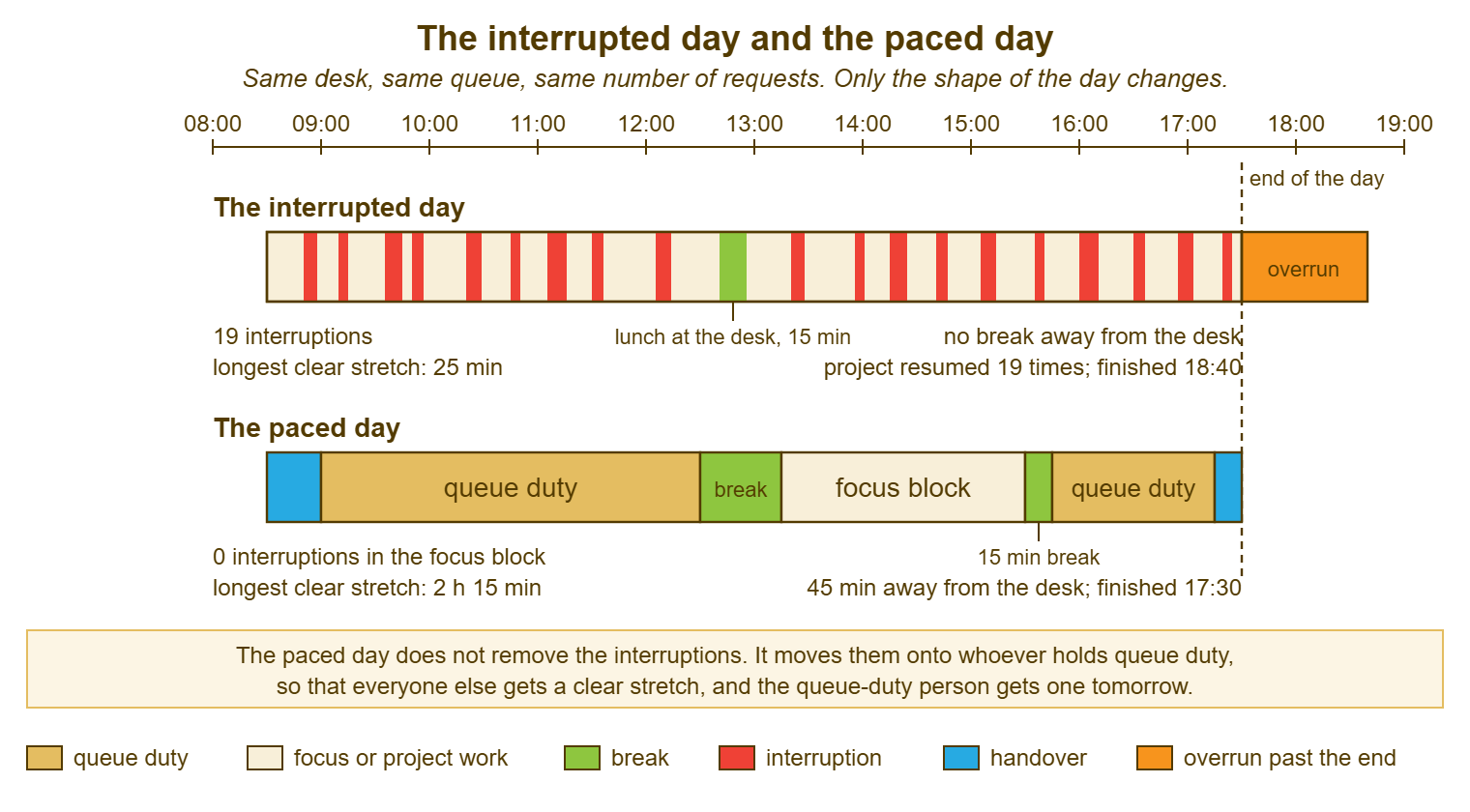
Notice what the paced day does not do. It does not make the queue-duty block pleasant; that block is the interrupted day in concentrated form, and the person holding it will be glad when it ends. It does not shrink the queue. It does not reduce the number of requests. What it does is put the recovery inside the day, as a block with edges that other people can see and protect. Recovery no longer sits at the end of the day, where it was always the first thing to go. The interrupted day finished at twenty to seven with the project done. The paced day finished at half past five with the project done. The difference was not effort. It was shape.
Building the Roster
The roster is a written grid of who holds queue duty in each block of each day. It is published a fortnight ahead, visible to the whole desk and to anyone who asks who to call. It is written down because a rotation that lives in people's heads is renegotiated every morning by whoever is most tired. And the most tired person always loses. It is published ahead because a technician who knows that Thursday afternoon is their clear stretch can plan work into it. And a technician who finds out on Thursday cannot.
Four rules keep a roster fair, and they are in the template at the end of this article. Everyone takes the same number of duty blocks over a month, including the senior technician and including, once a fortnight, the manager. Heavy blocks rotate too: if Monday morning is the worst block on the desk, nobody holds it two weeks running. Swaps are allowed and are written on the roster, so that the record stays true and nobody ends up holding the queue for a week by being agreeable. And duty ends when the block ends, by the clock, with a handover, not when the queue is "under control", because it never is.
The handover between duty blocks is short and written. It says what is open that the next person needs to know about, what has been promised to whom, and what is waiting on someone else. Two or three lines in a shared note is enough. Some tools show ownership by claim, so that every ticket in progress carries the name of the person who holds it, as QuerySolv does. Where the tool does that, the handover is mostly a glance at the list of what the outgoing person holds. The handover also includes a decision about what to pass on and what to keep. The full shape of a handover between shifts is in The Shift Handover. The queue-duty version is the same thing in miniature, done twice a day instead of once.
Expect the roster to be wrong for the first month. The blocks will be the wrong length. The busy morning will need two people where you planned one. Someone will discover that their project day is also the day the finance team runs its month-end. Change it, write the change down, and keep it. A roster that is adjusted is working. A roster that is abandoned at the first bad week was never going to survive a good one.
Breaks That Are Breaks
A break is time away from the desk with no queue in sight, and most technicians have not had one in years. Lunch eaten at the desk with the ticket list open is not a break; it is queue duty with a sandwich. A coffee fetched and carried back to the phone is not a break. The test is whether an interruption could reach you, and if it could, you are still at work, whatever you are eating. A technician who has been "at lunch" for fifteen minutes beside a ringing phone has had fifteen minutes of a different kind of work.
The rotation makes real breaks possible for the first time. The person on queue duty can be covered for lunch by someone off duty for half an hour. The people off duty can simply go. The desk agrees that lunch is away from the desk and that the forty-five minutes is taken rather than earned. It agrees that nobody carries the queue on their phone to the canteen. The person covering the duty person's lunch takes the queue in full for that half hour. It is not a favour. It is a block on the roster.
Short breaks matter as much as lunch, and they are easier to lose. Ten or fifteen minutes away from the screen in the middle of a queue-duty block, with the phone covered, is the difference between a block that is tiring and a block that is grinding. Put it on the roster rather than hoping it happens. It will not happen on its own, because the queue is always there and there is always one more ticket that would take only a minute. (It takes four minutes. It is never one.)
The End of the Day That Ends
The day ends at a time, written on the roster. At that time the person on duty writes the handover and leaves, whether the queue is forty-eight or four. This is the rule that desks find hardest, because it means walking away from work that could be done. Technicians are people who find that physically difficult. The end-of-day rule is also the rule that matters most, because the end of the day is where recovery lives. A day with no end has no recovery in it. The queue will be there in the morning. That is not a failure of the evening. It is what queues are.
Three things make it possible to leave. The last hour of a duty block takes no new deep work. The technician closes what can be closed, writes notes on what cannot, and does not open the two-hour ticket at twenty past four. The handover says what is open, what was promised and what is waiting, so that nothing depends on the leaving person's memory. And the desk has agreed, in advance and out loud, what carries overnight: everything that is not an outage. The response-time promises for ordinary tickets are measured on a business-hours schedule rather than a wall clock. That is how most service-level targets are written anyway and how the ones in SLA Design are built.
What happens after the end of the day is its own subject, with its own series. Whether the desk needs cover at all in the evening, how a small team shares it, and what counts as a genuine after-hours call are all in After-Hours and On-Call Support. Nothing in this article should be read as a reason to answer chat from the sofa. The point here is narrower: the ordinary day has an end, and the end is on the roster. And the person who honours it is doing the desk a service, not letting it down.
Remember: queue duty ends by the clock, with a handover, never when the queue is "under control". A day with no end has no recovery in it. And the queue will look the same in the morning whether or not someone stayed.
The No-Heroics Rule and What It Costs
The no-heroics rule says that nobody stays late to make the queue smaller and nobody works through lunch to catch up. Nobody answers the chat from home, and nobody takes a colleague's duty block "because they are better at it". It is a rule rather than a preference. Without a rule the most conscientious person on the desk will break it first and most often, out of nothing but decency. In that case, the desk will quietly reorganise itself around their decency until it runs out. Kwame is not breaking a rule by staying. There is no rule. That is why he is staying.
The rule has a cost and the desk should know it before adopting it. Some evenings the queue will be bigger in the morning than it would have been. Some tickets will take a day longer. Occasionally a response target will be missed that a late night would have met, and someone will notice. That cost is real and it is paid in exchange for something specific: the same people, still on the desk, still writing good notes, in a year. A desk that cannot afford a slightly bigger queue on Thursday morning cannot afford to lose a technician in the spring either. And the second costs far more than the first.
Say the cost out loud to management, in those words, before the first time it is paid. "We have stopped staying late to work the queue down, because that was costing us people; the queue will be a little higher some mornings and the response times will move a little, and here is what we expect." A manager told in advance hears a plan. A manager who discovers it from a missed target hears an excuse. The honest line in the report, and how to write it, is in Measuring Load Without Surveillance.
The rule has exactly one exception, and it is the genuine outage. That means many people unable to work, declared as an incident by whoever the desk has agreed can declare one. On that evening people stay, because that is what the desk is for. The following week is lighter for them, on the roster, in writing. That is the subject of Recovery After a Bad Stretch. An exception that is declared, bounded and paid back is a rule working. An exception that happens every Wednesday is a rota with a hole in it, and the hole has a name.
The Manager Who Takes a Queue Shift
The manager holds a queue-duty block once a fortnight, on the roster, like everyone else, for three reasons. The first is that it is the only way to know what the load is. A manager who reads the ticket counts knows the volume; a manager who has held the phone through a Monday morning knows the weight. And the two are not the same thing, as the whole of this series is at pains to say. The second is that it makes the rules believable. A desk told to leave on time by someone who leaves on time will leave on time. A desk told to take lunch away from the screen by someone eating at their desk has been told nothing.
The third reason is that it earns the manager the right to set the rota. A rotation imposed from outside the queue is a management decision. A rotation held by someone who has taken their turn in it is a shared arrangement, and shared arrangements survive bad weeks in a way that decisions do not. The rest of the manager's job in this subject, staffing honestly, noticing early, and the one-to-one that asks, is in The Manager's Responsibilities. The queue shift is where it starts.
Two cautions. The manager on duty is on duty: they take the phone and the walk-ups and the triage. And they do not spend the block in meetings with the queue open in another window, which is the most common way the shift becomes theatre. And the manager off duty stays off duty, which means not hovering behind the person on duty asking how it is going. The desk does not need help holding the queue. It needs the person holding it to be left alone to hold it, and then relieved on time.
A Short War Story: The Standing Hero at Bellweather Logistics
At Bellweather Logistics the desk of three had no roster. For fourteen months the queue at the end of every day belonged to a technician called Tomás. He stayed until it was "tidy", answered the chat from the train, and took the Monday phone because he was good at it. His manager, Sade, thanked him often and changed nothing. Then Tomás took three weeks of leave at once, having carried over most of two years of it. That week the remaining two technicians, expecting to drown, drew up a rotation on a whiteboard because there was nobody else to hold the queue. The queue did not drown. It was higher by nine tickets on the first Thursday morning and about the same by the second week. The two of them finished a laptop refresh that had been "about to start" for a year. When Tomás came back, Sade put the whiteboard on the roster and put herself on it. She counted the cost of the fourteen months. There were two projects that had never happened, and a technician who had been working ten-hour days for over a year. There was a leave balance that had become a liability on somebody's spreadsheet. The lesson she wrote at the bottom was that a rota that depends on one person's willingness is not a rota. It is a countdown.
The Queue-Duty Roster
The roster below is one week of a three-person desk, with the manager taking one block a fortnight. Stretch it to the size of yours by adding names and, on a bigger desk, a second duty slot in the busy morning block. Fill the blocks a fortnight ahead, pin it where requesters can see who is on duty, and write swaps on it rather than agreeing them in the corridor. The rules at the bottom are the ones the desk agrees to before the first week. And the one most desks argue about is the fourth; argue about it before you start, not at twenty to six on a Wednesday.
QUEUE-DUTY ROSTER — ONE WEEK
Desk: ______________________   Week beginning: ________   Drawn up by: ______________

Block            Mon           Tue           Wed           Thu           Fri
Morning duty     __________    __________    __________    __________    __________
  (08:30-12:30)
Lunch cover      __________    __________    __________    __________    __________
  (12:30-13:15)
Afternoon duty   __________    __________    __________    __________    __________
  (13:15-17:30)
Off duty         __________    __________    __________    __________    __________
  (project work)  __________    __________    __________    __________    __________

Duty blocks this week:  ________ : __   ________ : __   ________ : __   Manager: __
Heaviest block last week: ______________   Held this week by: ______________

HANDOVER AT THE END OF EACH BLOCK (two or three lines, in the shared note)
  Open and needs watching: ______________________________________
  Promised to someone, by when: _________________________________
  Waiting on someone else: ______________________________________

SWAPS (write them here; a swap not written here did not happen)
  Date ______  ________ took ________'s ________ block   Paid back on ______

RULES THE DESK HAS AGREED
  1. On duty you take everything and plan nothing. Off duty you take only
     what the duty person hands you.
  2. Everyone holds the same number of blocks a month, the manager included.
  3. Nobody holds the heaviest block two weeks running.
  4. Duty ends by the clock, with a handover. Not when the queue is tidy.
  5. Lunch is away from the desk; the lunch-cover person holds the queue.
  6. The only exception is a declared outage, and the week after is lighter
     for the people who worked it.
  Agreed on: ________   Reviewed on: ________
Stonebridge put the roster up the Monday after Kwame mentioned, in a one-to-one, that he had not left before six since the spring. The queue was fifty-three on the first Tuesday morning and forty-one by the following Friday. Nobody could quite explain that, except that three people with clear stretches had each closed the long-running tickets they had been unable to get to for months. Kwame holds the queue on Wednesdays now, until half past five. Then he goes home, which turned out to be allowed.
Frequently Asked Questions
Will the queue grow if nobody stays late to work it down?
Should the most skilled technician hold more queue duty because they are faster?
What does the person on queue duty do when it is quiet?
How long should a queue-duty block be?
We are two people. Does any of this apply?
What if management says leaving on time is not an option during the busy season?
From the QuerySolv team: we build self-hosted help desk software for Windows. QuerySolv runs as one Windows service on your own network. It takes requests by web form, e-mail, live chat, social messages and REST API. It is licensed once per installation rather than per agent per month. The free trial runs the full product for 30 days.