
The Dig-Out Plan: Two Weeks From a Ticket Mountain to Daylight
"So you'll all just pick off a few extra each day?" The IT manager at Bluewater Bank said it kindly, on a Friday afternoon, with the inventory table on the desk between them. Noor said no. She had tried that in the spring. Four technicians picking off a few extra each day had produced, over three weeks, a backlog eleven tickets smaller. They had also produced a team that was tired of hearing about it. The pile was 368 tickets over thirty days old. And "a few extra each day" was how the pile had been built in the first place, in reverse. It was a small number, applied inconsistently, for a long time. What she wanted was the opposite. A large number, applied deliberately, for two weeks, with the door shut.
The manager asked what she needed. Two technicians, every afternoon, from one until four, for ten working days, with nothing else booked in those hours. A third person covering the live queue. A number on the wall every evening at five. And a promise that nobody would ask them to "just look at something quickly" between one and four. The manager made that promise. It turned out to be the hardest part of the plan to keep.
A dig-out is a short, protected, deliberately ordered effort to reduce a backlog to a size the desk can carry. After that, the normal habits take over. It is not a new way of working; it is a fortnight. This article is part of our Backlog Recovery series. It assumes you have the inventory from Taking Stock Before You Dig. A dig-out without an inventory is a fortnight of finding out what the tickets are.
It covers why two weeks is the right length and what "daylight" means. Next come the blocks of protected time and who covers the live queue. Then come the order of attack and why it runs in that sequence, and the daily target and the burn-down line. Next it covers how to work a single ticket inside the dig-out, and keeping the live queue from becoming a second pile. It finishes with the second-week slump, how to end the dig-out properly, and the two-week plan to copy, in that order.
Why Two Weeks, and What Daylight Means
Two weeks is long enough to move a pile and short enough to protect. A week is not enough. The chases you send on day one need time to be answered. The real work needs more than five afternoons. A month is too long. Nobody can keep afternoons clear for a month. And a dig-out that is not protected is a normal month with a name. Ten working days, with a visible start and a visible finish, is the length that a team will actually give you. A manager will actually defend it.
Daylight is the finish line, and it is a shape rather than zero. Write it down before the dig-out starts, in three parts. Nothing over ninety days old is open without an owner, a reply to the requester, and a date. The count of tickets over thirty days old is below a number you choose, usually a week or two of inflow. And every ticket still open is in one of two states. It is being worked, or waiting on a named person with a date on which the desk will act. Zero open tickets is not daylight. Zero is a desk that has stopped accepting work, or started closing it dishonestly. Both are worse than a backlog.
Choose the number honestly. Bluewater's desk received about 160 tickets a week. The inventory said roughly 70 of the 368 were real, unstarted work that needed other teams. Noor set daylight at 60 over thirty days. That was the real work she expected to still be in flight, with owners and dates, on the final Friday. A target of zero would have meant closing things that were not finished. A target of 200 would have meant stopping before the pile was moved. Sixty was a number the team believed, and belief matters more than ambition on a Monday morning.
Protected Time and Who Covers the Queue
The dig-out happens in blocks, and the blocks are the whole method. A block is a fixed period, two to three hours, on the calendar, in which the diggers work the backlog and nothing else. Not the live queue, not the walk-up, not the meeting that was moved, not the project that is nearly done. For a desk of four, two people in a three-hour block every afternoon is about right. For a desk of two, use one person in a two-hour block, alternating days. For a desk of one, use a two-hour block three afternoons a week with the phone forwarded and a sign on the door. That is covered honestly in the one-person articles elsewhere in this library.
Afternoons are better than mornings. Mornings are when the live queue is busiest, when the overnight tickets arrive, and when people walk up. By one o'clock the morning's inflow has been triaged, and the live queue can usually be held by one person until four. Pick the block that costs the live queue least. Then keep it, every day, at the same time. That way, the rest of the organisation learns that the desk is doing something between one and four and stops asking. The first three days they will ask anyway. (The fourth day they will ask whether it is still happening.)
Someone covers the live queue during every block, and that person is not digging. The cover technician owns everything new: first replies, the walk-ups, the due-this-hour list. Rotate the cover role daily so that nobody digs for ten days straight and nobody is left out of the dig entirely. The dig-out is also the fortnight in which the team learns what has been in the pile. A cover technician works from three standing views, whatever your tool calls them (waiting on the desk, response overdue, and due within the hour). With those views, they can hold a desk of four's inflow alone for three hours on most days. On the day they cannot, the block loses one digger for an hour. That is the plan working, not failing.
Management's job during the dig-out is to protect the blocks, and it is worth saying so out loud when you ask for them. The blocks will be attacked, kindly, by people with reasonable requests. These include the director who needs a laptop today, the project that slipped, and the vendor call that could only be Tuesday at two. The manager who agreed to the dig-out is the person who says no to those, or who says "after four". If the manager cannot do that, the blocks are not protected, and you are back to picking off a few extra each day.
The Order of Attack
The order is: decisions first, chases second, quick wins third, real work fourth, and the oldest remaining last. It is not oldest-first, which is the order people expect, and it is not easiest-first, which is the order people drift into. Each step in the sequence is placed where it is because of what it does to the steps after it.
Decisions first, on day one, because they move the most tickets for the least effort and they free attention for everything else. A decision is one choice that closes a cluster. Examples include the seventy tickets about a system that was replaced, the forty about a shared drive that was migrated, and the ninety assigned to someone who left. Each cluster gets one carefully written reply, sent to every ticket in it. The reply says what happened and invites the requester to re-raise if the need remains. Writing that reply well takes an hour. Sending it takes an afternoon with a predefined reply. And the burn-down drops by a hundred on day two. Whether a cluster should be closed this way at all is a bankruptcy question. The care it needs is in Declaring Ticket Bankruptcy. The inherited tickets are not a cluster to close; they are a cluster to re-triage, quickly, into the other piles.
Chases second, also on day one, because a chase has a lag. A chase is a message to a requester or a supplier whose ticket is waiting on them. It says what the desk is waiting for and the date on which the ticket will be closed if nothing arrives. Send every chase on day one with a closing date near the end of week two. The answers then trickle in through the fortnight while the diggers work on other things. Send them on day eight and the closing date falls after the dig-out. In that case, the biggest pile in most inventories is still open on the final Friday. The wording that gets replies is a subject of its own in Follow-Up Messages That Get Replies; the dig-out just needs them sent early.
Quick wins third, oldest first, from day two to day four. The quick wins are the tickets the inventory marked as still needed and under thirty minutes: the monitor, the mailbox permission, the printer driver. Work them in age order, oldest first. The oldest quick ticket has the most embarrassed requester. And a reply on a two-hundred-day-old ticket that says "done, sorry it took so long" repairs more trust per minute than anything else the desk can do. Quick wins come before real work because the count falls fast and the team sees the line move. The inventory's guesses get corrected cheaply, too. A quick win that turns out to be real work goes into the next pile with nothing lost.
Real work fourth, highest impact first, from day five to day nine. The real work is the pile that cannot be chased or decided away: still needed, more than thirty minutes, often needing another team. Order it by impact, meaning how many people it affects and how much it costs them, and not by age. A four-month-old request that blocks a department outranks a six-month-old request for a nicer keyboard. Each ticket gets re-triaged as if it were new: a priority, an owner, a reply with a date. Some will be finished in the block. Most will be started, and "started, with an owner and a date" is the state the finish line asks for.
The oldest remaining last, on day ten, by hand. After nine days there will be a handful of tickets that fit no pile: strange ones, half-projects, requests nobody understands. Open each one, read the history, and decide. Most become one of the three honest endings: a proper close, a bankruptcy close with an invitation, or a project outside the queue with a date. This is also the day the chase deadline passes, and the tickets that did not answer are closed with the reply the chase promised.
Remember: decisions and chases go out on day one, because they take days to pay off. Everything that is done by hand goes after them, quick before slow, old before new within each pile.
The Daily Target and the Burn-Down
The daily target is one subtraction. Take the starting count of tickets over thirty days, subtract the daylight number, and divide by ten. Bluewater's was 368 minus 60, over ten days, which is about thirty-one a day. Draw it as a straight line from the start count on day zero to the daylight number on day ten. That line is the burn-down: the picture of where the count should be at the end of each day. Every evening at five, somebody counts and marks the real number on the same picture. The two lines tell the team how the fortnight is going without a meeting.
The count has to be the same count every day, from the same place. Count open tickets over thirty days old, by the same definition, at the same time, by the same person. Write the number on the wall. Where the tool reports backlog by age, as most ticketing tools can, the number comes from there. Where it does not, the spreadsheet from the inventory is re-run with today's date. Do not count "tickets closed today", because the diggers close old tickets while the cover technician closes new ones. The two get mixed. The pile is the number. Nothing else moves the line.
The picture below is Bluewater's fortnight, and it is typical. The target is the straight dashed line from 368 to 60. The actual count barely moves on the Monday, because Monday was decisions written and chases sent. Nothing closes until the replies are ready. On the Tuesday the two clusters close and the count drops by nearly a hundred in one afternoon. Wednesday and Thursday are quick wins, steady drops of twenty-odd a day. Then the real work starts and the line flattens. From Friday of week one to Wednesday of week two the count falls by only ten or fifteen a day. The actual line is above the target line for four days running. On the Thursday of week two the chase deadline passes and sixty-eight unanswered tickets close with the reply that was promised. The fortnight ends at 71, against a target of 60.
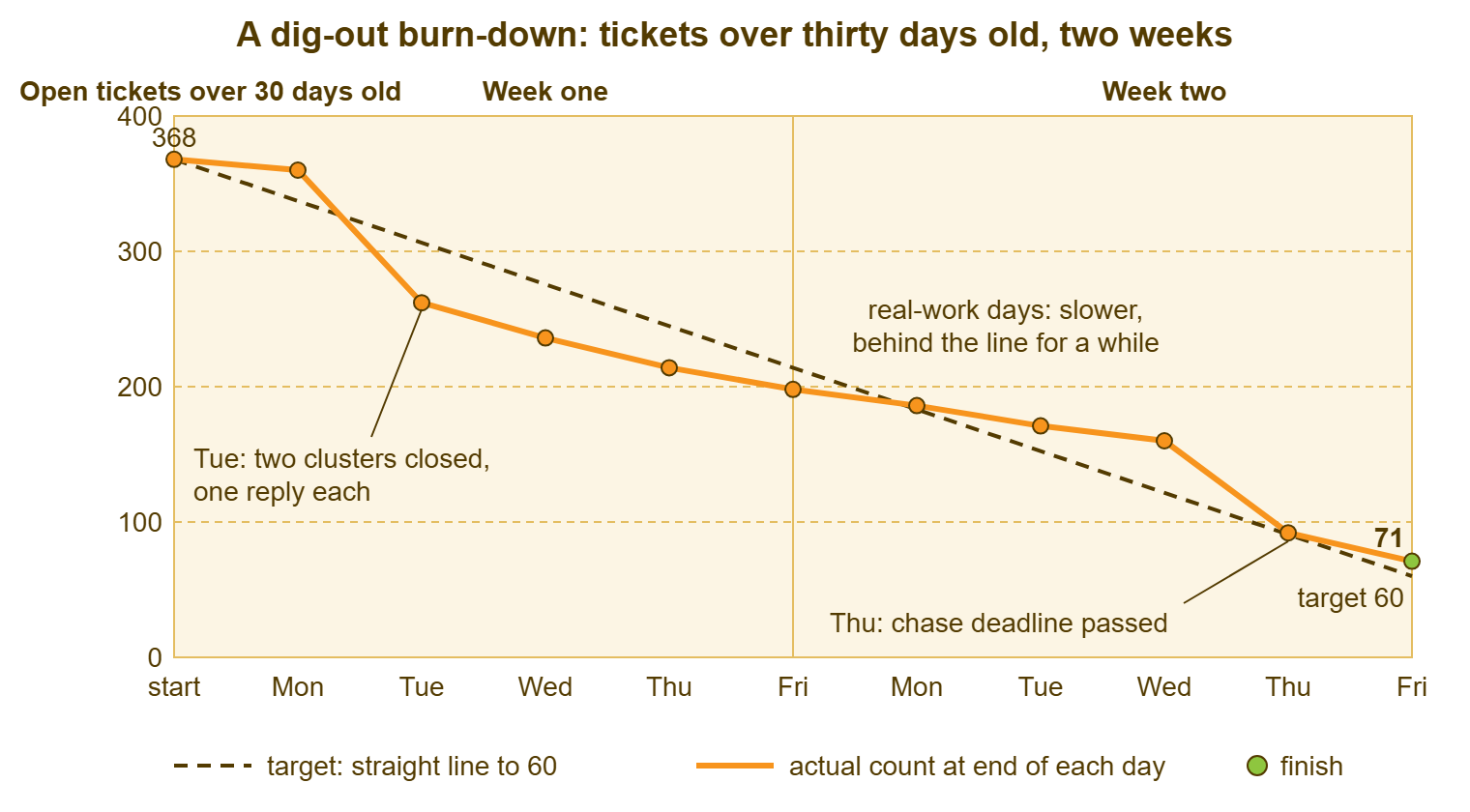
Read the shape, not the gap. The actual line will be behind the target for most of the second week. That is not failure. It is the real-work days, which are slow because real work is slow. What matters is whether the flat part is flat because the team is doing hard tickets properly, or flat because the blocks were interrupted. The first is the plan. The second is the manager's problem, and the burn-down on the wall is how the manager finds out. A chart that nobody can argue with is worth a great deal of meetings.
If the line is badly behind by day five, change one thing, not the plan. Add a third digger for the second week, or move the chase deadline a day earlier, or narrow daylight from 60 to 90 and say so. Do not extend the dig-out. A dig-out that runs into a third week has stopped being protected, and what you have is the old habit with a chart.
Working One Ticket in the Dig-Out
Inside the block, each ticket gets the same four steps. The steps are what stop the dig-out from becoming a bulk close. Read the history first: who asked, what the desk did, when it was last touched, and what it is waiting on. Decide which pile it belongs to, which is usually what the inventory guessed and sometimes not. Do the thing the pile requires: the quick fix, the re-triage with an owner and a date, the chase, or the bankruptcy close. Then reply to the requester, in every case, with what happened. The reply is not optional, and it is the step that separates digging out from sweeping under.
Close properly or do not close. A proper close has a reply to the requester saying what was wrong, what was done and how to tell if it comes back. It also has a short internal note for the next technician. What that looks like, line by line, is in What a Proper Close Looks Like. The temptation in a dig-out is to skip the reply because the requester has waited so long they have surely forgotten. They have not. In many tools a status change on its own sends the requester nothing. Even where it sends an automatic line, the line says nothing about what was done. A close without a reply is a silent close. And a silent close on a two-hundred-day-old ticket is the one message that is worse than none.
Use predefined replies for the repeated messages and only for those. The cluster close, the chase, and the "done, sorry for the wait" quick-win reply are each written once, carefully, by one person, and then used by everyone. Most tools have some form of saved or canned reply. In some it is personal unless shared. Sharing may need a permission. That is worth sorting out on day one rather than discovering at two o'clock on day two. The replies that are not repeated, the ones on real work, are written by hand. A requester who waited four months for a real answer can tell a template when they see one.
Merge and link where the inventory found duplicates, with care. Two tickets from the same requester about the same problem become one. In most tools a merge cannot be undone. In some it is only allowed between tickets of the same requester. So read both before merging. Tickets from different requesters about the same cause are not merged. They are linked under a shared name and closed together when the cause is fixed. Each requester gets their own reply. A digger who merges forty tickets in an afternoon has either found forty duplicates or made thirty-nine mistakes, and the history will say which.
Keeping the Live Queue Alive
New tickets do not stop arriving because the desk is busy. A dig-out that lets the live queue slide builds a second backlog behind the first. The cover technician's job is first-touch discipline on everything new. That means a human reply within the hour, a priority, an owner, and a time the requester will hear next. This is the first-touch discipline described in the intake and triage series. They do not dig. They do not get pulled into the block because it is "nearly done". They hold the door.
Watch the new end of the queue as closely as the old end during the fortnight. The burn-down measures tickets over thirty days. So a ticket created on day one of the dig-out cannot appear on it. That means the chart will look fine while the live queue quietly fills up. Add one line to the evening count: tickets under seven days old with no reply. If it rises for three evenings, the cover is not enough, and a digger comes off the block for the morning. The dig-out fails quietly in exactly one place, and this is it.
Resist tidying the live queue into the pile. Putting new tickets On Hold so the view looks calm does nothing except hide them. In many tools the SLA clock keeps running on a ticket that is On Hold. In those tools, the hidden ticket breaches on schedule with nobody watching. Some tools pause the clock on hold. You should know which yours is before anyone parks anything. The live queue is worked, not parked. Parking is how the last mountain started.
The Second-Week Slump
The second week is slower, and everyone should know that before it starts. Week one has the clusters and the quick wins. The count falls by the hundred, and the team is pleased. Week two has the real work. There, a ticket takes an afternoon and ends as "started, owner, date" rather than "closed". The count falls by ten. The actual line sits above the target line for days. Morale follows the line down. By Wednesday of week two someone will say the dig-out is not working. They will be looking at a chart that says the dig-out is working exactly as planned.
Say so in advance and say so again on the Monday. "This week the number moves slowly because the tickets are hard. The chase deadline is Thursday and the count will drop then." A team that was told will read the flat line as the plan. A team that was not told will read it as failure. And failure in week two of a dig-out looks like people drifting back to the live queue, where the wins are quick. That is the drift that built the pile.
Do not solve the slump by lowering the bar on real work. The fast way to move the line in week two is to close real tickets with "please re-raise if still needed". That turns real work into bankruptcy and sends sixty people a message that says the desk gave up. The slow way is to re-triage each one properly and accept that it leaves the fortnight open, with an owner and a date. That is what the finish line always called for. The slow way is the plan. The fast way is a different, worse plan wearing the same chart.
Ending the Dig-Out
End on the Friday whether or not the number was reached. Count and fill in the after column of the inventory table. Write the brief for management, whose format is the subject of the last article in this series. The brief says the start number, the finish number, what was closed and how, and what is still open and why. It also says what the desk needs so that the pile does not come back. Seventy-one against a target of sixty is a good fortnight and should be reported as one. The eleven should be explained: real work, owners named, dates set.
Then stop. The blocks end, the cover rota ends, and the chart comes off the wall. The desk returns to normal hours with one difference. The weekly habits that keep the pile from rebuilding, which are the subject of Keeping the Backlog From Rebuilding, start the following Monday. A dig-out without those habits is a fortnight that bought a year. A dig-out with them is the last one you do.
I have run four of these and the second one went badly. That was because I let it drift into a third week "to finish the real work". The third week was not protected, the real work did not finish, and the team stopped believing the next block would be honoured. The fortnight is the plan. When it ends, it ends.
A Short War Story: The Fortnight That Was Not One at Tollgate Foods
Tollgate Foods is a food manufacturer with three technicians supporting a plant and two offices. It decided to clear a backlog of 640 open tickets by asking everyone to "dig when you can" for two weeks. There were no blocks, no cover and no chart. Hamid, the senior technician, dug for an hour on the first Monday. He was then pulled into a line-side scanner fault, a laptop build for a new supervisor and a vendor call. By the second Friday the count was 598. Two technicians had given up four evenings to it. A production supervisor whose ticket from the spring was still open escalated to the plant manager. The plant manager asked what the two weeks had achieved. The honest answer was "forty-two tickets and some overtime". The second attempt had two people in a three-hour block every afternoon and one covering. The chases were sent on day one, and two clusters closed on day two. A burn-down went on the canteen wall. This attempt took the count of tickets over thirty days from 410 to 55 in nine working days. The cost of the first attempt was a lost fortnight, four evenings, and a plant manager who now asks for the chart. The lesson Hamid gives new starters is that a dig-out without protected time is a normal fortnight with a name on it.
The chart stayed on the canteen wall for a month afterwards, which nobody had planned. The plant manager walked past it every day. The chart did more for the desk's standing than the fortnight did.
The Two-Week Plan
The plan below is the fortnight on one page: the numbers, the blocks, the order, and the evening count. Fill in the top from the inventory, assign the names, and put it on the wall next to the burn-down. The daily lines at the bottom are filled in at five each evening, by the same person, from the same count.
THE TWO-WEEK DIG-OUT PLAN — ONE PAGE
Desk: __________________  Start: Monday ________  Finish: Friday ________

NUMBERS
  Open tickets over 30 days at start: ____   Over 90 days: ____
  Daylight (over-30 count on final Friday): ____
  Daily target: (start minus daylight) / 10 = ____ per day
  Live-queue guard: new tickets under 7 days with no reply, must stay under ____

BLOCKS
  Block time: ____:__ to ____:__ every working day
  Diggers in each block: ____    Cover technician (rotates daily): one
  Cover rota:  Mon ______  Tue ______  Wed ______  Thu ______  Fri ______
  Protected by (manager who says no to interruptions): ______________

ORDER OF ATTACK
  Day 1   Decisions: clusters identified, one reply written per cluster
          Chases: every waiting ticket chased, closing date = Day 9
          Inherited tickets re-triaged into piles
  Day 2   Clusters closed, one reply each; predefined replies set up
  Day 3-4 Quick wins, oldest first; reply on every one
  Day 5-9 Real work, highest impact first; owner, priority, date, reply
  Day 9   Chase deadline: unanswered tickets closed with the promised reply
  Day 10  Oldest remaining decided by hand; after-count; brief written

RULES
  [ ] No ticket closed without a reply to the requester
  [ ] No merge without reading both tickets
  [ ] No real-work ticket closed as "re-raise if needed"
  [ ] No block cancelled; a lost block is recorded here: ______________
  [ ] Count at 17:00 by the same person from the same report

EVENING COUNT
  Day  Over 30   Target   New under 7, no reply   Note
  1    ______    ______   ______                  ______________
  2    ______    ______   ______                  ______________
  3    ______    ______   ______                  ______________
  4    ______    ______   ______                  ______________
  5    ______    ______   ______                  ______________
  6    ______    ______   ______                  ______________
  7    ______    ______   ______                  ______________
  8    ______    ______   ______                  ______________
  9    ______    ______   ______                  ______________
  10   ______    ______   ______                  ______________
Adjust the shape to the desk, not the principle. A desk of two runs one digger in a two-hour block on alternate days. It stretches the plan to three weeks of blocks that still total ten. A desk of eight runs two blocks a day. A desk with several departments runs the plan per department, because the clusters and the chases are different in each. What does not change is the order, the protected time, the reply on every close, and the number on the wall every evening.
Noor's fortnight ended at 71, eleven over the target, with the eleven listed by name and owner on the brief. The manager's first question was not about the eleven. It was whether the desk could keep the afternoon blocks. The answer, which is the right answer, was no. The blocks were a fortnight. The thing that keeps the pile from coming back is smaller than a block and happens every week. That is the next article. The dig-out is the easy part, in the sense that it has an end.
Frequently Asked Questions
Can a dig-out be done in evenings or at the weekend instead of blocks?
Why not simply work oldest-first?
What if the live queue gets busy during a block?
How should the daily count be taken if the tool has no age report?
We hit daylight on day seven. Should we keep going?
What happens to tickets that are still open when the fortnight ends?
From the QuerySolv team: we build self-hosted help desk software for Windows. QuerySolv runs as one Windows service on your own network. It takes requests by web form, e-mail, live chat, social messages and REST API. It is licensed once per installation rather than per agent per month. The free trial runs the full product for 30 days.