
Empathy Without Being a Doormat: Warm and Firm at Once
Thursday, 14:10, at Harbourview Clinic. Nadia is three months into her first desk job and is replying to Rosa, a practice nurse. Rosa wants her own tablet joined to the clinic network that carries patient records. The answer is no; personal devices do not go on that network, and Nadia agrees with the rule. Her draft reads: "Hi Rosa, I'm so sorry, I really wish I could help with this, unfortunately our policy doesn't allow personal devices, I'm really sorry about that, I know it's frustrating, I'll see if there's anything I can do and get back to you, sorry again." Tomas, the desk lead, reads it over her shoulder. "You have apologised four times," he says, "for a rule you agree with. And you have promised to look into a thing that is not going to change."
Nadia's draft is kind, and it is going to cause a week of trouble. Rosa will read "I'll see if there's anything I can do" as a maybe. She will tell the other nurses that IT is looking into it and come back on Monday for the answer. At that point the desk will have to say no twice to a person who has been told yes once. The warmth was real. It was also doing the work the boundary should have done, and warmth is not built for that.
Empathy, at a help desk, is showing the requester that you understand what their problem is costing them, in their terms, accurately. It is not sharing their feelings and it is not apologising. A doormat reply is one that gives up the boundary, apologises for it, or hints that it might bend. It does this to avoid the discomfort of stating it. Firm means that after the message the boundary is exactly where it was and the requester knows where that is. The two are not ends of one slider. They are two separate dials, and a good reply turns both up. This article is part of our Support Tone & Voice series. This article is about turning both up at once.
It covers why warm and firm are not opposites, with a picture, and what empathy means at a desk and what it does not. Then come the doormat reply and why technicians write it, and what over-apologising costs. Next are the boundary stated kindly, as a five-line frame, and holding the line when the requester pushes back. Teaching warm-and-firm to a team, a short war story, and the warm-and-firm phrase table to copy come last, in that order.
Warm and Firm Are Not Opposites
Most technicians arrive at a desk believing in a trade-off: the kinder the message, the softer the boundary. In that belief, the firmer the boundary, the colder the message. The belief comes from the two bad examples everyone has received. The cold reply quotes the rule and signs off. The soft reply apologises for the rule and leaves the door open. Because those are the two replies people remember, the choice looks like one slider between them, and the only question is where to set it. It is not one slider. Warmth is about how much the message shows you understand the requester's situation. Firmness is about whether the boundary moves. You can have both at full, both at zero, or either one alone.
The picture below shows the same reply three ways. Sam has asked for a spreadsheet add-in to be installed today. The desk tests software before installing it, which takes two working days. Nobody is going to skip the test. The cold version states the boundary and nothing else. The over-apologetic version is warm to the point of discomfort and buries the boundary under four apologies and a promise to "push it through". The warm-and-firm version names Sam's deadline, states the boundary in one sentence, books a day, and tells him what to do if the deadline moves. Only one of the three leaves Sam knowing what will happen and feeling that a person wrote it.
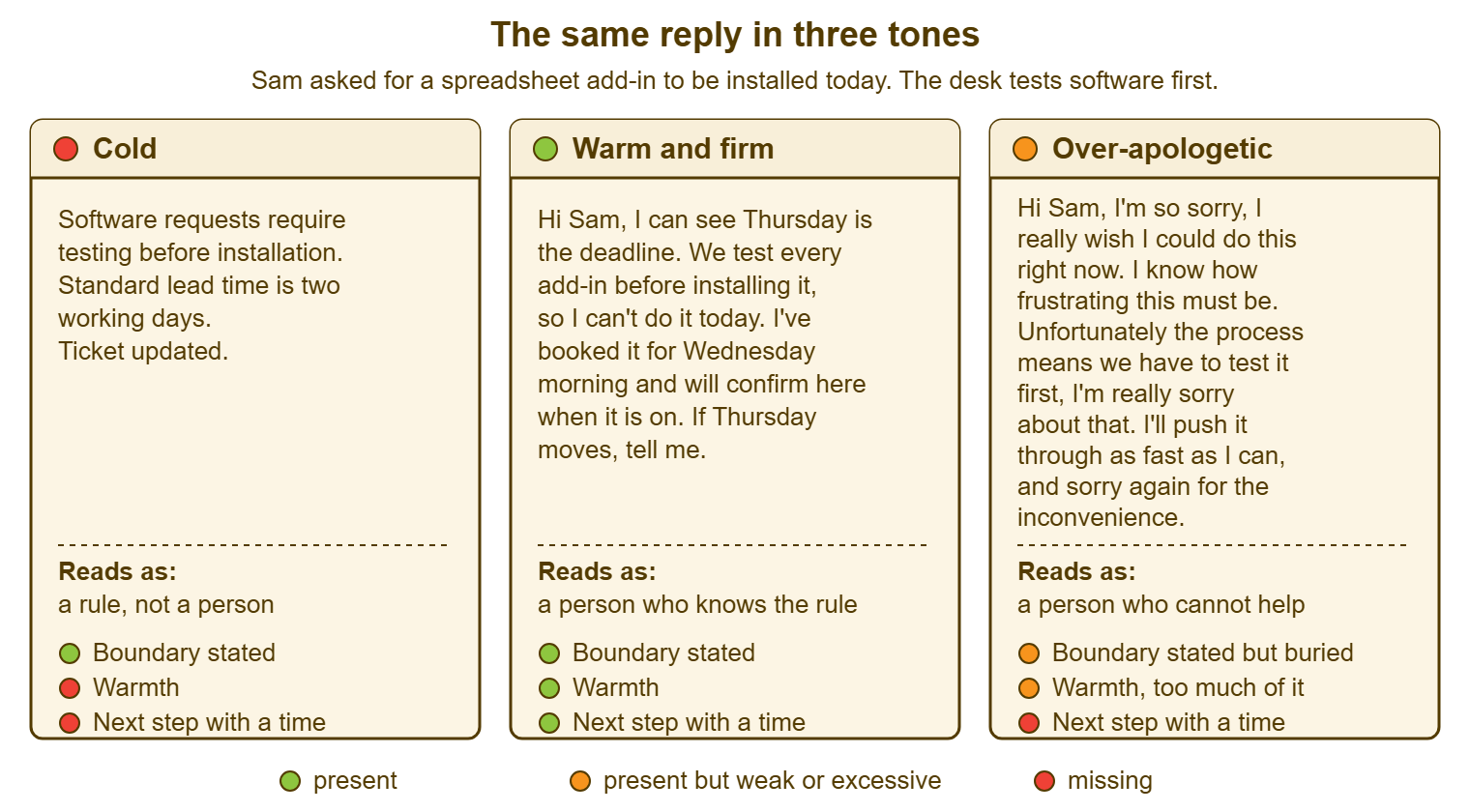
Read the three checks under the cards and notice what the over-apologetic version is missing. It is not missing warmth; it is drowning in it. It is missing the next step. A reply that apologises four times and never says "Wednesday" has given the requester a feeling instead of a plan. The feeling wears off by lunchtime. (The requester does not want your feelings. They want their Wednesday.) Warmth that replaces information is not kindness. It is a longer way of saying nothing.
What Empathy Means at a Help Desk
Empathy in a support message is one or two sentences that prove you have understood what the problem is costing this particular person. "I can see Thursday is the deadline" is empathy. "I can see the whole team is locked out until this is fixed" is empathy. "I understand how frustrating this must be" is not. It is true of every ticket ever raised and therefore tells the requester nothing about whether you read theirs. The test of an empathy sentence is whether it could be pasted into a different ticket unchanged. If it could, it is sympathy wallpaper.
Empathy is also not agreement. You can understand completely that Rosa wants her tablet on the network and that it would save her twenty minutes a shift. You can understand that the clinic's own tablets are slow and there are not enough of them, and still say no. In fact, saying all of that and then saying no is far more convincing than saying no alone. It shows the no was reached with the facts in view. The requester who feels unheard appeals; the requester who feels heard and refused usually accepts it, or at least appeals to the right person.
The craft of naming someone's impact honestly, especially when they are angry about it, belongs to acknowledging impact honestly. That craft applies to every reply, not just the hard ones. For this article the point is narrower: the empathy sentence and the boundary sentence are different sentences, and they do different jobs. Keep them separate and both get done. Blend them, as Nadia did, and the apology eats the boundary.
The Doormat Reply and Why We Write It
The doormat reply has four tells. It apologises for a rule rather than for a mistake. It hedges the boundary with "unfortunately", "I'm afraid" or "at the moment", each of which implies the boundary is regrettable and possibly temporary. It offers to "see what I can do" or "check with my manager" about a thing that is not going to change. And it ends without a next step. The writer could not bring themselves to write "so this will not happen" and wrote "I'll get back to you" instead. Any one of these makes the boundary look negotiable. A boundary that looks negotiable gets negotiated. Requesters can smell it.
Technicians write doormat replies for reasons that are entirely decent. Saying no to a person is uncomfortable, and typing "sorry" is a small way to make the discomfort go away. There is the fear of the complaint and the memory of the last requester who went to their director. There is the simple wish to be liked by the people you serve. There is also, on many desks, a training course somewhere in the past that taught everyone to apologise for everything. That included the weather, in the name of "customer delight". None of this is weakness. It is a kind person using the only tool they were given.
The fix is not to stop being kind. It is to notice that the apology and the hedge are doing a job they are bad at. The job is to make the requester feel understood and to leave them with something. The empathy sentence does the first part better than any apology. The "what I can do" sentence does the second part better than any hedge. Once a technician has those two tools, the apology stops being load-bearing. It can then go back to meaning what it is supposed to mean: that the desk got something wrong.
What Over-Apologising Costs
The first cost is that an apology for a rule tells the requester the rule is wrong. If the desk is sorry about it, the desk must think it is unreasonable. And if the desk thinks it is unreasonable then surely an exception is available for someone who asks nicely, or loudly, or twice. Rosa did not arrive thinking the network policy was negotiable. Nadia's draft would have taught her that it was. The desk does not have to defend every policy with enthusiasm, but it should not undermine the ones it is about to enforce.
The second cost is the appeal. "I'll see what I can do" is heard as "yes, pending paperwork". When the answer arrives as no, the requester is now refusing something they believe they were half-promised. That conversation is longer, angrier and often involves a third person. I have written "I'll see what I can do" about things I could not do, more than once. Every one of them came back as a meeting. A plain no on Thursday takes two minutes. A soft no on Thursday takes a meeting on Tuesday.
The third cost is the one that matters most over a year. Sorry is a word that loses value every time it is printed. A desk that apologises in every reply has nothing left to say on the day it actually deletes somebody's folder. The requester has seen "I'm so sorry" attached to a password reset, a printer queue and the clinic's choice of screensaver. They cannot tell this apology from those. Tone in hard moments is about the apology that is short and specific and means something. That apology only works on a desk that has not already spent the word.
The fourth cost is cultural, and it is the quietest. A desk that apologises for its boundaries starts to see its boundaries as embarrassing. And a desk that is embarrassed by its rules enforces them unevenly, by mood, by requester and by who is on shift. That is the beginning of the inconsistency this series exists to prevent. The over-apologetic reply is not a tone problem in one message. It is a desk telling itself, one ticket at a time, that it is probably in the wrong.
Remember: apologise for mistakes, never for rules. Show you understand the requester's situation in one specific sentence. State the boundary in one plain sentence. Give the reason once, say what you can do, and end with a next step. The boundary is the same after the message as before it.
The Boundary Stated Kindly
A warm-and-firm reply has five lines, in a fixed order, and the order is most of the technique. First, the impact, specific to this requester. Second, the boundary, in one plain sentence with no hedge in it. Third, the reason, once, in a sentence the requester would accept from a colleague. Fourth, what you can do, which is almost never nothing. Fifth, the next step, with a time if there is a wait. The frame below is the shape. The conversation of saying no, from the first sentence to the alternative, is the subject of the anatomy of a good no. And this frame is the tone it is delivered in.
THE BOUNDARY STATED KINDLY — FIVE LINES

1. Impact      I can see ____________________________________________.
2. Boundary    We do not / I cannot ___________________________________.
3. Reason      That is because _______________________________________.
4. Can do      What I can do is ______________________________________.
5. Next step   I will ______________ by ______. If ______, tell me here.

Write each line once. Do not add a second reason.
Do not apologise unless the desk made a mistake.
Here is the frame applied to Rosa. "Hi Rosa, I can see the clinic tablets are slow and that having your own would save you time on every ward round. Personal devices cannot join the records network. That network is restricted to devices we manage, because patient data moves across it. What I can do is check whether a managed tablet is free this week and raise a request for an extra one for your team, and I can set up access to the rota and messaging on your own device, which do not touch patient data. I will tell you about the spare by tomorrow afternoon. If a managed tablet would not solve it, tell me what would and I will see whether it is possible." That is six sentences. Rosa knows where the line is, why, and that a person on the other side has thought about her ward round.
Notice what the reply does not contain. No "unfortunately". No "I'm afraid". No "at the moment", which would imply the policy expires. No "sorry". The reason is given once, in one sentence, and not defended. The warmth is entirely in the first and fourth lines, and it is specific warmth: ward rounds, slow tablets, the rota. Give the reason once. Once. The second reason is the beginning of a negotiation, and the third is a committee.
Holding the Line When They Push Back
About one requester in five will reply to a warm-and-firm no with a second request. The second reply is where most desks go soft. The requester adds a reason: the deadline, their seniority, the fact that someone in finance was allowed something similar. The technician, feeling the pressure, adds a reason of their own, or softens the boundary, or offers to ask someone. Each addition tells the requester that the boundary moved a little, and that a third message might move it further. The rule for the second reply is simple and feels wrong the first few times. Repeat the boundary in the same words. Add nothing to it. Acknowledge the new point, if it is new, and say what you can do about that point specifically.
"I understand the audit is Friday and that makes this urgent. Personal devices still cannot join the records network. For Friday, I can have a managed tablet set up for you by Wednesday morning, and I will prioritise it." Same boundary, same words, new empathy sentence for the new fact, new offer for the new fact. If the requester pushes a third time, the right reply is the route of appeal, said as information rather than as a threat. For example: "If you would like this reviewed, the desk lead is Tomas and I can add him to this ticket now." Most requesters stop at the second message. Those who do not were always going to escalate, and you have given them the right address.
Separate the escalation from the emotion. A requester who appeals is not an angry ticket, and an angry ticket is not an appeal. And the two should not be filed the same way. If you run QuerySolv, flagging a ticket for the lead's attention is a separate act from changing its priority. That is a useful separation here. Rosa's request did not become more urgent because she asked a second time, and it does not need to be marked as if it did. In other tools, add the lead to the ticket by whatever means exist. Note in an internal note that the requester has asked for review, and let the lead reply in their own voice. The whole conversation when a requester is already angry at the first message, rather than disappointed at the second, is in the first sixty seconds.
Teaching Warm-and-Firm to a Desk
Count the apologies. Take a week of outgoing replies, search for "sorry", "unfortunately" and "I'm afraid". And read each one with the question "did the desk make a mistake here?" On most desks the honest answer is no for nine out of ten. Show the team the count, without names, and the two or three replies where the apology was earned. So the point is not that apologies are banned but that they are being spent on the wrong things. A desk that sees its own count usually fixes half the problem that afternoon.
Read the hard drafts aloud before sending, to a colleague or to the wall. A doormat reply sounds like one when spoken; the fourth "sorry" is audible in a way it is not on screen. Pair the newer technicians with the ones who already do this well. Have them swap drafts for a fortnight on anything that contains a no. The peer-review habit for all replies is described in one voice across five people. For boundaries specifically, ask the reviewer to answer two questions only. Can you tell where the line is, and does it sound like a person who understood the request?
Give the team somewhere to put the sentence they want to write. A technician who has been asked for the fourth time to bend the same rule has a sentence in them. And it should not go to the requester. It should go in an internal note, where the next person to pick up the ticket will see the history and where it does no harm. Writing the frustrated sentence in the note and the warm-and-firm sentence in the reply is not dishonesty. It is the difference between what the desk thinks and what the desk says, and every professional organisation keeps those in different places.
A Short War Story: The Soft No at Tollgate Foods
At Tollgate Foods, a shift supervisor called Jo asked the desk to switch off the automatic screen lock on the six shared terminals on the production floor. Operators lost time logging back in between tasks. Ravi, who had been on the desk a year and liked Jo, replied "I'll see what I can do," meaning no. Ravi said the same thing, in slightly different words, to two follow-ups over the next three weeks while hoping the request would go away. Jo told the shift the lock was being removed. When the operations director asked why it had not been, the desk had to say no for the first time, formally. The desk said it in front of a director who had been told for a month that it was being looked into. The desk lead spent ninety minutes in a meeting defending a rule that nobody in the room disputed. A complaint was logged against the desk for "poor communication". The screen-lock policy came within one signature of being reversed to end the argument. Ravi's three replies had contained no boundary, and three absences of a boundary had been heard as a promise. A soft no is heard as a yes with paperwork.
The Warm-and-Firm Phrase Table
The table is the template for this article. Each row is a situation that produces doormat replies, with the doormat version, the cold version, and the warm-and-firm version side by side. That way, a technician can find their own habit in the middle columns and the replacement on the right. Copy the right-hand column into the desk's style guide and adapt the specifics. The phrases are plain on purpose; the warmth comes from filling in the blank with something true about this requester.
| Situation | The doormat version | The cold version | The warm-and-firm version |
|---|---|---|---|
| A request the rule does not allow | "I'm so sorry, unfortunately our policy doesn't allow this, I'll see what I can do." | "Not permitted under policy." | "I can see ____. We do not ____ because ____. What I can do is ____." |
| Asking to jump the queue | "I'll try my best to squeeze it in, so sorry for the wait!" | "Tickets are worked in priority order." | "I can see the deadline. Yours is booked for ____ and I will confirm here when it is done. If the deadline moves, tell me." |
| The fix will take longer than they want | "I'm really sorry it's taking so long, I know it's frustrating." | "ETA is Wednesday." | "This affects ____ for you, so here is where it stands: ____. The next step is ____ by ____." |
| They want a workaround the desk cannot support | "I guess you could try ____ but I'm not sure, sorry." | "Unsupported." | "That would get you going today, and it would also ____, so we do not set it up. The supported route is ____, and I can start it now." |
| Second request after a clear no | "Let me check with my manager and get back to you." | "As previously stated, no." | "I understand ____ is new information. The answer is still ____. For ____ specifically, I can ____." |
| Third request, or a demand for an exception | "I'll ask again, sorry." | "Escalate if you wish." | "If you would like this reviewed, the desk lead is ____ and I can add them to this ticket now." |
| They are angry about the rule itself | "I totally agree, it's a silly rule, I'm sorry." | "The rule is the rule." | "I can hear this is costing you ____. The rule stands, and the person who owns it is ____. I will pass your point on today." |
| The desk made a mistake | "Sorry sorry sorry, this is all my fault, I feel terrible." | "The error has been corrected." | "That was our error: ____. It is fixed as of ____. Sorry, and thank you for flagging it." |
Nadia's second draft to Rosa used the first row and the frame, ran to six sentences, and contained no apology at all. Rosa replied within the hour: "Fair enough. Yes please to the spare tablet." Tomas pinned the table above Nadia's monitor, where it stayed until she no longer needed it, which was about a month. The policy did not move. Rosa still says hello to the desk when she walks past. Both of those are the point, and neither of them needed a sorry.
Frequently Asked Questions
Isn't "firm" just rude with better grammar?
What if the rule really is wrong?
How many times should a reply say sorry?
The requester keeps pushing back. Do I keep explaining?
Does "I understand your frustration" count as empathy?
Should the warmth be different for external customers than for staff?
From the QuerySolv team: we build self-hosted help desk software for Windows. QuerySolv runs as one Windows service on your own network. It takes requests by web form, e-mail, live chat, social messages and REST API. It is licensed once per installation rather than per agent per month. The free trial runs the full product for 30 days.