
The First Sixty Seconds With a Frustrated User
Monday, 08:05, at Harbourview Clinic. Grace is on the front desk, and the patient check-in screen has frozen for the second Monday running. Fourteen people are standing in a line that reaches the automatic doors, which keep opening. She types into the desk's live chat with one hand: "Check-in is down AGAIN. 14 people waiting. Is anyone actually there?" Hana, on the desk, sees it land. She has about a minute before Grace's next message. What she types in that minute will decide whether the next twenty minutes are a repair or an argument. Her hands want to type "Have you tried refreshing the page?" Her hands are wrong.
The first sixty seconds are the stretch from the requester's first words to your first commitment, and they set the shape of everything after. De-escalation is the plain-words name for what you are trying to do in them. It means bringing the heat down far enough that the problem can be worked on, without pretending the heat is not there. This article is part of our Working With Frustrated Users series. The previous article explained where the anger comes from and how to read how far it has climbed. This one is about what you say and do once it is in front of you.
It covers why the first minute decides the rest, then the four moves and the one rule. These are listen without interrupting, acknowledge the impact, do not defend, ask one question, and say what happens next. A picture lays the minute out in order. We cover the phrases that work and the phrases that make it worse, then how the same minute changes on the phone, in chat and by e-mail. Next comes what to do when the minute ends and you still cannot fix it. We finish with a short war story and the opening lines to copy, in that order.
Why the First Minute Decides the Rest
The first minute decides the rest because the requester is deciding, in it, whether you are on their side. They arrive braced for a fight, with the history of the last two tickets ready to quote. And they are listening to your first sentences for one thing: is this person going to help me, or explain to me? Once they have decided you are explaining, every true thing you say afterwards is heard as an excuse. Once they have decided you are helping, they will forgive a slow fix, a wrong first guess and a twenty-minute wait. The minute is cheap and the twenty minutes are not, which is why the minute deserves more thought than it usually gets.
Most desks get the minute wrong in the same way: by starting to solve. The technician hears "check-in is down", recognises the symptom, and goes straight to the fix. That feels like the most helpful possible response and is received as not listening. Grace did not type "is anyone actually there?" because she wanted a troubleshooting step. She typed it because she is standing in front of fourteen people and does not know whether a human has seen her. The fix matters enormously and it matters second. I learned this by typing "try refreshing" to a receptionist who had already refreshed six times, and reading what she typed back.
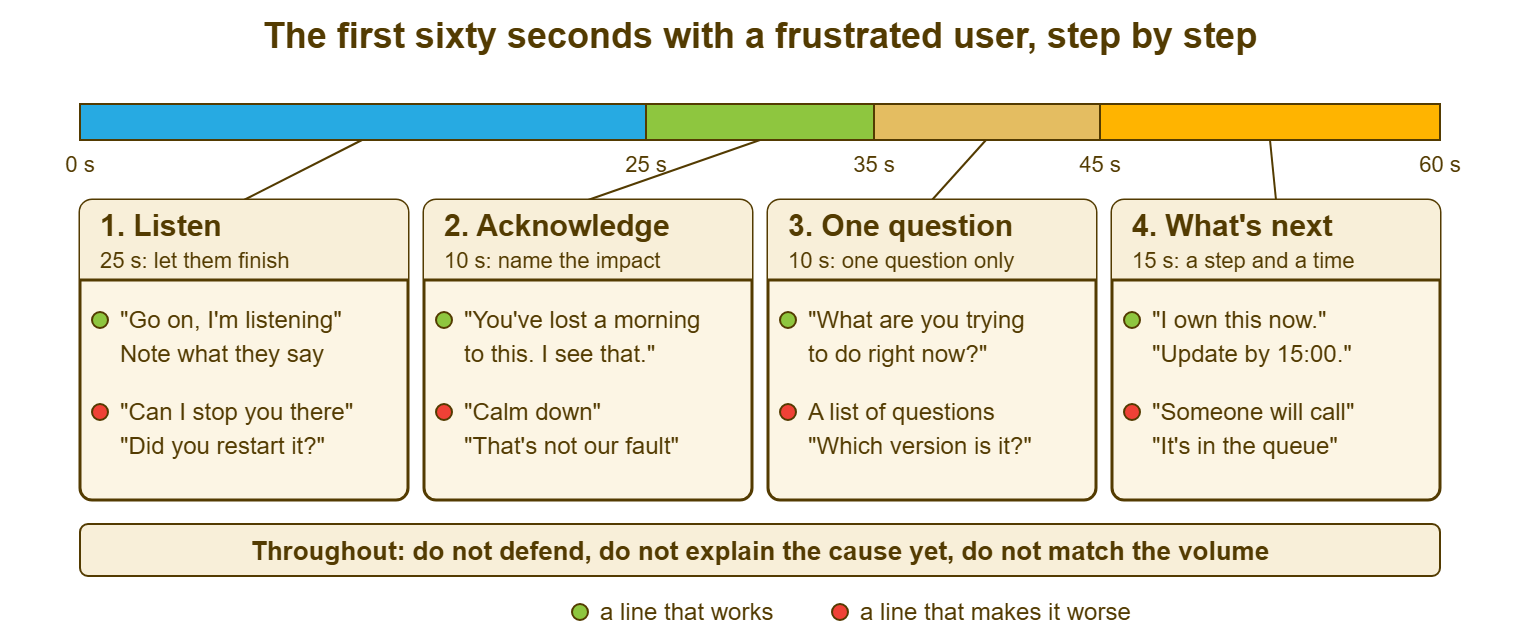
The minute has four moves and one rule, and the order matters. Listen without interrupting. Acknowledge the impact. Ask one question. Say what happens next, with a time. The rule, which runs under all four, is that you do not defend: not yourself, not the desk, not the previous technician, not the vendor. The picture below lays the minute out as a timeline with a line that works and a line that makes it worse under each step. The timings are rough, and the order is not.
Move One: Listen Without Interrupting
The first move is to let the requester finish, and it is the hardest because it means doing nothing while someone is upset at you. On the phone, that means not speaking until there is a real gap, not the half-second pause where they draw breath. In chat, it means waiting for the second and third messages that are coming, because angry people type in bursts. It means not replying to the first burst before the third arrives. In e-mail, it means reading the whole message, including the forwarded chain underneath, before you form a sentence. Twenty or thirty seconds of listening feels like a long time when the other person is angry. It is not; it is the length of one complaint, and the complaint has to be delivered before anything else can happen.
Listening is active, not silent, and the difference shows. On the phone, small sounds that say you are there: "right", "go on", "I'm listening". In chat, a one-line "I'm here and reading, go on" within the first ten seconds, then quiet until they finish. Write down what they say, in their words, while they say it. You will need their words in the next move. The act of writing also stops you composing your reply instead of hearing them. A technician who is composing is not listening, and requesters can tell, even over the phone, in the quality of the "right".
Interrupting, even to help, resets the requester to the start. "Can I just stop you there" is heard as "I have stopped listening", however it was meant, and the requester begins again from the beginning, louder. The particular interruption to avoid is the diagnostic one: "Did you restart it?" Asking that while they are still describing the problem tells them you have classified them as the kind of person who did not restart it. Save every question for move three. There will be exactly one.
Move Two: Acknowledge the Impact
The second move is one or two sentences that show you heard what the problem is doing to them, in their words. Not the fault; the impact. Grace's fault is a frozen screen. Her impact is fourteen people in a queue and a second Monday in a row. "You've got a queue to the door and this is the second Monday running. I can see that." That is the whole move. It is specific, it uses what she said, and it does not promise anything yet. It tells her a human has read the message and understood why it matters, which is what "is anyone actually there?" was asking.
Acknowledgment is not apology and not agreement, and keeping the three apart is what makes it safe to do before you know anything. You can say "you have lost a morning to this" without knowing whose fault the morning is. You cannot yet say "I'm sorry we broke it", because you do not know that the desk did. You should not say "you're right, this is unacceptable", because you do not know that either. What you can always say truthfully is what the impact is, because the requester just told you. The fuller treatment of what to say when it is the desk's fault, when it is not, and when nobody knows yet is in Acknowledging Impact Honestly. In the first minute, stay with the impact and leave the fault for later.
Two phrases that sound like acknowledgment and are not. "I understand how you feel" claims knowledge you do not have and is heard as a script, because it is one. "Calm down" is an instruction, and nobody in the history of the help desk has calmed down on being told to. Both substitute a judgement about the requester's state for a statement about their situation. Say the situation. The requester will supply their own calm when they hear that someone has understood the situation, and not before.
The Rule That Runs Through All of It: Do Not Defend
Underneath all four moves is a rule, and the rule is that nothing in the first minute defends anybody. Not you: "I've only just come on shift." Not the desk: "we did fix it last time, it's a different fault." Not the previous technician: "I don't know why they closed it." Not the vendor, the network, the budget or the weather. Every one of these may be true. And every one of them tells the requester that the desk has heard an accusation and is answering it rather than them. The requester did not ring to allocate blame. They rang because the screen is frozen and fourteen people are watching.
Defending is tempting because being blamed for something you did not do is unpleasant, and the correction is right there. Resist it for the whole minute, and ideally for the whole interaction. The facts that would defend you can come out later, if they are needed at all. They can come in a calm sentence once the fix is under way: "For what it's worth, last week's fault was the server and this one is the kiosk's network cable, which is why it came back." By then the requester can hear it as information. In the first minute it is only ever heard as "not my fault".
The rule has a quieter cousin, which is do not explain the cause yet either. The technician who has recognised the symptom wants to say what it is, because knowing is satisfying and sharing it feels like progress. To the requester it is a paragraph between them and the fix. Save the cause for the end, when they ask, in three sentences, which is the length covered in The Three-Sentence Explanation. In the first minute, the only technical content the requester wants is what happens next.
Remember: in the first minute you listen to the end, name the impact in their words, ask one question, and say what happens next with a time. You do not defend anyone and you do not explain the cause. The fix comes second, and it comes faster for coming second.
Move Three: Ask One Question
The third move is a single question, chosen so that its answer changes what you do next. Not a list of questions, not the triage form read aloud, not "which version of the software is it?" One. For blocked work, the question is usually about the deadline or the workaround: "What's the next thing you need to do, so I can get you a way to do it?" For a repeat, it is about the pattern: "When it went last Monday, was it the same time of day?" For feeling unheard, the question is often "Who have you spoken to so far?", which both gathers the history and shows you intend to read it. Pick the one whose answer you most need and ask it plainly.
One question works where five fail because an angry person experiences a list as an interrogation. And an interrogation is a delay with a form attached. They have just finished explaining the problem; being asked six things they feel they already said tells them nobody wrote it down. (Somebody did. You did, in move one. Use it.) A single question, after the acknowledgment, reads as the start of help. And the requester will usually answer it fully and offer the next three things unasked. The information the triager would normally gather up front is still needed. The discipline of asking for it once, in a form the requester will finish, is in Gathering the Right Information Up Front. In the first minute, you are not triaging. You are earning the right to.
Choose the question that moves the fix, not the one that satisfies your curiosity. "Did you restart it?" is almost never the right one, because if they did it tells you little and if they did not the question has just blamed them. "What does the screen show right now?" is better, because it is about the thing and not the person. The answer also usually tells you whether a restart would help without anyone having to say the word.
Move Four: Say What Happens Next
The fourth move is the commitment, and it has three parts: who, what and when. "I've got this. I'm going to bring the spare kiosk tablet down to you now, and I'll be at the front desk inside ten minutes." Who is you, by name, in the first person. What is the very next concrete step, not the whole plan. When is a time the requester can check, and it must be a time you will keep, which means padding it. If you think five minutes, say ten. A kept ten is worth more than a missed five, by a wide margin, because the whole complaint of a frustrated requester is that times have not been kept.
The commitment ends the minute and starts the work. And it needs to be a sentence the requester can repeat to the fourteen people in the queue. "Someone will be in touch" cannot be repeated to a queue, because it has no who and no when. "It's in the queue" is worse, because it tells them they are a line in a list. "I own this now; you'll have an update from me by quarter past" can be said to a queue. It changes the requester's job from arguing with the desk to waiting for quarter past, which is a job they can do. Honest times, and what to do when you cannot give one, are the subject of Honest ETAs. The short version for the first minute is: commit to the next update, not to the fix.
When you genuinely cannot fix it inside the minute, which is most of the time, the commitment is still the same shape; only the "what" changes. "I'm going to find out whether anyone else is seeing this, and I'll come back to you by 08:20 either way." Either way is the important phrase. It promises contact at a time regardless of progress, which is the thing a frustrated requester has stopped believing in. Then put the time in the ticket, where the next person will see it. Keep it, even if what you say at 08:20 is "no change yet, next update at 08:40". Silence is the one thing you cannot afford, having just promised there would not be any.
Phrases That Work and Phrases That Make It Worse
The table collects the lines that come up in nearly every hot interaction, with the version that helps and the version that does not, and why. Most of the bad lines are not rude; they are scripts, and the requester hears the script. The good lines share three features: they are specific to this requester, they are in the first person, and they contain either an acknowledgment or a next step. A line with none of those is filler, however polite.
| Moment | Makes it worse | Why | Works |
|---|---|---|---|
| They are still talking | "Can I just stop you there" | Heard as "I have stopped listening"; they start again, louder | "Go on, I'm listening." Then write it down |
| Acknowledging | "I understand how you feel" | Claims knowledge you do not have; sounds like a script | "You've got a queue to the door and it's the second Monday. I can see that" |
| Acknowledging | "Calm down" or "there's no need to shout" | An instruction about their state, not a statement about their situation | Say the situation back to them in their words |
| Being blamed | "That's not our fault" or "I've only just come on" | Answers the accusation instead of the person | Say nothing about fault. Move to the impact |
| Gathering facts | "Have you tried restarting it?" | Classifies them as someone who did not; adds nothing if they did | "What does the screen show right now?" |
| Gathering facts | Five questions in a row | An interrogation; implies nobody wrote down what they said | One question whose answer changes what you do next |
| Committing | "Someone will be in touch" | No who, no when; cannot be repeated to a waiting queue | "I've got this. Update from me by 08:20 either way" |
| Committing | "It's in the queue" or "I've raised a ticket" | Tells them they are a line in a list | "I've logged it so it can't get lost, and I'm working on it now" |
| Explaining | "So what's actually happening is..." in the first minute | A paragraph between them and the fix | Save the cause for when they ask; three sentences, at the end |
Notice that the ticket is never the villain and never the hero. Raising one is right, because it is how the work survives a shift change and how the history that defends the desk later gets written. Announcing it as the main event is wrong, because to the requester a ticket number is a receipt, and nobody standing in front of fourteen patients wants a receipt. Log it, say you did in half a sentence so it cannot get lost, and move on.
The Same Minute on the Phone, in Chat and by E-mail
The four moves are the same in every channel and the timing is not. On the phone, the minute is a real minute, and the hard part is move one, because silence on a call is uncomfortable and the requester can hear you breathing. Fill it with the small sounds of listening, not with words. The commitment at the end is spoken and then immediately written into the ticket. A spoken time that is not written down is a time that will be remembered differently by both parties. Phone also lets you hear the rung directly, which is an advantage chat and e-mail lack. Volume, pace and the words they lean on tell you how far up the ladder they are before they have finished the first sentence.
In chat, the minute is stretched and the moves are typed, which gives you time to think and takes away your tone. Reply to the first message within seconds with one line that says you are here and reading. Then wait for the burst to finish; three or four messages is normal. Acknowledge in one message, ask the one question in the next, and commit in the third. Keep each message to two lines, because a wall of text in a chat window reads as a template even when it is not. Resist the typing indicator trap, where you start a reply, delete it, and start again. In that trap, the requester watches "typing..." for ninety seconds and concludes you are drafting an excuse. Decide the sentence, then type it. If you run QuerySolv, the chat and the e-mail that follows it from the same requester are both ordinary tickets in the same queue. That means the minute you spend in chat is written into the same history the next person will read, rather than vanishing when the window closes.
By e-mail, the minute is a reply, and the reply has to do all four moves in six or seven lines because there is no back-and-forth. Open with the acknowledgment, not a greeting template. Ask the one question as a question, on its own line, so it is seen. Commit with a time, in bold if your mail allows it, and put your name under it rather than the desk's. The failure mode in e-mail is the opposite of chat: too much, not too little. A long reply to an angry e-mail reads as a defence even when every paragraph is helpful. Six lines, one question, one time, your name. The tone to hold across all three channels when the heat is up is the subject of Tone in Hard Moments. The structure here is what the tone is carried on.
When the Minute Ends and Nothing Is Fixed
The minute almost never ends with the problem solved, and it does not need to. It ends with the requester knowing that a named person has understood the impact, asked something sensible, and committed to a time. That is enough to turn the next twenty minutes from an argument into a wait. And a wait is survivable in a way an argument is not. What you owe them after the minute is the time you promised, kept, and then the next time, kept, until the fix lands. Each kept time repays a little of the trust the earlier tickets spent.
Write the minute into the ticket as you go, as an internal note rather than a public reply. That way, the next person who touches it knows the impact, the rung, the one question's answer and the time you promised. "Grace, front desk, 14 patients queueing, second Monday running, promised update by 08:20." Twenty words, and the colleague who picks it up when you are under a desk with a network cable can keep your promise for you. A promise that lives only in your head is a promise the desk cannot keep when you are busy. You will be busy, because you just took on a frozen kiosk with a queue behind it.
A Short War Story: The Till at Northgate Retail
Simone managed Northgate Retail's busiest store. On a Saturday morning the second till stopped taking card payments with a queue of eleven at it. So she rang the desk and got Felix, who had been on the desk for three weeks and knew the till system well. Felix recognised the symptom at once and said so: "Ah, that's the payment terminal losing its pairing, it does that after the overnight update, you need to go into the settings menu, hold the function key..." Simone was standing at the till with eleven people watching her hold a phone to her ear. She said "I don't care what it is, I've got a queue." Felix, stung, said the fix would only take a minute if she would let him explain it. The call went downhill from there for four more minutes before the store's assistant manager took the phone and did the steps. The till was down for nine minutes, of which the steps took one and the argument took the rest. The store's weekly survey carried a complaint about "IT lecturing us while customers walked out". Felix had been right about the fault from the first second. The lesson his desk wrote up afterwards was that being right in the first minute is worth nothing until the requester knows you have heard them. The fix would have landed in sixty seconds if it had come after an acknowledgment and a "stay on the line, I'll walk you through it, you'll be taking payments in two minutes" instead of before.
The Opening Lines
The lines below are the first minute as a script you can keep beside the phone or paste into a chat window and adapt. They are deliberately plain and deliberately short, because the requester's words go in the gaps, and the gaps are the point. Use the version for your channel, fill the blanks with what the requester actually said, and never send a blank unfilled. A template that still says "[impact]" in it is worse than no template, and it has been sent, by people who were in a hurry, more than once.
OPENING LINES — THE FIRST SIXTY SECONDS

PHONE
  Listen:       let them finish; small sounds only, such as "right" and "go on"
  Acknowledge:  "You've got ______________ and this is ______________. I can see that."
  One question: "______________________________________________________________?"
  Next step:    "I've got this. I'm going to ______________ now, and I'll
                 be back to you by ____:____ either way."
  Then write the impact, the answer and the time into the ticket before doing anything else.

CHAT
  Within seconds:  "I'm here and reading, go on."
  After the burst: "You've got ______________ and it's ______________. Understood."
  Next message:    "One question so I do the right thing first: ______________?"
  Next message:    "I own this now. I'm doing ______________ and you'll hear
                    from me by ____:____ either way."
  Keep each message to two lines. Decide the sentence, then type it.

E-MAIL
  Line 1:  "I've read this and I can see that ______________ (impact, in their words)."
  Line 2:  "I've taken ownership of it."
  Line 3:  "One question so I start in the right place: ______________?"
  Line 4:  "I'm doing ______________ now."
  Line 5:  "You'll have an update from me by ____:____ on ________, whatever the progress."
  Line 6:  Your first name, and a way to reach you directly.
  Nothing about cause, fault, or previous tickets. Six lines.

DO NOT SEND OR SAY
  "Calm down"     "I understand how you feel"     "That's not our fault"
  "Have you tried restarting it?"     "Someone will be in touch"     "It's in the queue"

AFTER THE MINUTE
  Internal note: who, impact, rung, the answer to the one question, the time promised.
  Keep the time. If nothing has changed, say so at the time, and give the next time.
Hana did not type "have you tried refreshing" that Monday. She typed "I'm here and reading, go on," waited for the second message ("fourteen people, Grace, it's the kiosk by the door"), and then: "You've got a queue to the door and it's the second Monday running. Understood. One question: is the kiosk screen frozen on the check-in page, or blank?" Frozen. "I own this now. I'm bringing the spare tablet down so you can check people in from that while I look at the kiosk. I'll be with you inside ten minutes." She was there in seven, and the queue was moving in nine. And the kiosk's cable, which had been crushed by the door's floor guide, was replaced that afternoon. Grace's message at 08:31 said "thank you, that was quick". Hana has it pinned above her desk, next to the lines.
Frequently Asked Questions
What if the requester will not stop talking long enough for me to say anything?
Is it dishonest to acknowledge the impact before I know whose fault it is?
What if the one question they need is "did you restart it"?
How do I give a time when I have no idea how long the fix will take?
Does this work when the frustrated user is a senior manager?
Should I use the opening lines word for word?
From the QuerySolv team: we build self-hosted help desk software for Windows. QuerySolv runs as one Windows service on your own network. It takes requests by web form, e-mail, live chat, social messages and REST API. It is licensed once per installation rather than per agent per month. The free trial runs the full product for 30 days.