
Staying on the Desk by Choice: A Career in Support
Thursday, 15:05, at Tollgate Foods. Mei has been on the desk for nine years and is, by any measure the desk keeps, the best technician it has. She has the lowest reopen rate, and writes the notes other people copy. She is the one the depot managers ask for by name and the one the new starters are sat next to. Howard, the IT manager, has just asked her, for the fourth time in three years and with every good intention, whether she has thought about moving into infrastructure. "No," she says, again. "I like it here." Howard nods, again, and goes back to his office. Mei goes back to a ticket about a label printer. She is aware that the question has started to sound like "when are you leaving?" That is not what he means and is exactly what it does.
Staying on the desk by choice is a career, not a failure to leave. It has three paths with real work in them. The senior technician owns the desk's hardest tickets and its standards. The team lead owns its people and its numbers. And the specialist owns the knowledge base, the automation or the training that the desk runs on. Each is a job with a title, a description and a case for a grade. And the desk that does not offer them loses exactly the people it most needs to keep. This article is part of our The Helpdesk-to-Sysadmin Ladder series, which draws the side path beside the ladder rather than below it. The rest of the series is about climbing, and this article is about the people who, having looked at the ladder, choose the desk.
It covers why "no" is not a confession and why the desk needs people who stay. Next come the senior technician path, the team lead path, and the specialist paths. We cover being paid for it in principle, then making the choice visible, then a short war story. We finish with the senior technician role outline, a one-page template for turning the choice into a role with a name, in that order.
"No" Is Not a Confession
The question "have you thought about infrastructure?" carries an assumption that the person asking rarely notices. The assumption is that the desk is a place people pass through, and that a good technician who stays must have been unable to leave. That assumption is wrong about most of the technicians who stay, and it is wrong in a way that costs the organisation. People stay on the desk because they like the people, the variety, the thirty small completions a day, and the sense of the whole organisation that nobody in the server room ever gets. Those are not consolation prizes. They are the reasons the job exists.
Infrastructure is a different job, not a better one, and the rungs in What the Helpdesk-to-Sysadmin Ladder Looks Like are ordered by blast radius, not by worth. A sysadmin's week is planned, quiet and lonely in the way planned work is, with one completion a fortnight and nobody at the end of it. A technician who wants that should go and get it. A technician who would hate it, and many would, is not being modest when they say no. They are describing themselves accurately, which is the most useful thing a person can do at a review. The honest answer to Howard's question is a sentence, and Mei has been giving it for three years. The organisation's job is to hear it and build something for her to stay in.
The Desk Needs People Who Stay
A desk where everyone good leaves within three years is a waiting room with a queue attached. And it fails in ways that never show on the dashboard. The knowledge walks out every spring with the best technician of the year. So the desk re-learns the label printers and the depot managers from scratch, each time a little worse. The new starters have nobody to sit next to who has been there longer than eighteen months. So the standards drift, the notes get shorter, and the reopen rate creeps up by amounts nobody connects to the leavers. And the users, who are better at noticing than any metric, stop learning technicians' names, because the names keep changing. They start phoning the one person who has stayed. The audit of what a desk loses when its expert leaves is in When the Expert Leaves. A desk with no one who stays runs that audit every year.
The people who stay are the desk's memory, its standard and its teacher, whether or not they are paid as any of those. Mei is why the depot managers trust the desk and why the new starters write usable notes by their second month. She is why a label printer ticket at Tollgate is a twenty-minute job rather than an afternoon. None of that is in her job description, which says "first-line technician", the same title she had nine years ago. The organisation is getting a senior technician's work at a first-line title and considers itself fortunate, which it is, right up until a competitor offers her the title.
The honest opinion: a desk should want a third or so of its people to be long-stayers, and should be building roles for them from the day it notices who they are. That is not sentiment. It is the cheapest form of knowledge retention there is, and it is the only one that also teaches the juniors.
The Senior Technician Path
The senior technician owns the desk's hardest tickets and its craft. They are the escalation point before the sysadmin, which means the ticket that first line could not finish goes to them first. Most of those tickets never need to go further. They own the standards: what a note looks like, what a reply sounds like, what gets linked to what, and when a repeat ticket becomes a problem record. They mentor, which means the new starter is sat beside them and the first thirty days are shaped by them. And they own the runbooks for the things the desk does repeatedly, which they wrote, because they were the ones who had done each of them twenty times.
It is not first line with a longer badge, and the difference is in what the role is accountable for. A first-line technician is accountable for their own tickets. A senior technician is accountable for the desk's tickets being done well, which is a different thing. It means reading other people's notes, and taking the escalation that a junior got stuck on and working it with them rather than for them. It also means saying, out loud and in writing, "this is the fourth of these this month, and it is a problem record now". The senior technician who does the hard tickets alone and teaches nobody is a hero, in the sense this library uses the word. And a hero is a risk with a desk attached. The senior technician who works them with the junior watching is building the desk's next memory.
The time splits roughly, and it should be written down. Perhaps half the week goes on tickets, the hardest ones. A fifth goes on mentoring and reviewing notes, and a fifth on the knowledge base and the runbooks. The rest goes on problem records and the conversation with the sysadmin about causes. Those proportions are a starting point for a desk of five or so, not a rule. And the role outline at the end of this article leaves them blank for a reason. What matters is that the mentoring and the writing are in the description, because work that is not in the description is work that the queue will eat.
The Team Lead Path
The team lead owns the desk's people and its numbers. They own the rota, the cover, the coverage calendar, the hiring, the first week, and the thirty-day review. They own the monthly report and the conversation with management about what the numbers mean. And they own the hard conversations, with the technician who is struggling and with the department that is abusing the desk. It is the path for the technician who found, somewhere in year four, that they cared more about whether the desk was working than about whether their own queue was empty. That technician kept noticing that nobody else was watching the rota.
What you give up is most of the tickets. A team lead who still works a full queue is a technician with a meeting problem. And a lead who stops working tickets altogether forgets what the queue is like. So the honest split is a small share of tickets, chosen to keep the hand in, and the rest on the desk as a system. What you take on is the manager's responsibilities, which on a desk are specific and unglamorous. They include pacing the load so that nobody burns out and defending the half day that the shadow arrangement needs. They include reading per-technician numbers for coaching rather than ranking. Those duties are set out in The Manager's Responsibilities. And a technician considering the lead path should read that article first, because it describes the job more accurately than most advertisements for it.
The numbers deserve a sentence of their own. A team lead sees every technician's figures, and the temptation to rank is strong because ranking is easy and coaching is slow. Where the tool produces per-technician reports, as QuerySolv does, they are there for the coaching conversation, with a minimum sample before any figure is read. A lead who posts them on a wall has learned the wrong lesson from the dashboard. The lead's measure of success is the desk's numbers moving, the juniors improving, and the long-stayers staying. None of those fits on a leaderboard, which is one of the better arguments against leaderboards.
The Specialist Paths
The specialist paths are for technicians who found one part of the desk's work more interesting than the rest and got good at it. And there are three that most desks can support. The knowledge base owner keeps the articles navigable, named, current and used. That is a job on any desk with more than a few dozen articles and is the subject of Every Article Has a Name on It. A desk where nobody owns the knowledge base has a knowledge base that is rotting at a rate nobody measures. The automation specialist owns the scripts and the scripted fixes. They turn the ten things the desk repeats every week into things that run with a click, safely, with guardrails and records. The trainer owns the first thirty days, the shadowing and the ticket review. That is the part of the desk that decides whether the next hire is any good by month three. The method is in Shadowing That Actually Teaches.
| Path | What it owns | What it produces | How you know it is working | Who it suits |
|---|---|---|---|---|
| Senior technician | The hardest tickets, the standards, the runbooks, the first escalation | Resolved escalations, usable notes across the desk, problem records raised | The reopen rate falls; juniors' notes improve; the sysadmin sees fewer tickets | The technician others already ask |
| Team lead | The people, the rota, the numbers, the conversation with management | A covered desk, a readable monthly report, coached technicians | Load is paced; nobody is a hero; long-stayers stay | The technician who watches the rota nobody asked them to watch |
| Knowledge base owner | The articles, their names, their currency, their use | A navigable base that answers before the ticket | Searches find things; deflected tickets rise; stale articles are rare | The technician who rewrites other people's articles unasked |
| Automation specialist | The scripts, the scripted fixes, their guardrails | Repeated fixes that run safely with a record | Hours come back to the desk and can be counted | The technician who wrote a loop for the forty accounts |
| Trainer | The first thirty days, the shadowing, the ticket review | New technicians who are useful by month three | Time to first unassisted close falls; the juniors stay | The technician the new starters are always sat beside |
Most desks of fewer than ten people cannot afford five specialist roles, and do not need to. The usual shape is one senior technician who carries one or two of the specialisms, and a team lead, with the rest shared. A desk of three has one person who is the senior technician, the knowledge base owner and the trainer before lunch. The point of naming the paths is not to create five jobs. It is to make sure that the work each path does is in somebody's description, so that it survives a busy quarter.
Being Paid for It in Principle
A career has three parts: a title, a description and a grade, and the desk career fails when any one of them is missing. A senior technician with the title and no description is a first-line technician who is asked to do more. One with the description and no grade is being paid as a junior for a senior's work, and will eventually be told so by a recruiter. What the grade is worth, how it compares to the junior administrator grade, and whether it is a pay rise or a band change, vary by place and by contract. This article names no figures. The principle is that a role with the senior technician's accountabilities is paid as a senior role. An organisation which pays for the desk career only when someone resigns has chosen the most expensive way of paying for it.
The case to the organisation is made with the role outline, the evidence and the cost of replacement, in hours. For a worked example, when Tollgate's previous senior-in-all-but-name left, the desk lead estimated the cost at something between three and five hundred hours over the following year. That included the hiring, the thirty days of shadowing for the replacement, and the label-printer fixes that took afternoons instead of minutes. It also included the knowledge re-learned from tickets that should have been articles. Those are one fictional desk's figures, stated as an example, and the shape holds elsewhere. The hours of a senior technician's departure are large, spread across a year, and attributed to nothing, which is why nobody budgets for them. The role outline puts a title and a grade against work that is already being done. That is not a new cost. It is a cost the organisation is already paying, in a form it cannot see.
Make the case before the resignation, not in response to it. A grade created to match a competitor's offer is a grade the technician knows was not offered freely. And most take the competitor's anyway, for the sound reason that the competitor valued them first. A grade created because the manager read the role outline and recognised Mei in it is a career, and careers are what people stay in.
Making the Choice Visible
Say it, in writing, on the ladder card: "staying, by choice", with the path named and the evidence for it. A technician who says "I like it here" at every review and nothing else is leaving the organisation to guess. The organisation will guess "passing through", because that is what the ladder looks like from an office. A technician who says "I want the senior technician path, here is the work I already do that belongs to it, and here is what I would take on" has handed the manager a role to create. Howard had asked Mei the infrastructure question four times because it was the only career question he had. The card gives him a second one.
The picture below is the ladder from the first article in this series, and it is here for the side path. The senior technician or team lead box sits to the right of the second rung, in a different colour. A dashed arrow back to the ladder says the later move is still open for those who change their mind. Keep the picture in mind at the review, because the conversation about staying goes better when both people can see that staying is a direction on the drawing and not the absence of one.
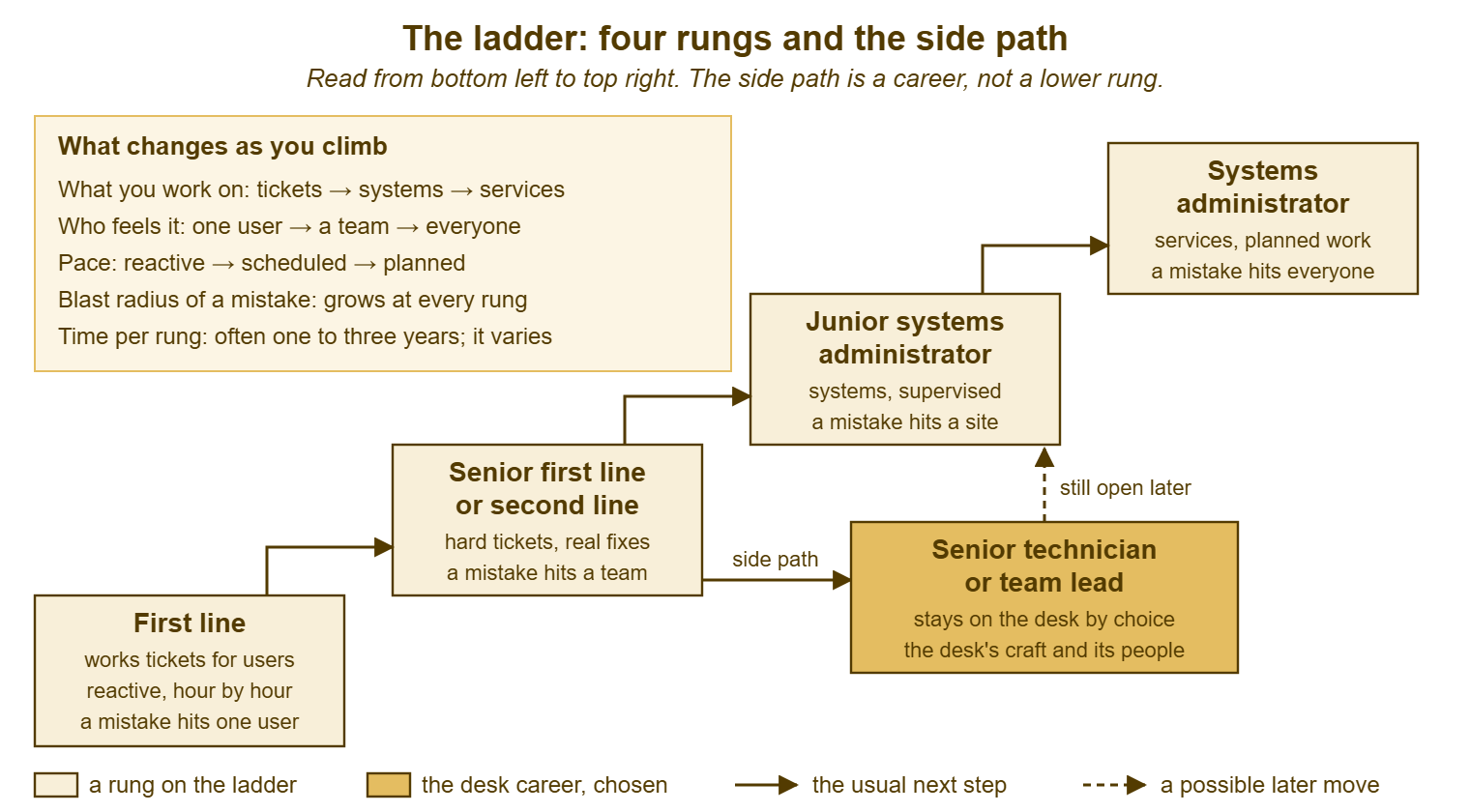
The dashed arrow matters more than it looks. A senior technician may, in year twelve, decide they would like infrastructure after all. In that case, they arrive at the junior administrator rung with more of the map, more change discipline and more runbooks written than almost anyone who climbs the ladder directly. A sysadmin would be glad of them. Staying by choice is not a door closing. It is a different room, and the corridor is still there.
Remember: the desk career exists only if it has a title, a description and a grade. Write the role outline before anyone resigns, and put the work that is already being done into it. And ask the technician who stays to say so on the card so that the organisation can stop guessing.
A Short War Story: The Title That Came From Elsewhere at Tollgate Foods
Before Mei, the desk at Tollgate Foods had Dev. He had been its best technician for eleven years under the title "first-line technician" because the company had never created another one. He had declined the infrastructure question, politely, every year of the last six. In his twelfth year a food-distribution competitor offered him the title of senior support technician, a description that read like the work he already did, and a grade to match. He accepted it in a week, which surprised everyone except the desk lead. The lead had been asking for the role to be created for three years and had been told that Dev seemed happy. The reopen rate at Tollgate roughly doubled over the following six months. The new starters' first thirty days became a thing the desk lead did between tickets. The label-printer fleet, which Dev had known by serial number, generated an afternoon's work per fault instead of twenty minutes. The lead put the year's cost at several hundred hours. The finance director, who had signed off the refusal, asked why nobody had warned him. Tollgate created the senior technician role four months after Dev left, for the person who replaced him, at the grade the competitor had offered. That was the most expensive possible route to the same job description. A career inside support exists on paper or it exists at another employer; the only choice the organisation gets is which.
The Senior Technician Role Outline
The role outline is one page. And it is written by the technician and the manager together, because the technician knows what the work is and the manager knows what the organisation can sign. It names the purpose and what the role owns. It names what the role does not own, which is as important for keeping the role from becoming "everything". It names how time is split, how the role is measured, where it reports, and what the title and grade are. Leave the proportions and the grade blank until the conversation. Fill the ownership lines in from the work the technician already does, because that is the argument. The same outline, with the ownership lines changed, serves for the team lead and the specialist paths. And the organisation that writes one for each has a career ladder for the desk that does not point at the server room.
SENIOR TECHNICIAN — ROLE OUTLINE (ONE PAGE)
Title: ______________________   Grade / band: ______________   Reports to: ______________________
Drafted by: ______________ (technician) and ______________ (manager)   Date: ____________   Review: ____________

PURPOSE
   The desk's hardest tickets are resolved well, its standards are kept, its knowledge is written down,
   and its newer technicians learn from someone who has done the work.

THE ROLE OWNS
   [ ] The first escalation point: tickets first line cannot finish come here before the sysadmin
   [ ] The desk's standards for notes, replies, linking and closure, and the review of them
   [ ] The runbooks for the desk's recurring work, and their currency
   [ ] Raising problem records when a repeat ticket becomes a cause
   [ ] Mentoring: the new starter's first thirty days, shadowing and the ticket review
   [ ] One specialism carried by this role:  [ ] knowledge base  [ ] automation  [ ] training  [ ] none

THE ROLE DOES NOT OWN
   [ ] The rota, cover and hiring (team lead)
   [ ] Shared systems and their changes (sysadmin); the senior works them with, not instead of
   [ ] Every hard ticket alone: escalations are worked with the junior who raised them where possible

TIME, AS A STARTING POINT (adjust at the review)
   Tickets, the hardest: ____%    Mentoring and note review: ____%
   Runbooks and knowledge: ____%   Problem records and causes: ____%

HOW THE ROLE IS MEASURED (for coaching, never ranking; minimum sample before reading)
   Escalations resolved without the sysadmin: ______   Reopen rate across the desk: ______
   Runbooks written and used: ______   New starters' time to first unassisted close: ______

EVIDENCE THIS WORK IS ALREADY BEING DONE
   1. ______________________________________________________________
   2. ______________________________________________________________
   3. ______________________________________________________________

AGREED
   Technician: ______________   Manager: ______________   Effective from: ____________
Mei and Howard wrote hers on a Friday afternoon, with the ownership lines filled in from nine years of work. The grade was left blank for the conversation Howard was going to have upstairs. He had the finance director's question from the Dev year to help him. The title arrived in the spring. Howard has not asked about infrastructure since, because he has a better question now, which is what the desk needs from her next.
Frequently Asked Questions
Is staying on the desk a sign that I lack ambition?
My organisation has no senior technician title. How do I get one created?
Can I be a senior technician on a desk of three?
Should the senior technician be measured on their own ticket numbers?
What if I stay by choice and change my mind in five years?
How do I stop the senior technician role from becoming "the hero"?
From the QuerySolv team: we build self-hosted help desk software for Windows. QuerySolv runs as one Windows service on your own network. It takes requests by web form, e-mail, live chat, social messages and REST API. It is licensed once per installation rather than per agent per month. The free trial runs the full product for 30 days.