
What the Helpdesk-to-Sysadmin Ladder Looks Like
Tuesday, 17:40, at Ashgrove Housing. Nadia has been on the desk for nineteen months. She has closed something over two thousand tickets and can clear a lockout in under a minute. She knows which of the forty-one housing officers will phone before reading the reply. Her annual review was this afternoon. "Where do you want to be in a couple of years?" "I'd like to be a sysadmin." "Great. Get some experience and we'll talk." She is back at the desk now, looking at the queue. There are fourteen password resets, a printer in the tenancy office, two new starters for Monday, and a shared folder somebody cannot see. Nothing in it says "experience" on the label.
The helpdesk-to-sysadmin ladder is the sequence of roles a technician moves through from answering the queue to running the systems the queue is about. It has four rungs in most organisations, whether or not anyone has written them down. They are first line, senior first line or second line, junior systems administrator, and systems administrator. Each rung changes what you work on, who feels your work, how the work arrives and how big a mistake can get. This article is part of our The Helpdesk-to-Sysadmin Ladder series. The series covers the ladder itself, the skills to build while still on the desk, and the tickets that teach infrastructure. It also covers certifications, making the jump, and staying on the desk by choice.
It covers why nobody draws the ladder, the four rungs in turn, and what changes as you climb. Then we cover the side path for the technician who stays, honest timescales from three fictional careers, and what the ladder is not. A short war story follows. We finish with the ladder card, a one-page template for working out where you are and what the next rung needs.
Why Nobody Draws the Ladder
"Get some experience" is what a manager says when they cannot describe the route, and most cannot, for an honest reason: they did not take it. Many desk managers came up through the desk and stopped there by choice. That is a fine career and the subject of Staying on the Desk by Choice. Many sysadmins arrived from somewhere else entirely and never worked a queue. Neither can draw the rungs between the two, because neither stood on them. The people who did climb the whole ladder mostly did it by accident, when someone above them left. An accident is hard to turn into advice.
The ladder exists anyway. Any organisation with both a queue and a server room has a gap between them, and that gap has a shape. The tickets get harder, and the things you touch get more shared. The work gets more planned, and the cost of being wrong goes up. Those four changes happen in the same order everywhere I have seen them. That includes a bank with a sixty-person IT department and a housing association with four. What differs is whether the rungs have names, titles and pay grades attached, or whether a person simply finds themselves doing rung-three work with a rung-one badge. Drawing the ladder is the first job, because a route you can see is a route you can ask for.
Rung One: First Line
First line is the person who takes the ticket first: the one who answers the phone, reads the e-mail, and meets the walk-up. They either fix the thing or find out enough to pass it on. The work is the queue, the users and today. A first-line technician's week is measured in tickets, and the good ones close a great many of them, mostly by knowing the organisation. They know which application finance lives in and who sits where. They know what the warehouse scanners do when the wireless drops, and which of the forty-one housing officers will phone.
What first line teaches is the user, and nothing else on the ladder teaches it. You learn what the systems look like from the outside and where people get stuck. You learn what "slow" means to someone with a queue of tenants at the counter. You also learn how to write a sentence that a stranger under pressure will understand. Every sysadmin I have trusted learned those things here. The ones who skipped the rung are the ones who schedule the change window for nine on a Monday morning. Nobody ever told them what nine on a Monday is like at a desk.
The limit of the rung is that you fix the instance, not the cause. You touch the user's device and the user's account; you do not touch the shared thing behind them. The printer is restarted, the mapped drive is reconnected, the password is reset, and the server that made them fail is somebody else's. The blast radius of a mistake means how many people feel it when you get something wrong. Here it is one user. The mistake shows up within the hour, usually in the form of the same user phoning back. That is the safest place on the ladder to be wrong, which is exactly why it comes first.
Rung Two: Senior First Line or Second Line
The second rung has two names because organisations build it two ways. Senior first line is the same queue with the hard tickets and the newer technicians routed to one experienced person. Second line is a separate queue that first line escalates to, staffed by people who no longer answer the phone. Small desks blur the two, and a desk of three usually has one person who is both, whichever title they hold. How the tiers are drawn is the subject of L1, L2 and L3 in Practice. For the ladder the difference matters less than what the rung has in common either way.
The work is the tickets first line could not finish, and the fixes rather than the workarounds. A first-line technician reconnects the mapped drive; a second-line technician finds out why it dropped and stops it dropping. The shared things come into reach for the first time. These include the print server's queues and the folder permissions. They also include the group that grants access to the finance application and the policy that sets the drive mapping. You are still working tickets, but the tickets now lead behind the user's screen into things that other people depend on.
The blast radius grows to a team. Change the wrong group and forty people lose the finance application at once, which is a different kind of afternoon from one user phoning back. This is the rung where change discipline is learned, because the mistake is now visible. Here a technician discovers that the first question before touching a shared thing is "who else uses this?" On a desk with claim-based ownership, the queue shows who holds each ticket, as it does in QuerySolv. In that case, this is also the rung where a name starts appearing on the hard tickets. That visibility is how the rung gets noticed by the people who decide titles.
What second line teaches is the map: which system feeds which, where the directory ends and the application begins, and what breaks when each thing is down. It also teaches the escalation conversation from the receiving end. A second-line technician learns quickly which first-line notes are worth reading and which are "user says broken". They spend the rest of their career writing the first kind.
Rung Three: Junior Systems Administrator
A junior systems administrator owns parts of systems under supervision. The word "owns" is the change. A server, a service or a routine is now yours to keep running, not yours to fix when a ticket arrives about it. The work is named systems and the routine around them. That means patching, checking the backups ran, and provisioning accounts at the directory rather than the user end. It also means the certificate calendar, the storage that is quietly filling, and the tickets second line escalated because they needed someone with the keys.
Two things are new at once, and both unsettle people who were good at the desk. First, nobody is standing behind you with a ticket. The work arrives as a schedule and a calendar rather than as a queue. And the day has gaps in it that a first-line technician has never seen. Second, mistakes are slow to show. A bad change at the desk phones you back within the hour. A bad change to a backup schedule shows up the day somebody needs a file from last month. The feedback loop that taught you everything on the first two rungs is gone. You have to build its replacement yourself out of checklists, change records and a habit of looking at things before they complain.
The supervision is not a lack of trust; it is the feature that makes the rung survivable. A senior administrator reads your change before you make it and stands beside you for the dangerous step the first few times. They take the call when it goes wrong. The blast radius is now a site or a service. And the organisation is lending you that much risk on the understanding that someone with a longer memory is checking. Take the review as a lesson rather than an insult. In a couple of years you will be the one reading somebody else's change at four on a Friday, wondering whether to let it through.
Rung Four: Systems Administrator
A systems administrator owns services: the things the organisation names when it says "e-mail is down" or "the file server is slow". They own them end to end. That includes what they run on, how they are recovered, when they are changed and what they will need next year. The work is design, capacity, the change calendar, the vendor relationship, the recovery plan, and the small number of tickets nobody else could resolve. The work is problems rather than incidents, in the language of Problems vs Incidents. It is not "the print server fell over" but "the print server has fallen over three times this quarter, and here is why it will not fall over a fourth".
The week is planned and the interruption is the exception, which is the exact inverse of first line. A sysadmin who spends the day in the queue has either a staffing problem or a service problem, and should find out which. The blast radius is everyone, and the mistake can take weeks to surface. So most of the job turns out to be deciding what not to change, and when, and who to tell first. People who climbed the ladder for the technical work are sometimes surprised to find that the top rung is largely writing. The writing is the technical work. It just does not look like it from the desk.
What the top rung teaches is judgement about risk. It teaches this by making you the person whose change everybody else's depends on. It is also the rung from which the ladder gets drawn for the next person, if anyone is going to draw it. The sysadmin who takes a second-line technician through a certificate renewal is doing more for the organisation's future than the renewal is.
What Changes as You Climb
Four things change at every rung, in the same direction each time. Once you can see them you can place yourself on the ladder without a title to help. What you work on goes from tickets to systems to services. Who feels your work goes from one user to a team to everyone. How the work arrives goes from reactive to scheduled to planned. And the blast radius of a mistake grows at each step. That is why the rungs come in this order and why skipping one is dangerous rather than merely ambitious. The table puts the four side by side, with a fifth row for what a good day looks like. That is the row most people recognise themselves in first.
| Rung | What you work on | Who feels a mistake | How the work arrives | What a good day looks like |
|---|---|---|---|---|
| First line | Tickets: the user's device, account and question | One user, within the hour | The queue, all day, as it comes | Many tickets closed, nothing waiting overnight |
| Senior first line or second line | The hard tickets and the shared things behind them | A team or a department, within the day | Escalations and the fixes behind repeat tickets | Three problems fixed for good, two juniors taught |
| Junior systems administrator | Named systems and their routine, under supervision | A site or a service, sometimes weeks later | A schedule and a calendar, with escalations on top | A change made as written, with nothing to report |
| Systems administrator | Services end to end: design, capacity, recovery | Everyone, and the organisation's reputation | Planned work; interruptions are the exception | A plan written, a risk removed, no tickets at all |
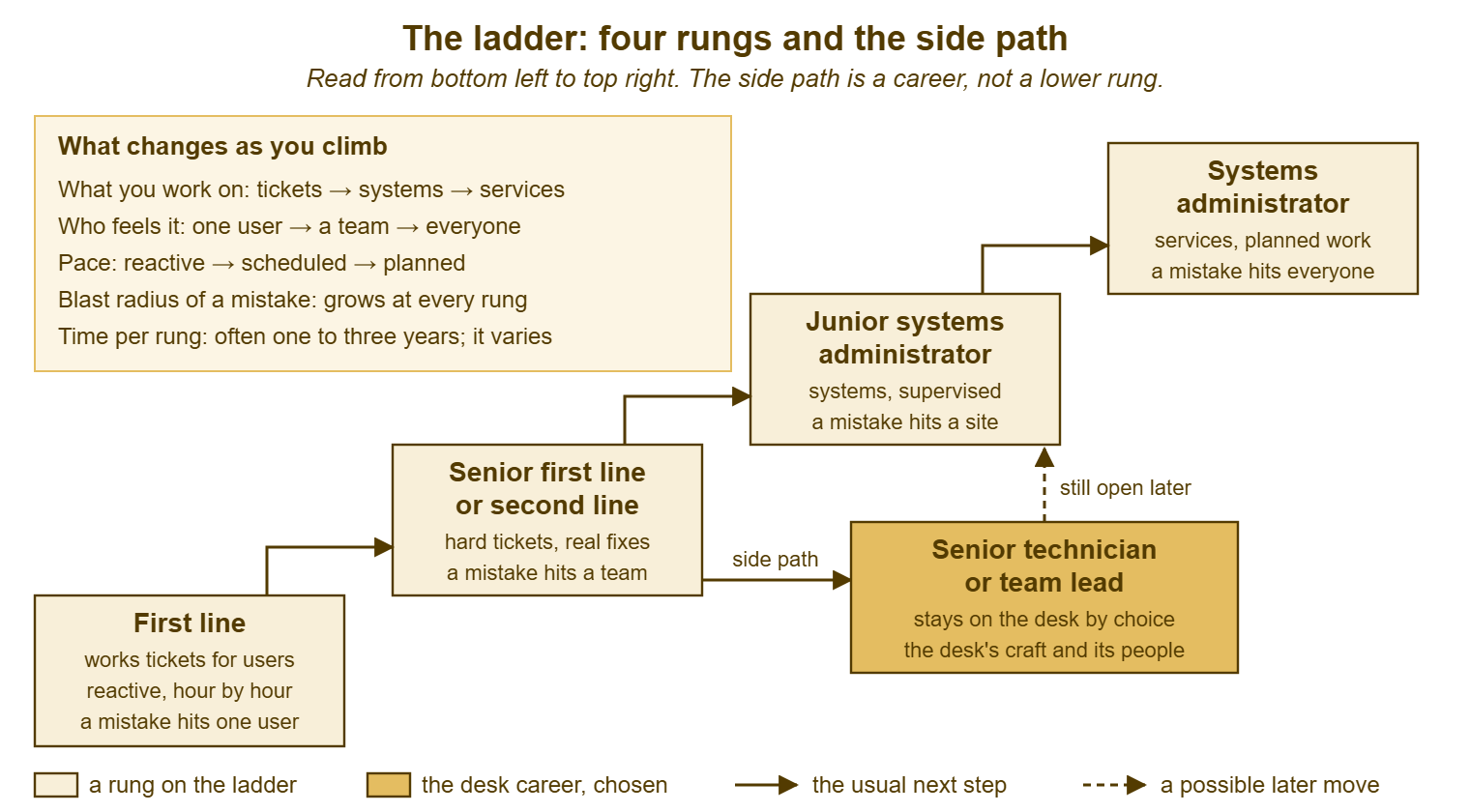
The picture below draws the same ladder as a staircase, reading from bottom left to top right, with the four changes in a panel. The side path, which the next section explains, leads off from the second rung. If the table is the reference, the picture is the one to keep in your head during the review meeting.
The Side Path
From the second rung a path leads sideways rather than up, to the senior technician or team lead. This person stays on the desk by choice, owns its hardest tickets and its standards, and teaches the newer technicians. If they take the lead role, they run the rota and the numbers. The picture draws the side path to the right of the ladder rather than below it, and the placement is deliberate. A senior technician is not a second-line technician who failed to leave. They are the reason the desk still works when the sysadmin is on leave. A desk that treats the role as a waiting room loses exactly the people it most needs to keep.
The side path is also not a dead end. A senior technician who later wants infrastructure has, by then, more of the map and more of the change discipline than most junior administrators start with. And the dashed arrow in the picture is there to say so. The whole of that path, what it looks like and how to make it a career with a title attached, is in Staying on the Desk by Choice. The rest of this article is about the rungs. But the side path belongs on every drawing of the ladder, because the question "do you want infrastructure?" has two good answers.
Honest Timescales
How long each rung takes is the question everyone asks and nobody answers. So here are three fictional careers, invented to show the range rather than to set a standard. Priya joined the desk at Bluewater Bank with no experience. Priya spent two years on first line, three on second line, and two as a junior administrator. Priya was a systems administrator at seven years. Marcus joined a two-person IT department at a parts distributor and spent fourteen months on first line. He became the junior administrator at two years when the only sysadmin left. He then stayed "junior" for four more because there was nobody above him to supervise anything and the title had nowhere to go. Lena worked first line at a large insurer for four years, because the second line there was a separate team with its own hiring. Lena then worked three years on that second line, then two as a junior administrator elsewhere, and reached the top rung at nine.
The honest range for a rung is one to three years. The honest range for the whole ladder is somewhere between four and nine years. The middle of that is ordinary, and either end has a story attached. Shorter than four usually means a departure above you, which is how Marcus moved. A departure above you is a vacancy, not a qualification. The war story below is about what that costs. Longer than nine usually means one of three things. It could be a large organisation where each rung is a separate team with its own door. It could be a desk with no sysadmin willing to teach. Or it could be a technician who never left the password queue because the password queue never let them. None of those is a verdict on the person. All of them are things a person can act on.
Two things reliably shorten the climb and neither is a certificate. The first is a small organisation, where the rungs are closer together because the same four people do everything. In a small organisation, the shared things are within reach from the first week. The second is volunteering for the tickets that lead behind the user's screen, the ones most of the queue avoids. That is the subject of The Tickets That Teach Infrastructure. Nadia's queue at Ashgrove had one of those in it on Tuesday evening, the shared folder somebody could not see. It did not say "experience" on the label. They never do.
What the Ladder Is Not
The ladder is not a ranking of worth. Consider a first-line technician who closes forty tickets a day with the users thanking them by name. They are not a lesser professional than the sysadmin whose change went in cleanly at two in the morning. The two are doing different jobs with different blast radii, and the organisation needs both every day. Draw the ladder to show the route, never to grade the people standing on it. A desk that uses the word "just" about first line, as in "just a first-line role", has told its best technicians where the exit is.
The ladder is not a promise, either. Having the skills for the next rung does not create a vacancy on it. A small organisation may have no rung three at all. In that case, the sysadmin is one person, they are not leaving, and the next step is at another employer. That is worth knowing early, said plainly, and planned for, which is what Making the Jump is about. The ladder is also not the same shape everywhere. In a one-person IT department the ladder is one rung with all four jobs on it. The person standing there is first line at nine, junior administrator at eleven and sysadmin at three, with nobody supervising any of it. Running Support Solo is the article for that shape.
And the ladder is not a reason to treat the desk as a corridor. Every rung is a place to do good work for years, and the senior technician on the side path is the proof. The purpose of drawing it is so that a technician who wants to move knows what "experience" means. And a technician who wants to stay knows that staying is a route too.
Remember: the rungs are ordered by the size of mistake you are trusted with, and each one teaches you to handle that size with someone watching. Climb them in order, however fast; the rung you skip is the one whose lesson you will learn alone.
A Short War Story: The Missing Rung at Bellweather Logistics
Owen had been on the first line at Bellweather Logistics for fourteen months, and was good at it. Then the company's only systems administrator resigned with four weeks' notice. Management made Owen the junior systems administrator on the Monday the sysadmin left, because he was keen and he was there. He had never changed a shared system with anyone watching, and there was now nobody to watch. In his third week he reorganised the permissions on the warehouse file share at eleven on a Tuesday morning. That was reasonable at the desk and unreasonable in a warehouse. The scanning system lost its share for just under three hours while sixty pickers stood about and the afternoon's despatch was re-scanned by hand. The company hired a contractor for six months to supervise Owen through the work he had been given. A rung two and a patient sysadmin would have done that for the price of a few hundred escalated tickets. The rung he skipped was the one where you learn the blast radius with someone standing beside you. He learned it with sixty people standing beside him instead.
The Ladder Card
The ladder card is one page per technician, filled in by the technician and read with the manager at the review. It says which rung you are on and what proves it, and which rung is next and what changes there. It names the gap in concrete terms and which three tickets or tasks in the next quarter would close part of that gap. It says when the two of you will look at it again. The evidence line is the one that turns "get some experience" into a conversation. It is ticket numbers, systems touched and changes made, not adjectives. If you run QuerySolv, the per-technician reports and the event history on each ticket already show which kinds of work a person has been closing. In that case, the evidence column is a filter rather than a memory exercise. In any tool, pull it from the record rather than from recollection. Fill the card in before the review, not during it, and bring two copies.
THE LADDER CARD — ONE PAGE PER TECHNICIAN
Name: ______________________   Desk: ______________________   Date: ____________
Manager: ___________________   Review again on: ____________

WHERE I AM
   Rung now:   [ ] first line   [ ] senior first line / second line
               [ ] junior systems administrator   [ ] systems administrator
               [ ] senior technician / team lead (side path)
   Evidence (ticket numbers, systems touched, changes made in the last six months):
      1. ______________________________________________________________
      2. ______________________________________________________________
      3. ______________________________________________________________
   Time on this rung: ______ months

WHERE I WANT TO BE
   Next rung:  ______________________________   or: staying, by choice [ ]
   What changes there (the work, who feels a mistake, how the work arrives):
      ______________________________________________________________________

THE GAP, IN CONCRETE TERMS
   Shared things I have never touched:   ______________________________________
   Changes I have never made with someone watching:   ______________________
   Skills I have not yet used on a real ticket:   _____________________________

THE NEXT QUARTER
   Three tickets or tasks I will volunteer for:
      [ ] ______________________________  with: ______________  by: ________
      [ ] ______________________________  with: ______________  by: ________
      [ ] ______________________________  with: ______________  by: ________
   One thing the manager will do (introduce, pair, schedule, approve): ____________

IS THERE A VACANCY?
   Next rung exists here:  yes / no / not yet     If no: the plan is ________________
Nadia filled hers in the Thursday after the review, with "shared folder, tenancy office, ticket 8812" as the first line of the next quarter. She put the sysadmin's name beside it. Her manager, who still could not draw the ladder, could read a card. That turned out to be enough.
Frequently Asked Questions
Do I have to go through second line to become a sysadmin?
My organisation has no junior sysadmin role. What is my next rung?
How do I know which rung I am actually on?
Is a move to junior sysadmin a step down in pay or status?
Will a certification let me skip rungs?
What if I do not want to be a sysadmin at all?
From the QuerySolv team: we build self-hosted help desk software for Windows. QuerySolv runs as one Windows service on your own network. It takes requests by web form, e-mail, live chat, social messages and REST API. It is licensed once per installation rather than per agent per month. The free trial runs the full product for 30 days.