
What Changes Between Fifty and Five Hundred Employees
Monday, 09:30, the all-hands at Larkspur Media. The chief executive has a slide with one number on it, two hundred and forty. That is what the company will be by next summer, up from a hundred and forty today. A second slide shows the floor plan of a new office across town. Priya runs the two-person desk. She is doing arithmetic on the back of the agenda: a hundred new starters, a second building forty minutes away. There is the ticket system she talked the company into last year. And the only person who knows how the finance system's sign-in works is the colleague beside her. That colleague has booked three weeks in August. The applause for the floor plan is still going when she writes "we are about to break" and underlines it twice.
A growth threshold is the point at which the way a desk works stops working because the organisation around it has grown. Something has to be added: a person, a tool, a process, a manager, a plan for a second site. The thresholds arrive in a steady order, because each way of working has a ceiling and each ceiling is reached by a particular kind of load. They arrive at headcounts that are only roughly predictable. A hundred and twenty designers with laptops and home offices load a desk very differently from a hundred and twenty people sharing twelve warehouse terminals. This article is part of our Scaling Support Through Growth series. It is the map the rest of the series walks. It covers six thresholds, what breaks before each, and how to tell which one you are standing in front of.
It starts with why growth breaks a desk in a predictable order. It covers the six thresholds in turn, from the solo administrator to the second site. Each comes with the breakage that announces it and the thing that must be added. Next come the thresholds drawn on one line and how to read which one your own desk has reached. A short war story covers the threshold organisations most often skip. The growth stage card to copy comes last.
Why Growth Breaks a Desk in Order
Ticket volume grows roughly with headcount. The work behind the tickets grows faster, because growth adds systems, roles, locations and expectations as well as people. Fifty staff share one building, one set of applications and one way of asking for help, which is usually to lean round a door. Five hundred staff have a finance system, a warehouse system and a sales system. They have a second building, a night shift, a board that wants a report, and a security policy that somebody has to enforce. Each of those is a kind of load the desk did not have before, and each lands on a method that was built for the load before it.
Every way of running a desk has a ceiling, and the ceilings are reached by specific kinds of load, which is why the order is steady. One person's memory holds a list until the list is longer than one person's attention; that ceiling is reached by volume. A shared list between two people holds together until nobody can say who owns what; that ceiling is reached by the second person. Habits agreed in a hallway hold until the third technician joins and never heard the hallway conversation; that ceiling is reached by the third person. A desk in one building holds until there is a second building. The breakage comes first and the threshold is named after it, which is why this article spends more words on what breaks than on what to add.
The headcounts are approximate and the order is not. A software company with laptops, three dozen cloud applications and a remote half can reach the second-person threshold at sixty staff. A food plant with shared terminals and a foreman who knows the scanners can reach it at a hundred and fifty. What does not change is that the second person arrives before the first manager. The first process arrives before the fifth technician. And the spares cupboard is still in the wrong building on the day the second site opens. The numbers in this article are the ranges where the fictional desks of this library hit each line. Yours will hit them at your own numbers, in the same order. (The order is the only reliable part. Treat the headcounts as weather.)
Threshold One: The Solo Admin
The first threshold is the moment somebody is officially the IT person, at around fifty staff. What breaks before it is the accidental admin: the office manager who knew computers, the developer who set up the wireless, the founder's nephew. The accidental admin fixes things well and records nothing, because recording is not their job and fixing was never meant to be. Passwords live in their head. The licence for the accounts package lives in their personal mailbox. The day they leave, the company discovers how much of its IT was a person. Before the solo admin, nothing is written down because nobody was ever asked to write it.
What the threshold adds is one person whose job it is, one list of what is open, and a backup plan for the week they are away. The list can be a notebook or a spreadsheet. Its job is to be the thing that exists outside the solo admin's head, so that the request made on Tuesday is not lost by Thursday. The backup plan is thinner than anyone would like. Usually it is a named person who can restart things and a document that says where everything is. It is still the difference between a holiday and an outage. The whole discipline of this stage has its own series in Running Support Solo. The single most useful thing a solo admin can do for the next threshold is in Documentation as Your Second Person. Write down what you know, because the second person is coming and will need it.
The solo stage ends well when the solo admin is already keeping the list a second person could pick up. It ends badly when the list is the solo admin. The difference is not effort; a solo admin at seventy staff is working flat out either way. The difference is whether the flat-out work leaves a record behind it or evaporates at six o'clock.
Threshold Two: The Second Person
The second threshold arrives at around eighty to a hundred and thirty staff, and what breaks before it is the leave week. The solo admin books two weeks off and the desk closes. Or they do not book it. Then the desk is run by someone who has not had a holiday in two years and answers tickets at nine in the evening. The second sign is the hero: the one person every hard ticket goes to. They know the finance system's quirks and the warehouse scanner's moods. They know the name of the one person at the supplier who answers the phone. The third sign is evenings. When the only way to keep up is to work after everyone has gone home, the desk has run out of a person's worth of hours. The exact arithmetic for proving that is in When to Add Heads.
What the threshold adds is a colleague, a queue the two of them share, and the first written handover. The shared queue is the bigger change than it sounds. Two people cannot work from one person's memory, so the list has to become something both can see and both can change, with a name on every item. The handover is the first process the desk ever writes down. Usually it is a page that says what is open, what is waiting on whom and what will go wrong this week. It exists because the second person's first day is also the first day the solo admin can be ill. The decision itself, when, who, and what the first week looks like, is owned by When to Hire the Second Person. This series does not rebuild it.
The second person changes the desk's character more than any later hire. One person has a style; two people have a disagreement about style, and the disagreement has to be settled by writing something down. That is not a cost of the second person. It is the first useful thing they do.
Threshold Three: The First Process
The third threshold arrives at around a hundred to a hundred and sixty staff, and what breaks before it is the lost request. Someone asked in the corridor, the technician said "leave it with me", and three weeks later the requester asks a colleague whether IT is still a department. The second sign is that the loudest request goes first. With no agreed order the order is whoever is standing closest. The third sign is the sentence "can you just look at it quickly?" That is what a requester says when they have learned that the queue is slower than the person. A desk with two people, no triage and a growing company loses tickets in exactly the ways described in The Seven Ways Support Quietly Fails. It does so without anyone being lazy.
What the threshold adds is small and specific. First comes triage at set times. Every new request is read, given an owner by name and a rough priority within a few hours. Next comes a written priority rule, so that two technicians give the same answer to "which first?" And it adds a close that tells the requester. That is the whole of the first process, and it fits on one page. The series article When to Add Process, and How Much owns the ladder that follows, and the first rungs of it are already written in First Processes. The temptation at this threshold is to add all of it at once, which the ladder article spends a section talking you out of.
Threshold Four: The First Tool
The fourth threshold arrives at around a hundred and twenty to two hundred staff. On many desks it arrives before the third. The second person and the shared list often make the spreadsheet give up before anyone writes a process. What breaks before it is the spreadsheet itself. Two people edit one file. A row gets deleted by accident. There is no record of who changed what. A requester has no way to see their own request. The second sign is the mailbox nobody owns. It is the shared support address that both technicians read and neither is responsible for. A request can sit unread there for a week because each assumed the other had it. The third sign is the reporting question nobody can answer: "how many requests did finance raise last quarter, and how long did they wait?" If answering that means an afternoon with a highlighter, the desk is past the threshold.
What the threshold adds is a ticket system. Every request lands in one queue, whichever way it arrived, with a name and a status on each. Reports on volume, age and waiting time come out of the system rather than out of a technician's weekend. The decision of which, and the far more important decision of what you need before you look at any, is owned by Choosing a Ticketing System. The triggers that say the time has come, as opposed to the triggers that only feel like it, are in When to Add Tools, and When Not To. This article will say only that the tool and the process are a pair. A tool without triage is a faster way to lose tickets. A process without a tool is a triage rhythm applied to a spreadsheet. It works for longer than vendors would like you to believe, and then stops.
Threshold Five: The First Manager
The fifth threshold arrives at around two to three hundred staff, when the desk has three or four technicians. What breaks before it is quieter than anything so far. Three technicians have three ways of working, because the habits agreed between the first two were agreed in a hallway and the third was never in it. Nobody writes the monthly report, because writing a report is nobody's job and everyone's queue is full. Nobody says no to the fourth project the desk has been handed, because saying no needs someone whose standing allows it. Hiring is done by the busiest technician on a Thursday afternoon between tickets, and the rota is whoever remembers. The desk is still closing tickets. It has simply stopped being run.
What the threshold adds is someone whose job is the desk rather than the tickets. That job includes the rota, the report, the hiring and the conversation with the finance director. It includes the quarterly look at what the queue is saying about the company, and the no. On a desk of three or four this is often a working lead who still takes tickets for part of the week. That is fine as long as the desk work is protected rather than fitted around the queue. Where the desk sits in the organisation and whom its lead reports to is the subject of Org Design and Reporting Lines. The first manager's first job, the report that leadership will read, is owned by Reporting to Leadership.
This is the threshold organisations skip, because a manager adds no hands. A fourth technician closes tickets; a lead writes rotas, and to a finance director the first looks like capacity and the second looks like overhead. The war story below is about the cost of that view. For now, the test is simple: name the person who would notice if the desk's reopen rate doubled over a quarter. If the answer is "nobody, we are all on tickets", the desk is past the threshold and has not crossed it.
Threshold Six: The Second Site
The sixth threshold arrives whenever the lease is signed, typically somewhere between two hundred and fifty and five hundred staff. What breaks before it is everything the desk built on the assumption of proximity. The spares are in one cupboard in one building. The walk-up window is in one corridor. The technicians know the faces at head office and none at the new site. The new site quickly acquires a local favourite, the one technician who visited in the first week. That technician's personal mailbox becomes the site's help desk. The remote half of the company, the people who work from home three days a week, broke the same assumptions a year earlier. They did it more quietly, and nobody noticed because they were not in a building at all.
What the threshold adds is cover across sites, spares in two places and a site field on the ticket. It adds a local champion with a defined and small role, and a catalogue that says what is supported where. What it must not add is a second queue. One queue with a site on each ticket keeps the reports whole and the ownership visible. A tool that already brings every channel into one queue, as QuerySolv does, has the easy half of this threshold handled. The hard half is the cupboard of spares in the other building. All of this has its own article, The Second Site and the Remote Half. The series ends with Planning a Year Ahead, which is how Priya gets ahead of the floor plan instead of underneath it.
The Thresholds on One Line
The picture below puts the six thresholds on one line from fifty to five hundred employees. Above the line, in amber, is what each stage adds. Below it, in cream with a red edge, is what breaks before the stage arrives. That is the row to read. The breakage is visible from inside the desk and the headcount is only a hint. A desk that recognises three items in one breakage box is standing at that threshold, whatever the headcount says.
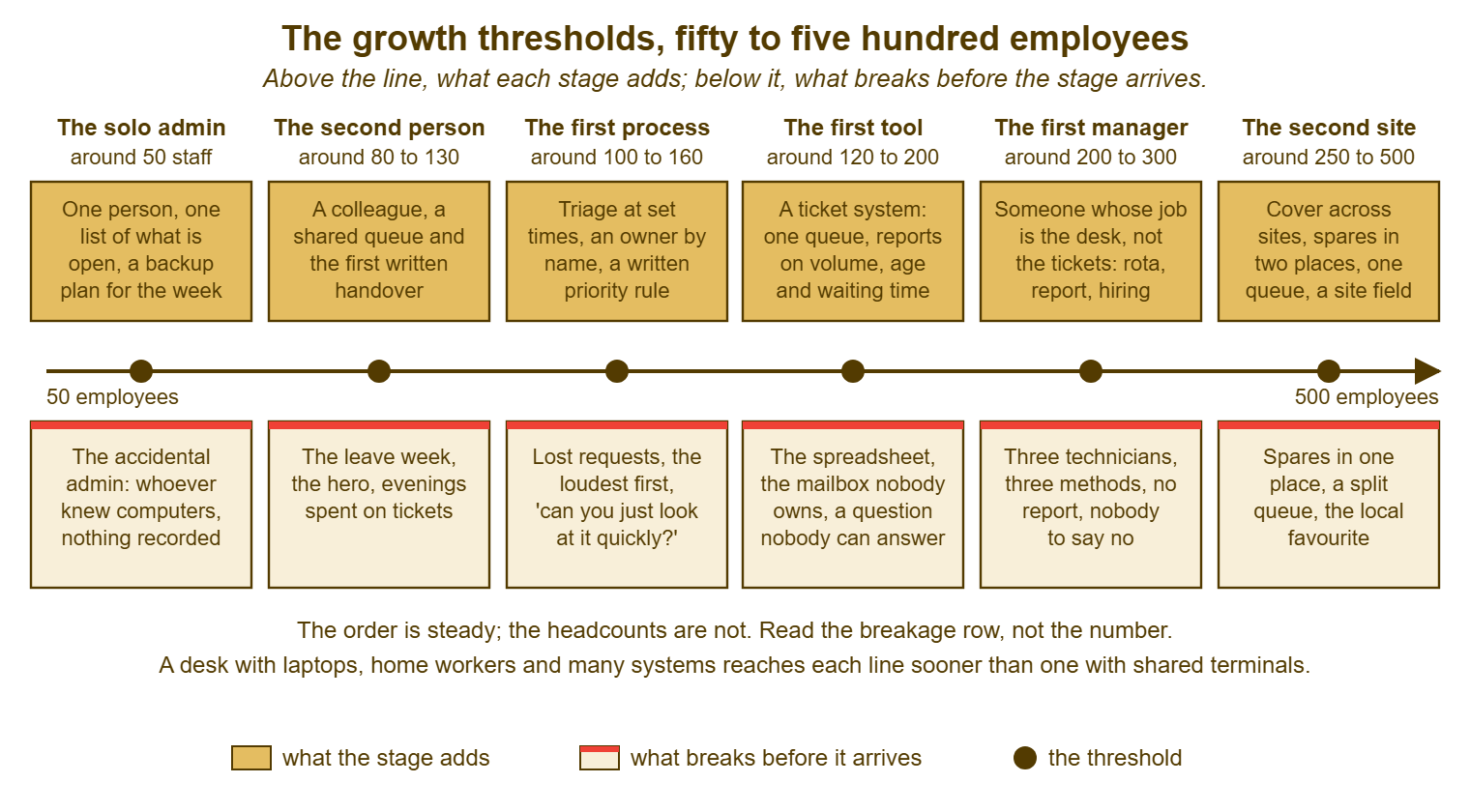
Two things about the line are worth saying in words. The thresholds overlap, and a fast-growing company can be standing at two at once. That is Priya's position at Larkspur: the first manager and the second site, in the same twelve months. The finance sign-in is still in one colleague's head. And the line does not stop at five hundred. Beyond it the thresholds keep coming: a third site, a second desk, a specialist team. But they are variations on the six. A desk that has crossed these six knows how to recognise the seventh.
Remember: the thresholds are named after what breaks, not after a headcount. Read the breakage, name the threshold, and add the one thing that threshold calls for before adding anything else.
Reading Which Threshold You Are At
The table below is the self-test, one row per threshold, with the sign that you are before it and the sign that you are past it. Score it on a Monday morning from what you can see in the queue and the calendar. Then score it again with the most senior non-IT person who will sit still for ten minutes. Several of the signs are invisible from inside the desk. A desk that is "before" on one row and "past" on the next has skipped a threshold. The skipped one is where the next six months of trouble will come from.
| Threshold | You are before it when | You have crossed it when |
|---|---|---|
| The solo admin | IT is done by whoever knows computers, between their real job and lunch; nothing is written down | One named person owns IT, keeps a list of what is open, and has a written backup plan for their absence |
| The second person | Leave is untaken or the desk closes; one name on every hard ticket; tickets answered after hours | Two people share one queue with an owner on every item and a written handover |
| The first process | Requests are lost; the loudest go first; "can you just look at it quickly?" is the usual route | Triage at set times, a one-page priority rule, and a close that tells the requester |
| The first tool | Two people edit one spreadsheet; the shared mailbox is nobody's; a volume question takes an afternoon | One queue for every channel, a name and status on each ticket, reports from the system |
| The first manager | Three technicians, three methods; nobody writes the report; nobody can say no to a new project | Someone's job is the desk: rota, report, hiring, and the conversation with leadership |
| The second site | Spares in one building; a local favourite's mailbox is the site's help desk; a second queue has appeared | One queue with a site field, spares in two places, named cover for each site, a catalogue per site |
Expect to be between rows rather than on one. Most growing desks are past one threshold and before the next, with the signs of the next one already visible if anyone looks. The honest score is usually a little worse than the first attempt, because the first attempt is scored by the people who built the desk, and builders are fond of their buildings.
A Short War Story: The Missing Manager at Ashgrove Housing
Ashgrove Housing grew from ninety staff to two hundred and sixty in eighteen months through a merger with a smaller association. Its desk grew from two technicians to four without anyone being made responsible for the desk itself. That was because the finance director's view was that a manager "doesn't fix anything". The four technicians ran four methods. One closed tickets on first reply, one waited for confirmation, one triaged at nine and one never triaged at all. The merged association's staff learned within a month which technician to e-mail directly. The board asked for a report on how long tenants' repair-line problems were taking to resolve. Nobody could produce one, because nobody's job was the report. The most experienced technician, Tomasz, left in the same quarter. He had spent a year being the hero to a desk that had no one to tell him to stop. The lead hired four months later spent his first quarter writing the triage rhythm the desk should have had at a hundred and sixty staff. He also spent that quarter digging out a backlog of over four hundred tickets. Ashgrove paid for a technician's year of output without ever seeing it. The threshold that adds no hands is the one that keeps the hands you have.
The Growth Stage Card
The card below is one page, filled in once a quarter by whoever runs the desk. Its purpose is to make the next threshold a dated decision rather than a surprise. The top half records where the organisation is and where HR says it will be. The middle half names the threshold the desk is standing before and ticks the breakage that is already visible. The bottom half says what will be added, by when, by whom, and what evidence will be shown to the person who has to agree. Keep the completed cards. Four of them in a row are a growth story leadership can read in two minutes. The version of the arithmetic that leadership will need is built in Planning a Year Ahead.
GROWTH STAGE CARD — ONE PAGE, ONCE A QUARTER
Organisation: ______________________   Prepared by: ______________   Quarter: ________
Staff now: ______   Staff in twelve months (from HR): ______   Sites now: ___  in twelve months: ___
Desk today: ___ technicians, ___ working lead/manager, tool in use: ______________________

THRESHOLD WE HAVE CROSSED (tick the highest that is fully true)
  [ ] Solo admin: one named owner, a list, a backup plan
  [ ] Second person: shared queue, owner on every item, written handover
  [ ] First process: triage at set times, written priority rule, close that tells the requester
  [ ] First tool: one queue for every channel, reports from the system
  [ ] First manager: someone's job is the rota, the report, the hiring and the no
  [ ] Second site: one queue with a site field, spares in two places, cover per site

THRESHOLD WE ARE STANDING BEFORE: ______________________
Breakage already visible (tick those seen this quarter)
  [ ] leave untaken or the desk closed      [ ] one name on most hard tickets
  [ ] tickets answered after hours          [ ] a request lost for more than a week
  [ ] "can you just look at it quickly?"    [ ] shared mailbox read by all, owned by none
  [ ] a volume question took an afternoon   [ ] three ways of working on one desk
  [ ] nobody writes the report              [ ] a project nobody could refuse
  [ ] spares in one building only           [ ] a site's requests going to one technician's mailbox
  [ ] other: ______________________________

WHAT WE WILL ADD: ______________________________________________________________
By when: ____________   Owner: ______________   Lead time needed: ______ weeks/months
Evidence we will show (hours, counts, ages, from the queue): ___________________________
Who has to agree: ______________   Asked on: ____________   Decision: ______________

NEXT CARD DUE: ____________
Priya filled in her first card the afternoon of the all-hands. She circled both "first manager" and "second site" under the threshold she was standing before. That is not what the card is designed for and is exactly what growth does. She took it to her director the following week with the leave-untaken and after-hours boxes ticked and the new floor plan clipped to the back. The director asked which one to do first. That is the right question, and the next article in this series is the first half of the answer.
Frequently Asked Questions
Our headcount says we should be at one threshold but the signs say another. Which do I trust?
Can we skip a threshold if we grow quickly?
Does the first tool have to come after the first process?
Does the first manager have to be a full-time, non-technical role?
We shrank rather than grew. Do the thresholds run backwards?
How often should we fill in the growth stage card?
From the QuerySolv team: we build self-hosted help desk software for Windows. QuerySolv runs as one Windows service on your own network. It takes requests by web form, e-mail, live chat, social messages and REST API. It is licensed once per installation rather than per agent per month. The free trial runs the full product for 30 days.