
Why Soft Skills Outrank Technical Skills at Level One
Friday, 16:10, at Tollgate Foods. Nadia runs a desk of four and is reading the week's satisfaction comments before she goes home. Two of them are about the same fault: the label printer on the packing line stops dead after someone changes the roll. The fix is in the knowledge base under "Label printer stops after stock change". It takes about six minutes. Marcus fixed it for Dev on Tuesday. Leah fixed it for Ola on Thursday. Dev's comment reads: "Sorted quickly, but I felt like I was wasting his time." Ola's reads: "Leah explained why it happens and what to do first next time. Brilliant." Same fault, same article, same six minutes. Nadia reads them twice and then opens both tickets to find out what happened in the other ninety seconds.
Soft skills, on a help desk, are the skills that handle the person rather than the machine. They include listening for what somebody actually needs and staying patient without talking down to them. They include owning a problem until it is genuinely someone else's. They also include writing so that a tired reader on a phone understands you first time. Level one, also called the first line, is the first person a user reaches when they ask for help. That might be by phone, chat, e-mail, form or the hallway. This article argues that at level one the soft skills matter more than the technical ones. It tries to argue it honestly, which means saying what the technical skills still have to do. It is part of our Soft Skills for Technicians series. The series covers each of the four skills in its own article and ends with how to teach and assess them.
It covers what level one is actually for and why the fix is usually already known. Next come what a soft skill is in plain words and the sentence that decides whether the user trusts the desk. It follows the two technicians at Tollgate Foods, step by step. Then come the foundation picture, what the technical skill still has to do, and why desks hire and measure the wrong way round. It finishes with a short war story and the level-one skills weighting to copy, in that order.
What Level One Is Actually For
Level one is the first person the user reaches, and its job is the person before the machine. The user did not come to the desk to have a service restarted. They came because something stopped them doing their work. They want to be able to do it again, with as little humiliation as possible on the way. The desk's reputation is made almost entirely at level one, because level one is the only part of the desk most users will ever meet. Nobody in accounts has met the second line. They have heard rumours.
The machine part of the job is narrower than it looks from outside. Most of what arrives at a small desk is a known fault with a known answer. It is the password, the printer, the drive that dropped off, the meeting room screen, "it's slow". The technician's technical contribution, most of the time, is recognising which known thing this is and applying the known answer without fumbling. That is a real skill, and it is a smaller one than the job advert suggests.
The person part of the job is wider than it looks. The user arrives with a fault and a feeling. The feeling is usually being late, embarrassed, or worried about looking incompetent in front of a manager. Or it is simply being interrupted in the middle of something that mattered. Level one's second job is to leave that person better than they arrived. That means not only with the fault fixed but with the sense that asking was a reasonable thing to have done. What good support looks like from the user's chair is almost entirely a description of this second job.
The Fix Is Usually Already Known
On a desk that has been running for a year, most level-one tickets have been seen before, and the answer is written down somewhere. The runbook exists. The knowledge base article exists, or should. That is exactly what a knowledge base is for: holding the known fix so that nobody has to be clever twice. A knowledge base with articles that only agents can see is where the level-one fix lives. That is how QuerySolv and most help desk tools arrange it. The technician's job is to find it, not to invent it.
Follow that thought one step and the argument of this article falls out of it. If the fix is in the article, and two technicians both apply the article correctly, then the entire difference between them is everything the article does not contain. That includes the first sentence, the tone during the six minutes, and the explanation afterwards. It includes whether the ticket note helps the next person and whether the user would ring again. The technical content of the two tickets was identical. The outcomes were not. Whatever made the difference, it was not technical.
This leads to an opinion I will state plainly. At level one, a junior technician with good soft skills and a search box beats a senior technician with neither, on most days and most tickets. The junior will find the article, apply it, and leave the user feeling heard. The senior will fix it from memory, faster, and leave the user feeling that they interrupted something important. One of these desks gets used. The other gets worked around, politely, by people who learned to ask a colleague instead.
The honest exception is the genuinely new fault, the one no article covers, and here technical skill is decisive. But notice what happens to that ticket on a small desk: it either becomes a second-line problem or it becomes a new article. The soft skill that matters in that moment is saying, without flinching: "I have not seen this before; here is what I am going to do and when you will hear from me". That is the honest version of the handoff that does not dump. The user forgives not knowing. They do not forgive being left.
What a Soft Skill Is, in Plain Words
"Soft" is a poor name for these skills, because nothing about them is soft, and the name has done them harm. They are specific, observable behaviours that can be watched, practised, and got wrong, and this series treats four of them. Listening is hearing the problem behind the request, because the request is often a proposed solution rather than a description of the fault. Patience is keeping the voice level on the sixth wrong click, without the sigh. It means avoiding the slowed-down speech that tells the user you think they are slow. Ownership is treating the ticket as yours until it is properly, acceptedly, someone else's. Clear writing is a reply that still works when read on a phone in a corridor between meetings. Each has its own article in this series; listening comes next.
It is as useful to say what a soft skill is not. It is not being nice. It is not being chatty, or apologetic, or relentlessly cheerful, and it is certainly not the customer-service voice that sounds like a recorded announcement. A technician can be warm and useless, and plenty are. Another can be brisk, almost terse, and excellent, because every one of their short sentences lands on the thing the user needed. The skill is in the behaviour, not the personality, and that distinction is the whole reason the skills can be taught.
Because they are behaviours, they can be observed. Because they can be observed, they can be coached. And because they can be coached, they can be assessed without anyone pretending to read minds. Teaching and assessing soft skills is the last article in this series and depends entirely on this point. You cannot coach "be more empathetic". You can coach "repeat the problem back before you touch anything", and watch whether it happens.
The Sentence That Decides Whether the User Trusts the Desk
There is one sentence in every level-one contact that decides how the rest of it goes, and it is not the fix. It is the first full sentence after the greeting, because it tells the user whether they were heard. Compare "Right, the label printer stopped after you changed the roll; that one is annoying and it is quick, give me a few minutes" with "Have you tried restarting it?" The second is a perfectly good diagnostic question. It is also the sentence every user has heard immediately before being ignored, and they brace for it. The first sentence repeats the problem back in the user's own terms, names it as a known thing, and gives a time. In about twenty words it has said: you were heard, you are not stupid, this will end.
The second most important sentence is the one after the fix. "There you go" closes the ticket. "That happens whenever the roll is changed; next time press the feed button once before you print, and if that does not do it, ring us and ask for whoever is on" closes the ticket and opens the door. It gives the user something they can do. That turns them from a person who was rescued into a person who knows a thing. It also tells them that ringing again is welcome. The difference in effort is about fifteen seconds. The difference in what the user says about the desk afterwards is the whole difference.
Users do not grade the desk on the fix, because they cannot judge the fix. The fix, as far as the user is concerned, happened inside a box they have been told not to open. What they can judge is whether they were heard and whether they were made to feel foolish. They can judge whether they left able to do their work and a little more capable than before. Those three judgements are made on sentences, not on commands, and they are made at level one or not at all.
Two Technicians, One Fix: Tollgate Foods, Step by Step
Here is what Nadia found when she opened the two tickets. Marcus and Leah are both competent. Both have been on the desk over a year. Both found the article within a minute and followed its four steps correctly. Dev and Ola are both packing supervisors with a line waiting behind them. Both rang the desk rather than raising a form, which on a stopped line is the right call. Nadia reconstructed the two conversations from the ticket notes and from asking, and the table below sets them side by side.
| Moment | Marcus with Dev (Tuesday) | Leah with Ola (Thursday) |
|---|---|---|
| First sentence after hello | "Which printer? Have you turned it off and on?" | "The line printer has stopped since the roll change? That one is known and quick; give me about five minutes." |
| During the fix | Silence for four minutes while he worked, then "try it now". | "I am clearing the stuck job now... that is gone... now I am sending a test label; tell me when it comes out." |
| After the fix | "There you go. Anything else?" | "It jams the queue whenever the roll is changed. Next time, press feed once before the first print. If that does not sort it, ring us straight away; it is a quick one." |
| The ticket note | "Fixed." | "Known fault, article followed, test label printed. Told Ola the feed-button step. Third time this month on line two; worth a problem record." |
| Time on the phone | About six minutes | About seven and a half minutes |
| Satisfaction comment | "Sorted quickly, but I felt like I was wasting his time." | "Leah explained why it happens and what to do first next time. Brilliant." |
Marcus did nothing wrong, and it matters to say so, because the lesson here is not that Marcus is a bad technician. He fixed the fault in six minutes, correctly, with nineteen tickets in the queue behind him. He wrote the note most of us wrote for the first five years. Leah's version cost about ninety seconds more on the phone and perhaps a minute more on the note. The ticket count was the same. The resolution time was, if anything, worse. Every number the desk reports looks the same or slightly favours Marcus.
Now count what the ninety seconds bought over a year. Ola's line pressed the feed button and raised fewer of these tickets. When they did ring they asked for the desk without dread. Dev's line kept raising the same ticket and, Nadia later found, had started asking the maintenance fitter to look at the printer first. That was because he was friendlier. Asking him first added a day to every fault. Leah's note also put "third time this month on line two" where somebody could see it. The printer on line two turned out to have a worn roller. One technician fixed a printer. The other fixed a printer, taught a supervisor, and started a problem record, in ninety seconds she did not strictly have.
Soft Skills as the Foundation
The picture below draws a level-one ticket as a building in cross-section, because the relationship is structural rather than a matter of proportions. At the top is the outcome the user remembers: the fault fixed and the desk worth asking again. Under it sits a layer of technical skills, the four that level one genuinely needs. They are finding the known fix, following the diagnostic order, knowing when to escalate, and using the tools without fumbling. Under both, wide enough to carry everything above, is the foundation: listening, patience, ownership and clear writing. The weights on the blocks are the ones Nadia's desk settled on for its review sheet. They are sixty for the foundation and forty for the technical layer. And they are an example rather than a standard. The template at the end of this article is where you set yours.
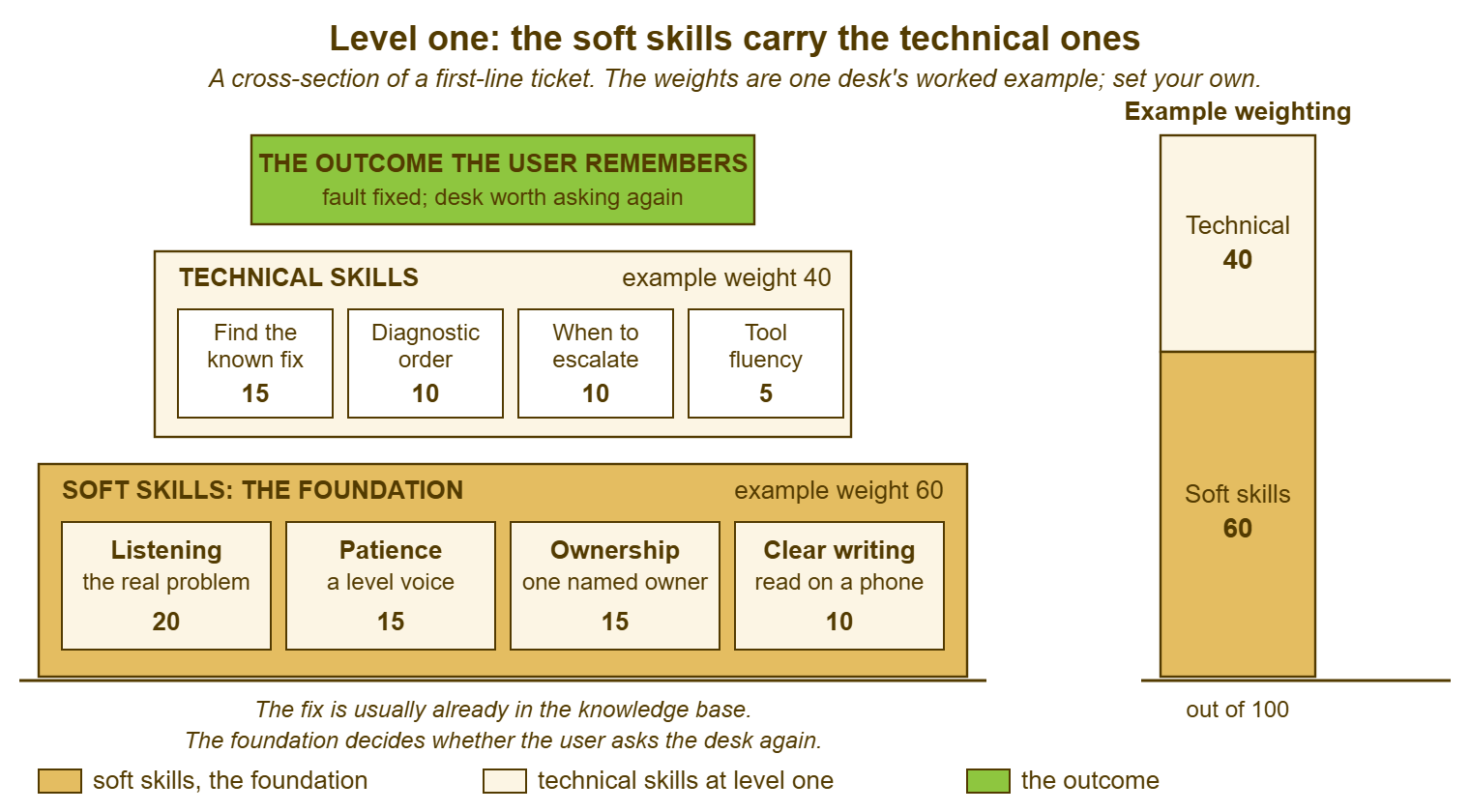
The reason it is a foundation and not a half is that the technical layer sits on it. A correct fix delivered so that the user feels stupid is not half a success. It is a fault the desk caused, and the user will route around the desk to avoid it happening again. A fix the user cannot understand, cannot repeat and was not told about is technically complete and practically useless. The technical work is real and necessary, and it only counts when something underneath it holds it up.
What the Technical Skill Still Has to Do
Outrank does not mean replace, and a reader who leaves this article thinking that technical skill does not matter at level one has been misled. The technician must still find the known fix quickly, which means knowing the knowledge base well enough to search it in the right words. They must follow the diagnostic order when the fix is not simply known, cheapest check first. The aim is to keep the user from watching them reinstall something that did not need reinstalling. They must know when to stop. And they must be fluent in the tools, because a kind technician who takes four minutes to find the remote-control button is a kind delay. Warmth does not fix a printer. It only decides whether the user comes back after it is fixed.
Notice what the level-one technical skills actually are, though, because they are not the ones job adverts list. Pattern recognition, which known thing is this, is the first and biggest. The diagnostic order is the second. Judgement about when a ticket has stopped being a level-one ticket is the third. It is the one most often missing in technically strong juniors. They will spend forty minutes on something the second line would have fixed in five. Tool fluency is the fourth. None of these is deep expertise in any one system, and the interview that screens for deep expertise is screening for a different job.
The escalation point is where the two kinds of skill meet, and it is worth watching closely because it tests both at once. Knowing that you are out of your depth is a technical judgement. Saying so to the user without making them feel abandoned is entirely soft. So is handing the ticket on so that the next person has what they need. Ownership later in this series is mostly about that moment. A technician who escalates well is doing the hardest thing level one does, and doing it with the skills this article is about.
Why Desks Hire and Measure the Wrong Way Round
Most desks hire for the technical layer because it is easy to compare. Certificates can be listed, counted and checked; whether somebody will repeat the problem back before touching the keyboard cannot be read off a form. So the job advert carries eleven lines of acronyms and one line that says "excellent communication skills". The interview spends forty minutes on subnetting and four on a conversation. What to screen for in a support hire argues the opposite order. The argument there is the same as here. At level one, you can teach the subnetting faster than you can teach the listening. You will need the listening on the first morning.
Most desks measure the technical layer for the same reason. Tickets closed, time to resolve and first-contact resolution all fall out of the tool in a report. All of them are blind to the ninety seconds that separated Marcus from Leah. The place the soft skills show up is the satisfaction comment, which is free text, awkward to count, and the most informative line in the whole report. What a satisfaction score actually measures is, to a large extent, the foundation layer of this article's picture. A desk that reads its scores and skips its comments is weighing the building and ignoring the ground.
The result is a desk staffed and scored for the smaller layer, which then wonders why its numbers are good and its users are leaving. The numbers are measuring what the desk chose to measure. The users are responding to what the desk chose not to. Neither is lying. They are simply looking at different floors of the same building, and only one of them is the one people walk out of.
Remember: at level one the fix is usually already known. So the difference between two technicians is everything the knowledge base article does not contain. Hire for that difference, coach it as specific behaviours, and read the comments, not just the scores.
A Short War Story: The Certificates at Meridian Parts
Meridian Parts hired Tomas for its three-person desk on the strength of three vendor certifications. He was hired ahead of a candidate called Anita who had none and had spent four years running a parts counter. Tomas was technically the strongest person the desk had ever had. Within four months two departments had quietly stopped raising tickets. They did so because every answer came back correct, fast, and so curt that one branch manager told the desk lead, Karen, about it. The branch manager said she would rather fix things herself than be made to feel like that again. Karen counted the drop in tickets from those two departments against a rise in direct calls to the one technician people found easy to talk to. She estimated the desk had lost about a quarter of a year rebuilding trust it had held before the hire. Tomas moved to the second line, where there is no user on the phone, and did well there. Anita was hired for the vacancy and became the technician the branches asked for by name. The certificates had been real. They had measured the wrong layer of the job.
The Level-One Skills Weighting
The sheet below is the one Nadia's desk wrote after the two comments. It is meant to be used three times. The first is when writing a job advert and scoring interviews. The second is when reviewing a technician's tickets. The third is in the monthly conversation about how someone is getting on. The weights shown are her desk's. The instruction is to argue about them once as a team and write the result down. Then use the same numbers for everyone until you agree in writing to change them. The behaviours under each skill are what a reviewer actually looks for, because "listening: 20" cannot be scored and "repeated the problem back before acting" can.
LEVEL-ONE SKILLS WEIGHTING — ONE PAGE
Desk: ______________________   Agreed by the team on: ____________   Reviewed yearly: [ ]
Used for:  [ ] job adverts and interview scoring   [ ] ticket reviews   [ ] monthly one-to-ones

THE FOUNDATION (soft skills)                              example weight: 60   yours: ____
  Listening .......................................... 20   yours: ____
     [ ] repeats the problem back in the user's words before acting
     [ ] asks what the user is trying to do, not only what is broken
     [ ] the ticket records the real problem, not just the stated request
  Patience ........................................... 15   yours: ____
     [ ] voice and wording stay level on the repeated mistake
     [ ] second explanation is different, not louder or slower
     [ ] no "just", "simply", "as I said" in replies
  Ownership .......................................... 15   yours: ____
     [ ] claims the ticket by name; no ticket left with a group
     [ ] updates before the user has to ask
     [ ] hands over with a note the receiver can act on; confirms after the fix
  Clear writing ...................................... 10   yours: ____
     [ ] first line says what is wrong or what was done
     [ ] one next step, named, with a time
     [ ] no jargon the user did not use first

THE TECHNICAL LAYER (at level one)                        example weight: 40   yours: ____
  Finds the known fix ................................ 15   yours: ____
     [ ] searches the knowledge base before improvising
     [ ] applies the article correctly; notes gaps in it
  Diagnostic order ................................... 10   yours: ____
     [ ] cheapest check first; does not reinstall what did not need it
  Knows when to escalate ............................. 10   yours: ____
     [ ] stops at the agreed point; says so to the user without abandoning them
  Tool fluency ........................................ 5   yours: ____
     [ ] no fumbling for the remote tool, the account console or the ticket

SCORING RULES
  Score behaviours as seen / not seen on a sample of tickets, never from memory.
  Per-person scores are for coaching, never for ranking; agree a minimum sample first.
  Total: ____ / 100     Strongest skill: ______________   One skill to work on: ______________
Nadia used the sheet once, that Friday, on the two tickets in front of her. Leah scored high on the foundation and the technical layer alike. Marcus scored high on the technical layer and lost most of his foundation points on two behaviours: the first sentence, and the sentence after the fix. The coaching conversation on Monday took twelve minutes and covered exactly those two sentences, with Leah's ticket as the example. Marcus, who is a good technician and knew it, found the whole thing slightly insulting for about a day. Then he started doing it. By the following month Dev's line had started ringing the desk again. The fix had not changed. The ninety seconds had.
Frequently Asked Questions
Does this mean we should stop hiring for technical skill at level one?
Our best technician is technically brilliant and terse. Is that a problem?
How do I argue this to a manager who wants to see certifications on the team?
Are soft skills really teachable, or are people either good with users or not?
Which metric shows whether soft skills are improving?
Does this argument hold for the second line too?
From the QuerySolv team: we build self-hosted help desk software for Windows. QuerySolv runs as one Windows service on your own network. It takes requests by web form, e-mail, live chat, social messages and REST API. It is licensed once per installation rather than per agent per month. The free trial runs the full product for 30 days.