
Why Users Get Angry at the Help Desk: It Is Rarely About You
Tuesday, 06:50, at Tollgate Foods. Ruth runs the dispatch office, and the label printer on the loading bay has stopped for the third time this month. Forty pallets are stacked behind the roller door, four drivers are drinking coffee they did not want, and the first delivery window closes at 08:00. She phones the desk and gets Dev, who is in his second week and has never heard of the label printer. "I don't want a ticket number," she says, before he has said anything but his name. "I don't want to hear about a ticket. I want labels. Why is this still happening?" Dev has not done anything wrong yet. He is about to, because his instinct is to explain.
A frustrated user is a person who needed something to happen, watched it not happen, and has been carrying the gap long enough for it to turn into heat. The heat lands on whoever answers the phone, because the desk is the only part of IT with a number you can ring. Almost none of it is about the person who answers. It is about the forty pallets, the third time, the two earlier tickets that were closed with "resolved", and the delivery window. This article is part of our Working With Frustrated Users series. It is about where the anger comes from and how to read it before you reply. What to say in the first minute is the next article's job; this one is about understanding what you are hearing.
It covers why the anger is rarely about you. Next come the five reasons behind most of it: blocked work, a repeat failure, feeling unheard, a deadline and a history with the desk. Then come why the desk gets the anger when the cause is elsewhere, and the frustration ladder from irritation to fury. The ladder has a picture and the signal at each rung. Next come how to read a ticket's rung before you answer it, and the one signal that is not on the ladder. A short war story and the frustration-signals card to copy finish the article, in that order.
It Is Rarely About You
The person shouting at Dev has never met Dev. She is shouting at the third failure, at the two tickets that said "resolved" when the printer was not. She is shouting at the automatic acknowledgment that thanked her for her patience, and at a morning that was already going to be hard. Dev is the first human being to answer, so Dev gets all of it. That is not fair, and it is also not personal, and both of those things are true at once. The anger is addressed to the desk the way a letter is addressed to a building: whoever opens the door gets handed it.
This matters because the natural response to being blamed is to defend yourself, and defending yourself is the one move that makes everything worse. Dev wants to say "I wasn't here for the first two times" and "it's actually a network issue, not the printer" and "I can't do anything without a ticket". All three are true. All three tell Ruth that the desk has heard an accusation and is answering the accusation instead of the pallets. The requester hears "it is not my fault", and the requester did not ring to assign fault. She rang for labels.
The useful frame is that anger at the desk is information, and it is almost always information about the requester's day rather than about you. Somebody is blocked, or has been let down before, or has a clock running that you cannot see. Once you know which, you know what to do first. Until you know which, every reply is a guess, and a guess delivered to an angry person in the wrong tone costs more than silence would have. I spent my first year on a desk explaining causes to people who wanted outcomes. I was correct every time and it helped nobody.
The Five Reasons Behind Most Anger
Almost every angry ticket I have read sits on one or more of five reasons. The reasons are worth naming because each one wants a different first move. Blocked work is the simplest: the requester cannot do their job until the thing is fixed, and every minute is a minute of standing still in front of colleagues. Ruth is not angry about a printer. She is angry about standing in a loading bay doing nothing while drivers watch her. The first move for blocked work is a way to get going now, even a bad one, and only then the proper fix.
A repeat failure is the same thing breaking again after it was declared fixed. This is the reason behind most of the hottest tickets, because the requester has already done everything right once. They reported it, waited, trusted the "resolved", and were proved wrong in public. The second report carries the whole weight of the first. The word to listen for is "again", and the first move is to read the earlier tickets before you say anything. "Have you tried restarting it?" to someone on their third occurrence is an insult dressed as a question. What a second report is telling you about the first fix is the subject of What a Reopen Is Telling You.
Feeling unheard is the reason that grows in silence. The requester raised a ticket, got an automatic reply, and then nothing. They replied "any update?" and got nothing. They do not know whether anyone has read it, whether it is being worked, or whether it has fallen down a crack. By the time they ring, they are not angry about the fault; they are angry about the not-knowing, which is worse than a bad answer. The first move is a human reply that says who has it and when they will hear next. (The auto-acknowledgment does not count. It has never counted. Nobody has ever been reassured by "your request is important to us".) How to send updates that stop the chase before it starts is in Status Updates That Prevent the Chase.
A deadline is a clock the requester can see and you cannot. The payroll run closes at noon, the tender is due at five, the client is in reception now. The fault may be small; the consequence is not. Deadline anger has a particular sound, which is urgency about time rather than about the fault itself: "I need this by", "there is no later", "the submission closes at". The first move is to ask what the deadline is and whether anything short of the full fix would meet it. The requester often has not thought about that. A workaround that gets the payroll out at 11:40 is a complete success even if the real fix takes a week. Deciding how urgent a deadline really is, and saying so, is the triager's job and not the first minute's. The point here is only to hear that a deadline is in the room.
A history with the desk is the reason you inherit. The requester was let down before, by this desk or a previous one, by a technician who left, by a ticket that was closed without a word. They arrive expecting it to happen again. The anger starts higher and comes faster than the fault deserves. The first words are often about the past: "last time you people", "this always happens", "I know how this goes". The first move is to not argue with the history, because it is theirs and it is probably accurate. Make this ticket go differently in a way they can see. If you run QuerySolv, the event history on the ticket already holds every handoff and every reopen. So the history the requester is carrying is a page you can read before you pick up the phone. It is not a story you hear for the first time while they are telling it.
| Reason | What it sounds like | What the requester is really asking for | The first move |
|---|---|---|---|
| Blocked work | "I can't do anything until this works"; "I've got people waiting" | A way to get going now | Offer a workaround or a loan device before the proper fix |
| Repeat failure | "Again"; "you said it was fixed"; "this is the third time" | Proof that this time is different | Read the earlier tickets before saying anything; name the repeat |
| Feeling unheard | "Is anyone looking at this?"; "I've heard nothing"; "any update?" twice | Evidence that a human has it | Reply with a name and a time for the next update |
| A deadline | "I need this by noon"; "the client is here now"; "there is no later" | The deadline met, by any means | Ask what the deadline is and what would meet it short of the full fix |
| A history with the desk | "Last time you people"; "this always happens"; "I know how this goes" | This ticket to go differently, visibly | Do not argue with the past; show a different present |
Most hot tickets carry two or three of these at once. Ruth has blocked work, a repeat failure and a deadline, and she rang at 06:50 because the delivery window is at 08:00. The reasons stack, and the anger is roughly the sum. That is also why a single move rarely fixes an interaction. You can offer the workaround and still be dealing with the repeat. You can acknowledge the repeat and still be dealing with the clock.
Why the Desk Gets the Anger
The desk gets the anger because the desk is where IT becomes a person. The network team has no phone number the warehouse knows. The vendor whose firmware broke the printer is a logo on a box. The decision to buy the cheaper printer was taken in a meeting two years before Dev was hired. None of those can be shouted at. The desk can, and it answers in under a minute, and it says its name. Every frustration that the rest of the organisation's technology generates flows downhill to the one place with a voice.
This is structural rather than unlucky, and knowing it changes how the anger feels. The desk is not being singled out for being bad at its job; it is being found because it is the only part of the system that can be found. A good desk should expect to receive anger that it did not cause. That anger is in rough proportion to how much technology the organisation runs and how reliably it runs. The desk should be built to receive it without taking it personally. A desk that is never shouted at is either superb or unreachable. The second is more common.
There is a second structural reason, which is that the desk's own habits add heat without meaning to. The automatic acknowledgment with a number in it tells a person in a hurry that they have been filed. The "please raise a ticket" to someone standing at the counter tells them the process matters more than the pallets. The status "resolved" on a ticket the requester never heard about tells them the desk closed something they still have. None of these are malice; all of them are small taxes on the requester's patience. The requester pays them every time until the day they stop paying and start shouting. The anger you hear at 06:50 is often the sum of six small taxes, not one big failure.
The Frustration Ladder
Frustration climbs in recognisable stages, and I find it useful to picture them as a ladder with four rungs: irritation, frustration, anger and fury. The rungs matter because the right response changes at each one. What works on rung one, a prompt and cheerful "I've got this, back to you by ten", is close to an insult on rung three. There, the requester has already heard "back to you by ten" twice and is quoting ticket numbers at you. And what rung four needs, a very calm voice and almost no words, would be odd on rung one. Read the rung, then respond to the rung. The picture below has the signal at each rung on the left and the response that fits on the right. The colour moves from green at the bottom, where an interaction is cheap to bring back, to red at the top, where it is not.
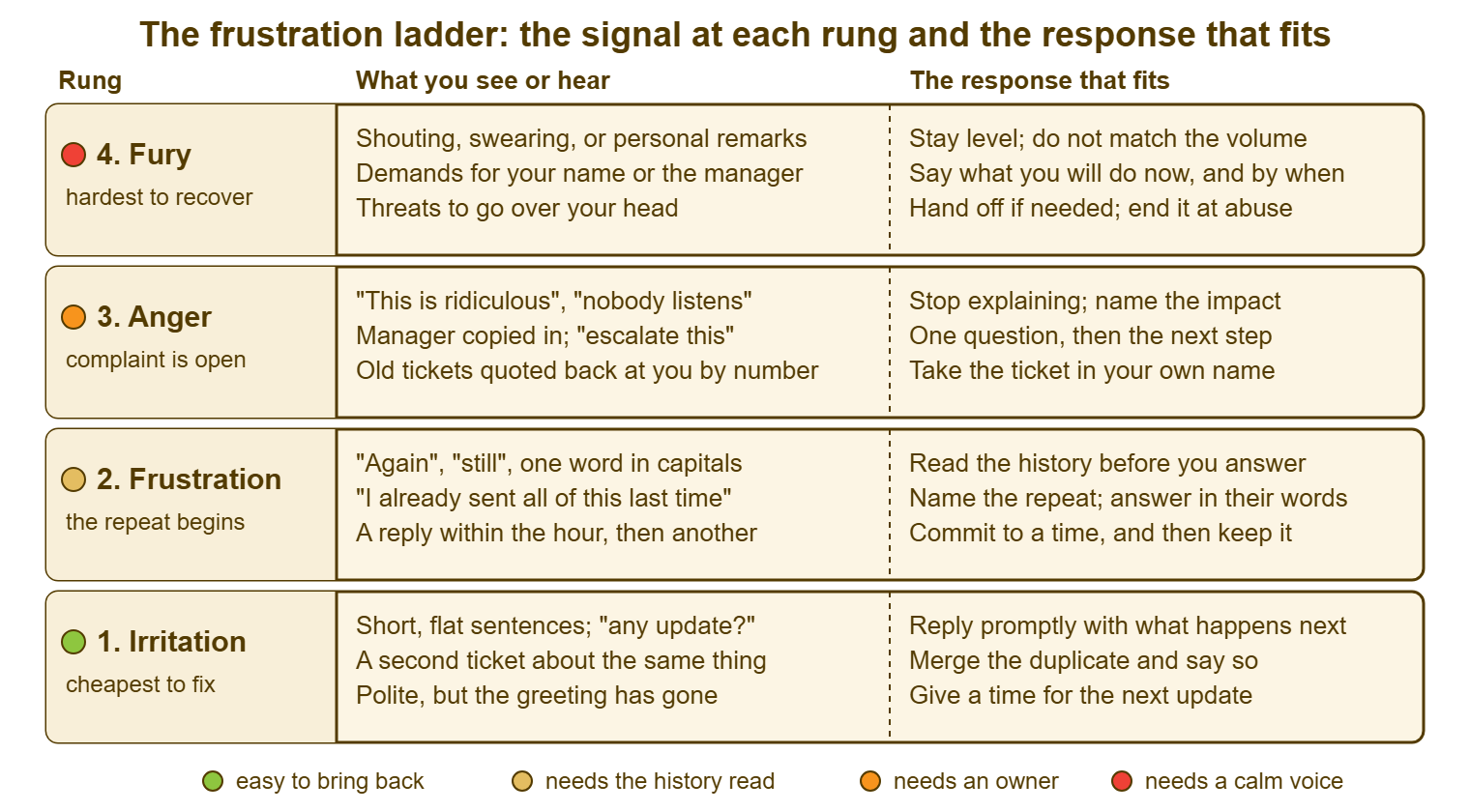
Two things about the ladder are worth saying before the rungs. First, people climb it faster than they descend it. A requester can go from irritation to anger in one bad reply, and coming back down from anger takes several good ones. Second, almost nobody starts at the top. The person who opens with fury has nearly always been on the lower rungs for days or weeks, in tickets that were not read as warnings. Fury is rarely a surprise to anyone who looked at the history. The ladder is a tool for catching people on the way up, where catching them is cheap.
The Lower Rungs: Irritation and Frustration
Irritation, the bottom rung, is the easiest to miss because it is polite. The ticket is short and flat. The greeting has gone: no "Hi", no "thanks", just "Printer on bay 2 not working again." A second ticket arrives about the same thing because the first one got no visible reply. A follow-up says only "any update?" The requester is still giving the desk the benefit of the doubt, and will keep giving it for about one more exchange. The response that fits is cheap: reply promptly, say who has it and what happens next, merge the duplicate and say that you did. Everything at this rung costs minutes. Everything at the next costs hours.
Frustration, the second rung, is where the repeat begins and the words get sharper. "Again." "Still." One word in capitals, usually AGAIN or STILL or THIRD. "I already sent all of this last time." Replies come faster: one within the hour of your last message, then another. The requester is no longer sure the desk is listening and is starting to build a case, which is why old details get repeated. The response that fits is to read the history before you answer. Name the repeat out loud so they know you have seen it ("I can see this is the third time since the start of the month"). Commit to a time that you then keep. A kept time at rung two is the single cheapest de-escalation on the whole ladder, because the requester's whole complaint is that times have not been kept.
Frustration is also where the desk's templates start to hurt. A canned reply that was fine on rung one ("Thank you for your patience, we are looking into this") reads at rung two as proof that nobody is reading. That is because it does not mention the "again". The fix is not to abandon templates but to answer in the requester's own words at this rung. If they said "third time", your reply says "third time". Showing someone their own words back is how you prove you read them.
The Upper Rungs: Anger and Fury
Anger, the third rung, is where the complaint stops being about the fault and becomes about the desk. "This is ridiculous." "Nobody is listening." The requester's manager is copied in, or the IT manager is. "I want this escalated" appears, which means "I no longer believe the person I am talking to can fix this." Old ticket numbers get quoted back at you, which means the requester has been keeping a file. At this rung, explaining anything is a mistake; every explanation sounds like an excuse because the requester has stopped extending credit. The response that fits is to stop explaining, acknowledge the impact in plain words, ask one question, and say what happens next with your name on it. Taking the ticket in your own name matters here more than anything else you can do. The requester's deepest complaint at rung three is that nobody owns the problem. The conversation itself, phrase by phrase, is in The First Sixty Seconds With a Frustrated User.
Fury, the top rung, is loud. Shouting, swearing, personal remarks, demands for your name or for the manager, threats to go elsewhere or over your head. The requester is no longer solving a problem; they are discharging a build-up, and nothing you say about the problem will land until the discharge is done. The response that fits is to stay level, which means not matching the volume, not going cold either, and saying very little until there is a gap. Then say what you will do now and by when, in one sentence. If you cannot stay level, hand the call to a colleague, which is not failure; it is the correct use of having colleagues. And there is a line past which fury becomes abuse, and at that line the conversation ends politely and the ticket continues in writing. Where that line is and what the desk does at it is the subject of Staying Professional Under Fire.
The ladder's colours are honest about cost: green means one good reply brings the requester back, red means the fix comes second to a calm voice. The desk's job is to keep conversations in the green and amber. That is mostly a matter of answering rung one when it arrives instead of discovering it at rung three.
Remember: anger at the desk is information about the requester's day, not a verdict on you. Read the rung before you reply, then respond to the rung you are actually on, not the one you wish you were on.
Reading the Rung Before You Reply
Reading the rung takes under a minute and should happen before any reply to a ticket that has heat in it. Open the ticket's history and count three things. First, how many times has the requester contacted the desk about this? Second, how long since the desk last said anything to them? Third, how many of the desk's messages were automatic rather than human? Three contacts, four days of silence and two auto-replies is a rung-three ticket whatever its words say, because the requester has been climbing while nobody watched. One contact and a flat tone is rung one, and a quick human reply keeps it there.
Then read the words for the signals in the picture. Capitals on one word. "Again" or "still" or an ordinal: "third", "fourth". Ticket numbers quoted. A manager in the copy line. The disappearance of the greeting. Questions that are not questions: "Is anyone actually reading these?" Each is a rung marker, and two or three together place the requester firmly. You are not diagnosing the person; you are deciding how much history to read and how much to say before you ask anything.
Then look for the reason, from the five above, because the rung tells you how to speak and the reason tells you what to do first. A rung-two deadline wants a workaround and a time. A rung-three repeat wants the history read and the repeat named. Rung and reason together take under a minute to read. The desk that skips this minute spends an hour recovering from the first sentence it said.
On the phone, where there is no history to open while they talk, listen for what the anger is about. It may be about time ("every time", "three weeks", "since Monday"). It may be about the desk ("you people", "nobody", "last time") or about the fault itself ("it just stops"). Time words mean a deadline or feeling unheard. Desk words mean history or a repeat. Fault words mean blocked work and, often, that the rung is lower than the volume suggests. People on rung one can still be loud when forty pallets are waiting.
The Signal That Is Not on the Ladder
The worst signal is not on the ladder at all, because it is silence. A requester who has climbed to anger and been failed again does not always climb to fury. Often they stop. They stop raising tickets, stop replying, find a colleague who knows a technician, or work around the fault for a year with a spreadsheet. From the desk, this looks like a quiet month. It is a department leaving. The desk that measures itself by how few angry calls it gets has an easy way to improve: become so unresponsive that people give up. A quiet queue is not always a happy one, and the silent requester is further up the ladder than any shouter.
The way to catch silence is to look for it on purpose, because it does not announce itself. Tickets that were closed with the requester's reply as the last message. Requesters who used to raise a ticket a month and now raise none. Departments whose volume fell without anything being fixed. Those are the signals, and they are the subject of The Seven Ways Support Quietly Fails, which is where the shadow channel and the falling count get their full treatment. For this article the point is narrower: fury is a person still trying. Silence is a person who has stopped. Treat the shouter as the more hopeful case.
A Short War Story: The Scanner Gun at Redbrook Engineering
Redbrook Engineering's stores supervisor, Callum, raised a ticket in the spring about a handheld scanner that dropped its connection whenever he walked past the welding bay. The desk closed it with "signal restored" after a technician rebooted the access point. It dropped again the next week. Callum's second ticket said "same scanner, same place, AGAIN" and got the same reboot and the same close. His third ticket, a fortnight later, copied in his manager and quoted the first two ticket numbers. The technician on duty read that as rudeness and answered with a two-paragraph explanation of wireless interference. Callum stopped raising tickets after that and did his stock counts on paper for five months. The finance team discovered this when the year-end count was out by eleven thousand units and nobody could say which scans had been lost. The desk's records showed one angry requester who had gone quiet, which they had read as the problem solving itself. Callum had been on rung one in the spring, where a second access point would have cost an afternoon. A desk that read the ladder would have caught him there.
The Frustration-Signals Card
The card below is the ladder as a desk-side reference, meant to be read in the minute before you reply to a ticket that has heat in it. The first block is the quick history count, the second is the signals by rung, the third is the five reasons with the first move for each. Fill in your own desk's reply time where the blank is, because "promptly" means different things on different desks. Print it, pin it where the newest person sits, and use it until reading the rung is a reflex. At that point you will not need it and the next new person will.
FRUSTRATION-SIGNALS CARD — READ BEFORE YOU REPLY

BEFORE ANYTHING, COUNT (from the ticket history)
  Contacts from the requester about this: ____
  Days since the desk last said anything human: ____
  Automatic replies they have received: ____
  Earlier tickets about the same thing: ____  (read them first)

PLACE THE RUNG
  1. IRRITATION   short flat sentences; "any update?"; a duplicate ticket;
                  no greeting
                  -> reply within ____ ; say who has it and when they hear next;
                     merge the duplicate and say so
  2. FRUSTRATION  "again", "still", one word in CAPITALS; "I already sent this";
                  fast replies
                  -> read the history; name the repeat in their words;
                     commit to a time and keep it
  3. ANGER        "this is ridiculous"; manager copied in; "escalate this";
                  old ticket numbers quoted
                  -> stop explaining; acknowledge the impact; one question;
                     take it in your own name; say what happens next
  4. FURY         shouting, swearing, personal remarks; demands for a name
                  or the manager
                  -> stay level; few words until a gap; one sentence on what
                     you will do and by when; hand off if you cannot stay level;
                     end politely at abuse and continue in writing
  OFF THE LADDER  silence: no reply, no new tickets, a department gone quiet
                  -> look for it on purpose; it is further up than fury

FIND THE REASON (often two or three at once)
  [ ] Blocked work      -> a way to get going now, then the proper fix
  [ ] Repeat failure    -> read the earlier tickets; name the repeat
  [ ] Feeling unheard   -> a human reply with a name and a next-update time
  [ ] A deadline        -> ask what it is and what would meet it
  [ ] History with desk -> do not argue with the past; show a different present

THEN
  Rung decides how you speak. Reason decides what you do first.
  Do not explain the cause until both are handled.
Dev did not have the card on his second Tuesday. He had the instinct to explain, and he began "So, it's actually a network thing". At that point Ruth said something about the network that does not need recording. What he did next was better. He stopped and said "You've got drivers waiting and this is the third time. I'm going to get you printing first and then I'm going to find out why it keeps happening." He walked a spare printer down to the bay. The labels were out by 07:20. The third ticket was the first one anybody read alongside the other two, and the access point that was dropping the printer was replaced that week. Ruth still phones the desk. She says hello first now, which on the ladder is the whole distance.
Frequently Asked Questions
Is it ever actually about the technician?
How can I tell a deadline from ordinary impatience?
Should the whole team learn the ladder, or just whoever answers the phone?
What if the requester is on rung three about something trivial?
How do I spot the silent requester before the year-end count?
Does naming the rung out loud to the requester help?
From the QuerySolv team: we build self-hosted help desk software for Windows. QuerySolv runs as one Windows service on your own network. It takes requests by web form, e-mail, live chat, social messages and REST API. It is licensed once per installation rather than per agent per month. The free trial runs the full product for 30 days.