
Measuring First Contact Resolution Honestly
Monday, 08:15, at Stonebridge Insurance. Lena runs a desk of five and has two spreadsheets open side by side. Both were built on Friday from the same ticket export for the same month. Ravi's says the desk resolved 294 of 412 tickets on first contact. Mo's says 203 of 440. Lena has checked the arithmetic in both and it is correct in both. Nobody has cheated, and nobody has mistyped. The desk's first contact resolution for March is either comfortably above two thirds or a little under half, depending on which of her technicians you ask. The operations director has asked for the number by Wednesday.
What Ravi and Mo disagreed about was not the month but the rules. Measuring first contact resolution honestly means making the counting decisions before the first count. Decide exactly which tickets go on the bottom of the fraction. Decide exactly what a ticket has to do to reach the top. It means applying those decisions the same way every month whether or not the result flatters anyone. The decisions are few, five in all. And each one has a lazy answer that pushes the number up and an honest answer that leaves it where it is. This article is part of our First Contact Resolution series. The definition itself, and the four conditions a ticket meets to count, are in What First Contact Resolution Means. And this article is about turning those conditions into counts that two people can reproduce.
It covers why two honest people get two numbers, then the denominator. We cover the five counting rules in turn: the reopen window, the handoff, the reply that closed nothing, the unlogged walk-up and the date rule. Then come the decision strip, counting by hand when the tool will not, and reporting the number with its counts. We finish with a short war story and the counting rules sheet to copy, in that order.
Why Two Honest People Get Two Numbers
Ravi had counted every ticket closed after a single reply from the desk, with the tickets opened in March as his base. Mo had counted tickets with no change of owner, one exchange with the requester and no reopen within ten working days. His base was the tickets closed in March, plus twenty-eight walk-ups logged after the fact. Each choice is defensible on its own. Each one moved the number, and all of Ravi's moved it the same way. That is the usual way with lazy rules: they are not biased on purpose, they are just all easier in the direction of a bigger number.
The lesson Lena took was not that Ravi was wrong, since nobody had told him the rules, but that the rules were the metric. A first contact resolution figure is not a fact about the desk. It is a fact about the desk under a stated set of counting rules, and without the rules it is an opinion with decimals. Write the rules down once, on one sheet, and every count after that is a reproduction rather than an argument. The sheet is at the end of this article; the rest of it is the reasoning behind each line.
There is a second lesson, less comfortable. The honest count is almost always lower than a desk's first count, because the first count was done without rules. The gaps were filled in the desk's favour by people who meant no harm. Expect the number to fall when you start counting properly, and say so in advance. It is the same desk. It has simply stopped grading its own homework.
The Denominator: Which Tickets Are Eligible
The denominator is the bottom of the fraction, the count of tickets the number is measured against. And the honest rule is that every ticket the desk handled in the period is in it. Not every easy ticket. Not every ticket in the categories where a first-contact fix is possible. Every ticket, including the hardware repair that needed a part, the access request that waited three days for approval, and the one the vendor took a fortnight over. Those cannot be resolved on first contact, and leaving them in is the point. The desk-wide figure is supposed to carry the mix of work the desk actually gets.
The temptation to exclude is strong and the arguments sound reasonable. "Procurement can never be first contact, so it is unfair to count it." It is unfair in the way gravity is unfair. The requester who wants a new laptop still had to ask more than once, and the desk-wide number should say so. The right response to the mix problem is not to shrink the denominator but to read the figure by category as well. That is the subject of First Contact Resolution by Category, where procurement gets its own expectation and the desk-wide figure keeps its honesty. Exclude nothing from the desk-wide count. Cut it afterwards as often as you like.
Two exclusions are legitimate and go on the sheet. Tickets the desk opened for itself, such as a monitoring alert that became a ticket, had no requester and no contact, and belong in neither count. Spam, and duplicates merged into another ticket, also come out, since the surviving ticket carries the contact. Everything else stays. If a third exclusion seems necessary, write it down, date it, and expect to be asked about it. (It will be the operations director who asks. It is always the operations director.)
Rule One: The Reopen Window
The reopen window is the number of working days after a ticket is marked resolved during which the requester saying "it has come back" counts as the same problem. And a ticket reopened inside it was not resolved on first contact, whatever it looked like on the day. The window exists because "fixed" is a claim that needs time to be tested. A print queue cleared at four in the afternoon has not been tested until the next morning's print run. The window is the desk admitting that its own opinion of a fix is provisional.
The window's length is the desk's decision and the honest rule is to use the one the desk already has. Many desks keep a ticket in a resolved state for some days before it closes, so that the requester can object. And that confirmation period is the natural reopen window for first contact resolution too. The thinking behind it is in Measuring Reopens Honestly, which this rule leans on rather than repeats. Pick it, write it on the sheet, and do not change it to improve the figure. A desk that shortens its window from ten days to two will see first contact resolution rise, and will have measured nothing but its own impatience.
Two kinds of reopen have to be caught. The first is the requester replying to the resolving message to say it is not fixed, and this one is usually visible. Where a requester's reply to a resolved ticket reopens it from any channel, as it does in QuerySolv and in many tools, the reopen inside the window is already marked for you. The second kind is the requester opening a fresh ticket about the same fault instead of replying. This one is invisible to any report until someone looks. Search the window for a second ticket from the same requester about the same thing, link it to the first and count the first as reopened. The fresh-ticket reopen is the one that gets missed, and it is missed in the number's favour.
Rule Two: The Handoff That Breaks the Chain
A handoff is any change in who owns the ticket between the first contact and the fix. And a handoff takes the ticket out of the top count, because the first person who answered could not finish the work. This covers formal escalation to the second line, reassignment to a colleague, and the transfer to another department. It covers the quiet reassignment at the end of a shift and the ticket a senior technician "just picked up" from a junior's queue to be helpful. The requester may never have noticed, and it still counts, because every one of those is a limit on the first line's reach.
Two edge cases need a ruling written down, and either ruling is acceptable as long as it is applied every month. The first is triage. On many desks one person reads every new ticket and assigns it, doing no work beyond the sort. The honest ruling is that this assignment is not a handoff. The first person to work the ticket is the first owner. The ruling only holds if the triager genuinely does nothing else; a triager who tries a fix, fails and then assigns the ticket has handed it off. The second edge is the consultation, where the owner asks a colleague for advice and finishes the ticket themselves. Many desks rule that this does not break the chain, since the requester had one contact and one owner. I agree, on condition that the advice went into the ticket as a note.
The handoff count is the easiest of the five rules to apply mechanically, if the tool keeps an ownership history. In that case, a filter for tickets with exactly one owner from first touch to resolution does the work. QuerySolv keeps a complete event history on every ticket, and most tools keep something like it, so this rule is a filter rather than a reading exercise. The desk that works from a shared mailbox with no ownership at all cannot measure this yet, and should fix ownership first.
Rule Three: The Reply That Closed Nothing
The third rule says that a reply is a resolution only if it contained a complete fix and nothing came back. The rule exists because the easiest way to inflate first contact resolution is to close tickets in the first reply whether or not the reply fixed anything. The forms are familiar. "Please try restarting and let us know if it persists", marked resolved. A link to an article that may or may not apply, marked resolved. "I have passed this to the network team", marked resolved by someone who has confused their own involvement ending with the problem ending. Each is a reply. None is a resolution, and a counting rule that cannot tell the difference will reward every one of them.
The honest test is what the reply asked of the requester. A reply that gives a fix and asks for nothing ("I have unlocked the account; it will work on your next sign-in") is a candidate, subject to the window. A reply that asks a question, or asks the requester to try something and report back, is the first half of a second contact. In that case, the ticket counts only if the requester's answer closes the matter in that same exchange. A reply that hands the problem to someone else is a handoff under rule two. If this sounds like it requires reading the reply, it does, for a sample at least.
The ticket closed for silence needs its own ruling. A desk sends a fix, the requester never answers, and the ticket closes when the confirmation window runs out. If the reply contained a complete fix and nothing came back in the window, it counts, cautiously, because silence after a fix usually means the fix worked. If the reply asked a question and the requester never answered, it does not count; the desk did not resolve anything, it outlasted the requester. Many desks give these tickets a bucket of their own, "closed, unconfirmed", and report the count beside the figure. That hides nothing and is the most honest of the three options. Stopping the silent close is the subject of Avoiding the Silent Close; this rule only decides how to count the ones you already have.
Rule Four: The Walk-Up That Was Never a Ticket
The fourth rule is that a contact that was never logged is in neither count. The only cure is to log it, because unlogged work distorts the number in both directions at once. A technician who fixes a password in the corridor and never logs it has removed a first-contact resolution from the top and the bottom. A desk that logs only the problems it could not fix on the spot will measure itself as a desk that cannot fix anything on the spot. I have watched a desk with an honest-looking figure of one in three discover, after a month of logging everything, that the real figure was closer to one in two. It had been underselling itself for a year.
The opposite distortion is subtler and worse. If technicians log walk-ups only when they went well, because a quick fix is easy to write up and a failed one is embarrassing, the logged walk-ups are all successes. In that case, the number rises on a sample the technicians chose. The rule has to be to log every walk-up, every corridor conversation and every "while you are here", resolved or not. Each is logged with a source that says where it came from. A one-line ticket logged after the fact is enough. The untracked walk-up is one of the ways a desk fails without noticing, and first contact resolution is one of the first numbers it corrupts.
Logging after the fact is not cheating, provided the ticket says so. "Walk-up, logged afterwards, fixed on the spot" is an honest record, and the same ticket with an invented opening time is not. A desk that logs its hallway is a desk that finally knows how big it is.
Rule Five: One Date, One Unit, Same Every Month
The fifth rule settles the mechanical questions two counters answer differently without noticing: which date puts a ticket in the month, and what the unit is. For the date, the choices are the day the ticket was opened and the day it was closed. Either works as long as it is written down and never changes. Close date is simpler, because every ticket in the month has an outcome. Open date is truer to "what happened to the tickets that arrived in March" but leaves the figure incomplete until the last ticket closes. Lena chose close date, and the question has not come up since.
The unit is the ticket, not the contact and not the requester. A requester who raised four tickets in a month and had three fixed first time contributes three to the top and four to the bottom. A merged ticket contributes nothing, because the surviving ticket carries the contact. Linked tickets, where one fault produced several records that stay separate, are each counted on their own. Pick the rulings, write them down, and resist the urge to revisit them in a month when the figure is disappointing. A desk that changes its rules every quarter has a different number every quarter and learns nothing from any of them.
| The leak | What it looks like in the tickets | Which way it pushes the number | The rule that stops it |
|---|---|---|---|
| Reopen missed | A second ticket from the same requester about the same fault, days after the first was resolved | Up | Search the window for same-requester tickets; link them; count the first as reopened |
| Hidden handoff | A senior technician's name on the resolving reply of a ticket a junior opened | Up | Filter on tickets with one owner from first touch to resolution; rule on triage and consultation once |
| Reply that closed nothing | A resolving reply that asks a question or says "let us know"; a closed ticket whose last message is the requester's | Up | A reply counts only if it gave a complete fix and asked for nothing; give the silent close its own bucket |
| Unlogged walk-up | A busy desk with a thin queue | Down, or up if only successes are logged | Log every contact with the source marked, resolved or not |
| Shrinking denominator | Categories or ticket types quietly left out "because they can never be first contact" | Up | Exclude only desk-opened tickets, spam and merged duplicates; cut by category afterwards instead |
| Rules drift | A different window, date or unit from last quarter | Either way | One sheet, dated; changes noted with the month they took effect |
The Decision Strip
The five rules reduce to a strip of four questions asked of every ticket in the month, in order, and the picture below draws it. Was a ticket logged at all? If not, the contact is in neither count and the fix is to log it. Did the first person who took it handle it to the end? If not, it was handed off. Was it fixed in the first exchange with nothing for the requester to come back for? If not, it needed a second contact. Was it still fixed when the reopen window closed? If not, it was reopened. A ticket that answers yes four times reaches the green box and goes on the top of the fraction. Every ticket that reached the first box is on the bottom.
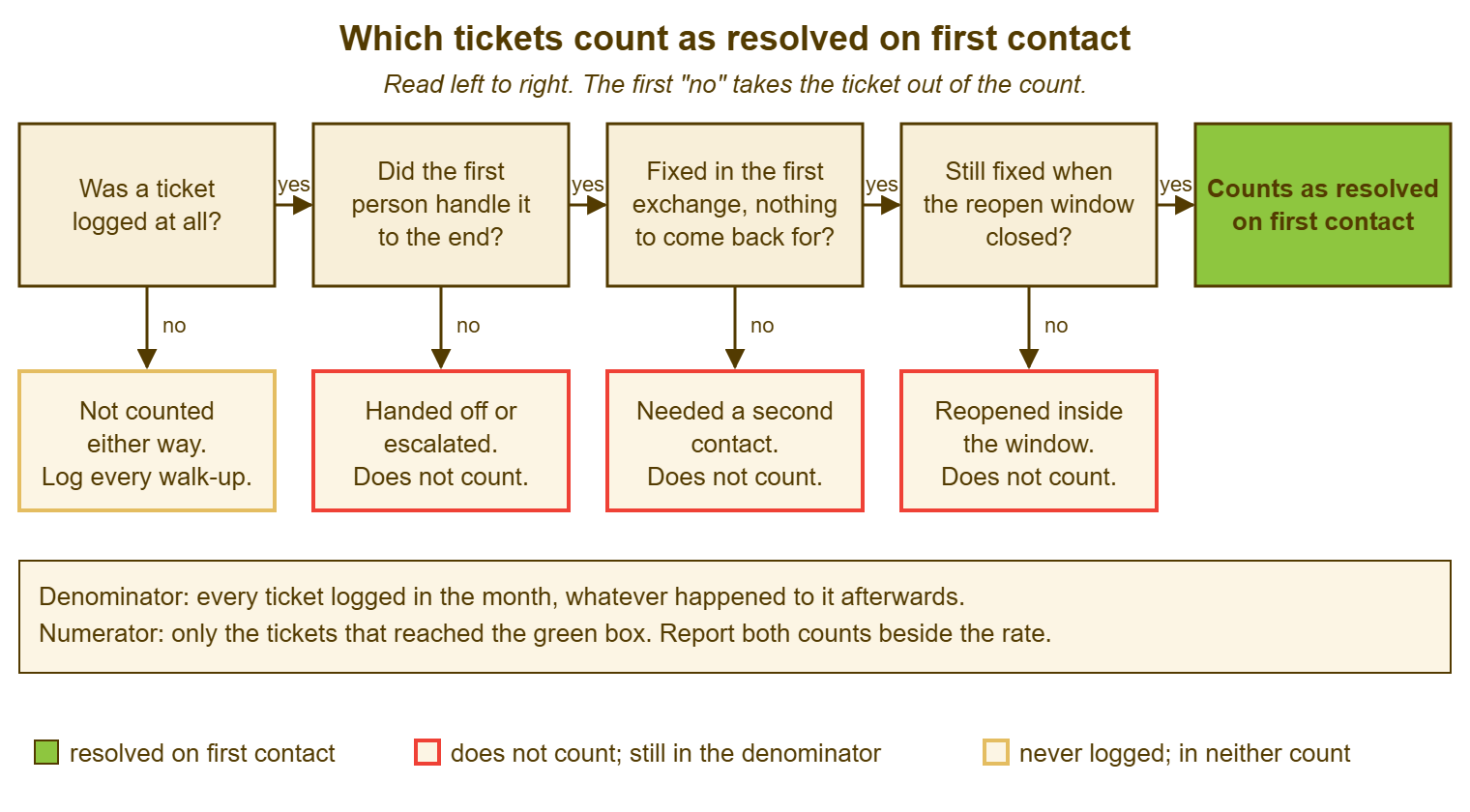
The questions are in order of cost. Whether a ticket exists is free; whether it had one owner is a filter. Whether it was fixed in one exchange is a count for most tickets and a reading for the rest. Whether it stayed fixed needs the window to have closed. That is why the month is counted a couple of weeks after it ends.
Counting by Hand When the Tool Will Not
Most help desk tools do not print first contact resolution, and the ones that do rarely say which rules they used. So the honest first count is done from an export in a spreadsheet. Export the month's tickets with, at least, the ticket number, the requester, the opened and resolved dates, and the source. Include the first and last owner, and the number of owner changes if the export gives it. Include the number of messages from the desk before resolution, and whether the ticket was reopened. Where there is no column for owner changes, count the ownership events in the history export.
Then the conditions become columns. A ticket passes rule two if its owner-change count is zero, or one if the desk's triage ruling says the first assignment does not count. It passes the exchange test, provisionally, if the desk sent exactly one message before resolution and the requester sent at most one after opening. It passes rule one if the reopened flag is clear and no other ticket from the same requester in the window matches by subject. The provisional passes then get a reading: take thirty at random, open each, and ask whether the one reply contained a complete fix. If twenty-seven of thirty did, the exchange test is holding. If nineteen did, the desk has a "let us know" habit and the reading is extended until the pattern is understood. In plain words, the figure is the count of rows that pass every test divided by the count of eligible rows. The reading is the check that the columns mean what you hope. Thirty is not a sample size blessed by anyone. It is the number at which a pattern either shows or does not. If the reading disagrees with the columns, trust the reading. The spreadsheet has never once asked whether the fix worked.
Reporting the Number With Its Counts
Report the two counts and the share together, every time, in that order: "203 of 440 tickets, a little under half". The counts are what a reader can check and what next month's figure is compared against. The share is what they will remember and misremember. A percentage to one decimal place is a figure asking to be compared with one from a different desk counted under different rules. Nothing good comes of that. Beside the counts, give the window, the date rule and the walk-up count in a line. It reads as pedantry the first month and as credibility every month after.
Small counts need care. A desk with forty tickets a month will see its figure move by several points when two tickets change sides. A month-on-month comparison at that volume is noise with a trend line drawn through it. Report quarters instead, or report the counts without a share, and say why. The same care applies with more force to any per-technician cut, where the counts are smaller still. A per-person figure is read for coaching, never for ranking, and not from fewer than forty or so tickets of a comparable kind. The fifth article in this series explains that rule. Nobody has ever been coached into a higher number by seeing their name at the bottom of a list.
Finally, report the number with the two figures that keep it honest, the reopen rate and the satisfaction score. A figure that rises while reopens rise is a desk closing faster, not fixing more. The pairing idea belongs to Reading Metrics Together; here it is enough that the figure never travels alone. A single number on a slide is a target. Three numbers on a slide are a measurement.
Remember: the counting rules are the metric. Decide the denominator, the reopen window, the handoff rulings, the reply test and the date rule once. Write them on one sheet with the date. Apply them identically every month, and report the two counts beside the share.
A Short War Story: The Eighty-Eight at Northgate Retail
When Tomasz took over the desk at Northgate Retail, the first thing he was handed was a slide showing first contact resolution at eighty-eight in a hundred for the previous year. The regional operations manager was proud of it. The store managers found it puzzling, since their staff described the desk as a place you asked three times. Tomasz recounted one month by hand under the four conditions. He found that the figure had been "closed after one reply". He found that unanswered tickets closed automatically after two days. And he found that a fifth of the "first contact" tickets had a second ticket from the same requester inside a week. The honest figure for the same month was a little over two in five. He spent about forty hours recounting the previous year so the trend line could be redrawn. He spent one long meeting explaining to the regional manager why the slide was being withdrawn. She took that better than he had feared and worse than he had hoped. The cost was a week of his time and a year of having every desk figure questioned by people who had been burned once. A number without its counting rules is not a measurement; it is a mood. And this one had been a good mood for a year.
The Counting Rules Sheet
The sheet below is the one Lena wrote after the two spreadsheets. It is filled in once, dated, and reused every month until the desk agrees in writing to change a line. Section A fixes the denominator. B to E are the five rules with the chosen rulings circled. F is the method so that whoever counts next month does it the same way. G is what leaves the desk. Keep it with each month's count. When a figure is questioned a year from now, the sheet is the answer. When the figure moves, the first thing to check is whether the sheet did.
FIRST CONTACT RESOLUTION — COUNTING RULES SHEET
Desk: ______________________   Rules agreed by: ______________________   In force from: ____________

A. THE DENOMINATOR
   Every ticket in the period is eligible, EXCEPT:
   [ ] tickets the desk opened for itself (alerts, change records, internal tasks)
   [ ] spam and junk
   [ ] duplicates merged into another ticket (the surviving ticket carries the contact)
   No other exclusions. Any further exclusion is written here with a date: ______________________

B. RULE ONE — THE REOPEN WINDOW
   Window: ____ working days after the ticket is marked resolved
   (same as the desk's resolved-to-closed confirmation period: yes / no)
   A reply from the requester inside the window saying it is not fixed ......... reopen
   A NEW ticket from the same requester, same fault, inside the window ......... reopen; link the two

C. RULE TWO — THE HANDOFF
   Any change of owner between first touch and resolution breaks the chain.
   Triage assignment with no work done on the ticket ............ is / is not a handoff
   Consultation where the owner stays the same ................... breaks / does not break the chain
   (condition: the advice is recorded as a note on the ticket)

D. RULE THREE — THE REPLY TEST
   A reply counts as a resolution only if it gave a complete fix and asked nothing of the requester.
   A reply that asks a question or says "try this and let us know" .... is NOT a resolution
   Ticket closed for silence after a complete fix, nothing came back ... counts / own bucket
   Ticket closed for silence after a QUESTION .......................... does not count

E. RULES FOUR AND FIVE — WALK-UPS, DATE AND UNIT
   Every walk-up, call and corridor fix is logged, resolved or not, source marked: ______________
   A ticket belongs to the month of its ............ open date / close date (pick one)
   The unit is the ticket. Merged tickets count once. Linked tickets count separately.

F. THE METHOD (same every month)
   1. Count two weeks after month end, so every reopen window has closed.
   2. Export: ticket, requester, dates, source, owners, owner changes, desk messages, reopened.
   3. Apply A to E as columns; count rows passing every test, and all eligible rows.
   4. Read 30 passing tickets at random; confirm the one reply held a complete fix.
   5. Search the window for same-requester follow-up tickets; link and recount.

G. WHAT LEAVES THE DESK
   "____ of ____ tickets, about ____"  plus: window ____ days, by ______ date, ____ walk-ups logged
   Beside it, always: reopen rate ______   satisfaction ______
   Per-technician figures: coaching only, never ranked, not read below ____ comparable tickets
Lena sent the operations director Mo's number on Wednesday, with the sheet attached. She included a sentence saying the figure was lower than the one he might have heard before because the rules were now written down. He asked why the walk-ups were in it. She explained. He asked whether the number would go up now that it was measured properly. She said it would go up when the first line could finish more tickets, and not before. That is the subject of the next article in this series. Ravi rebuilt his spreadsheet from the sheet the same afternoon and got 203 of 440. Two honest people, one number.
Frequently Asked Questions
Our tool reports a first contact resolution figure already. Can we just use that?
The requester replied "thanks, that worked" and we closed the ticket. Is that one contact or two?
We use a shared mailbox and nobody formally owns a ticket. Can we measure this at all?
Why count two weeks after the month ends instead of on the first?
How many tickets do we need before the monthly figure is worth reading?
We changed our reopen window last quarter. Can we still compare with earlier months?
From the QuerySolv team: we build self-hosted help desk software for Windows. QuerySolv runs as one Windows service on your own network. It takes requests by web form, e-mail, live chat, social messages and REST API. It is licensed once per installation rather than per agent per month. The free trial runs the full product for 30 days.