
Aptitude Versus Experience: Which Support Hire Suits Which Desk
Thursday, 17:10, at Redbrook Engineering. Priya runs a three-person desk and in three weeks it will be a two-person desk, because Olu has handed in his notice. She has two finalists. Marcus has eight years on an outsourced desk and knows two ticketing tools and three remote-support tools by name. He talked for an hour without once needing a question repeated. Lena was a laboratory technician who ended up running the lab's sample-tracking system because nobody else would. She has never opened a ticket queue. She spent the troubleshooting exercise asking questions Priya had not thought to put in it. Priya's manager has already said what he thinks: "Get the experienced one. We can't afford to train anybody." Priya's instinct says Lena. Her calendar says Marcus. Neither of them has done the arithmetic.
Aptitude is the capacity to learn the job and do it well: the curiosity, calm, clear writing and ownership described in What to Screen For in a Support Hire. Experience is having done the job already: tickets handled, queues carried, users calmed, tools used. They are not opposites and they are not a scale with one at each end. The argument between them never ends because both sides are arguing about a line when the picture is a grid. This article is part of our Hiring Support Staff series, and it draws the grid.
It covers the two words and why they get used as slogans, then the four-quadrant view, with the picture. Next come the career changer who has aptitude and no tickets and the experienced technician who arrives with habits to unlearn. Then it explains which hire suits a three-person desk and which a twelve-person one. The training cost in hours follows, as a worked example from a fictional desk. Then the article covers how to read the ramp without surveillance. A short war story and the aptitude-experience grid to fill in per candidate follow, in that order.
Two Words That Get Used as Slogans
"Hire for attitude, train for skill" and "we need someone who can hit the ground running" are both slogans. A slogan is a decision that has stopped thinking. The first is usually said by someone with a trainer to spare; the second by someone who has just lost a technician. Both are describing their own desk's situation and calling it a principle. The honest version of each asks how many hours this desk can spend teaching in the next three months. How many weeks can it wait for a full share of the queue to be carried?
Aptitude without experience is a person who will be good at this job and is not yet. Experience without aptitude is a person who has done this job for years and is about as good at it as they are going to get. Both are hireable. Neither is free. The cost of the first is training hours and a slow start. The cost of the second is a ceiling and, very often, a set of habits learned on a desk that was run differently from yours. Nobody writes "eight years of habits" on a CV, though it would be more accurate.
The mistake is to treat experience as a stand-in for aptitude. That assumes years on a desk proved that the person had the traits the desk needs. Some experienced technicians have them in abundance; some have survived eight years without them, on desks that never noticed. The exercises in Interview Exercises That Actually Predict measure aptitude directly. The whole point of using them for every candidate, the experienced ones included, is to let experience be exactly what it is. It is a second thing you know about the person, not a reason to skip finding out the first.
The Four-Quadrant View
Put aptitude up the page and experience across it, and every candidate you will ever interview lands in one of four boxes. The picture below names them. Top left, high aptitude and little experience, is the career changer. This hire learns fast, has not held a queue yet, costs training hours before paying back, and suits a desk with a trainer to spare. Top right, both high, is the rare find. This hire is productive in days, is still growing, suits any desk, and will not stay at level one for long. Bottom right, real experience and less aptitude, is the habits hire. This hire is productive early, plateaus early, arrives with the last desk's habits, and suits a desk that needs cover this month. Bottom left, little of either, is not this time.
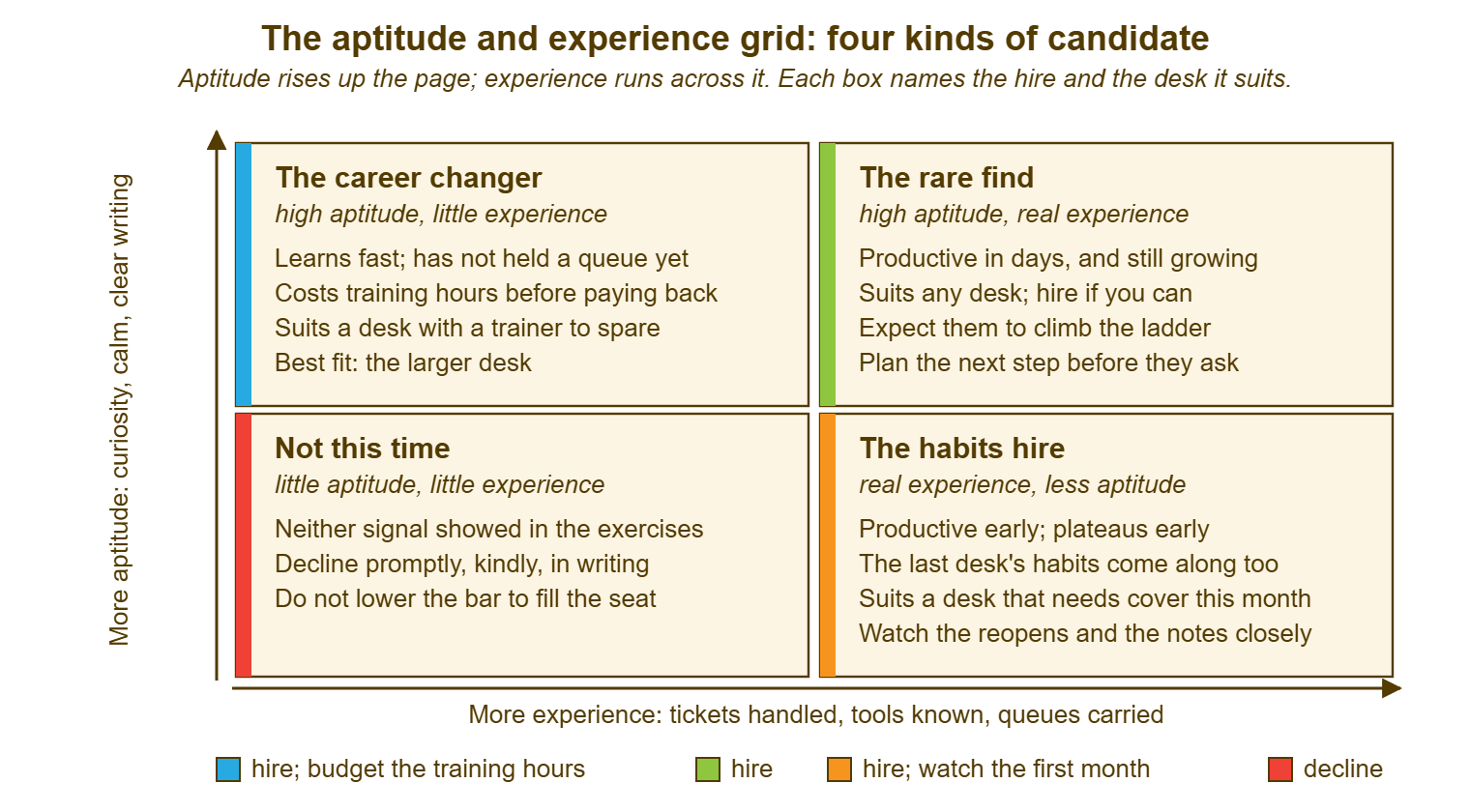
Two things about the grid are easy to miss. The first is that the top-right box is nearly empty in any given hiring round. The rare find is rare, is usually already employed, and is usually already being promoted. So a desk that waits for one will wait a long time. The second is that the bottom-right box is a hire, not a rejection. A technician with real experience and modest aptitude will keep a desk running, and there are months when that is exactly what a desk needs. The grid is not a ranking. It is a map of what each hire will cost and what it will give back. The aim is to base the decision on the desk's situation rather than on the hiring manager's slogan.
Which box a candidate lands in comes from two separate pieces of evidence, and they must stay separate. Aptitude is scored on the exercises and the screen, the same for everyone. Experience is read from the CV and the interview, against what the desk actually does rather than against a count of years. A candidate can score high on both, and a candidate with a long CV can score low on aptitude. When that happens the aptitude score is the one that was measured. The CV was only ever a claim.
The Career Changer: Aptitude and No Tickets
The career changer comes from somewhere adjacent: a pharmacy counter, a call-centre floor, a classroom, a laboratory, a hotel reception, a warehouse where they were the person everyone asked about the scanner. What they bring is the half of the job that is not about computers. They have calmed people down for a living and explained things to people who did not want an explanation. They have worked a queue of some kind under time pressure. Lena had spent four years telling research scientists why their samples were not where they thought they were. The desk's requesters will be easier.
What the career changer lacks is specific and teachable: the vocabulary, the tool reflexes, and a sense of what "normal" looks like on this network. They also lack the pattern library that lets an experienced technician hear "it's slow" and think of three likely causes before the user has finished. None of that is aptitude. All of it is hours, and the hours come out of someone else's week. That is why the career changer is a decision about the desk's capacity rather than about the candidate. The first weeks are described in The New Technician's First Thirty Days. The reason shadowing works when it is done properly is in Shadowing That Actually Teaches. Read both before you hire one, because the plan has to exist before the start date.
The career changer's hidden advantage is that they arrive without habits from another desk. They will do things the way you teach them, write notes the way your standard says, and close tickets the way your close works. That is because they have no other way to compare it with. That is worth more than it sounds. The experienced technician's third week is spent being told "we do it differently here". The career changer's third week is spent doing it.
The Experienced Technician: Habits to Unlearn
The experienced technician's great gift is speed from the first week. They know what a queue looks like, what a priority means, and how to ask a vendor for an update. They know roughly where the fault is likely to be in six of the ten commonest tickets. On a desk that has just lost a person, that speed is not a luxury. It is the difference between a backlog that stays flat and one that is the subject of Backlog Recovery by the autumn.
The gift comes in a box with the previous desk's habits in it. A technician from a desk that measured only closed tickets will close tickets without confirming the fix. Your reopen count will tell you so. What a Reopen Is Telling You explains how to read that. A technician from a desk with no note standard will write "fixed" and move on. A technician from a desk where level one was not allowed to touch anything will escalate tickets you expected them to solve. One from a desk with no escalation path at all will sit on tickets they should have passed up. None of these is a character flaw. Each is a habit that was rewarded somewhere else. Habits that were rewarded for years do not leave in a week because a new lead asked nicely.
You can find the habits in the interview. Ask every experienced candidate one pair of questions: "What would you keep from the way your last desk worked, and what would you change?" The answer tells you three things at once. It tells you whether they noticed how their desk worked, whether they can see its faults, and which of its ways they are attached to. A candidate who would change nothing has either worked on a perfect desk or has not been looking. A candidate who names the silent close as the thing they would change has already half-unlearned it. Ask the pair of questions, write the answer on the sheet, and you have the one piece of experience-side evidence that predicts anything.
Which Hire Suits the Three-Person Desk
A three-person desk has no slack. Each person carries a third of the queue. When one leaves, the other two carry half each until the hire can carry a share. Every week the hire cannot is a week of the lead doing two jobs. The three-person desk therefore leans toward experience. That is not because experience is better but because the desk cannot pay the training cost without the queue noticing. That is an honest reason, and When to Hire the Second Person makes the same argument for the smallest desk of all.
The lean has two conditions. The first is that the experience must be in the tickets this desk actually gets. Eight years on a desk that supported one application in one building is less use to a general desk than two years on a desk like yours. So read the CV against your own top ten ticket types rather than against the calendar. The second is that the habits question must be asked and the answer must be scored. That is because a three-person desk is the worst place in the world to discover a silent-closer. There is nobody spare to read their tickets, and the reopens arrive at the lead's own desk.
The three-person desk can still take a career changer, under one condition: the lead has to be honest about whether the training hours exist. Can the lead genuinely give the hire two full days a week for a month and a day a week for two months after that? Can the other technician cover? If both are true, the career changer is a fine hire and will probably be the better technician in a year. If those hours are a hope rather than a plan, the hire will be left to learn from the queue. The queue is a terrible teacher. It marks every mistake and explains none of them.
Which Hire Suits the Twelve-Person Desk
A twelve-person desk has slack it does not always notice. One hire carrying nothing for a month costs each of the others a twelfth of a share, which they absorb without a conversation. The desk has, or can have, a shadowing structure, a buddy, a ticket review habit and a lead who is not also the only senior technician. That is the desk for the career changer, and it should hire them deliberately. That is because the career changer with aptitude is the one who becomes the next level-two technician. The ladder that gets them there is in What the Ladder Looks Like.
The twelve-person desk's risk is the opposite of the small desk's: it can afford aptitude hires and tends not to make them. That is because each hiring manager, facing one vacancy, reasons like Priya's manager and takes the experienced candidate. Twelve of those decisions in a row produce a desk full of people who are good at level one and have no particular wish to leave it. That is a fine desk for the moment and a desk with no bench. The large desk should set itself a rule, in writing, about the mix. Some share of hires should come from the top-left box, each with a named trainer and a plan. The aim is to build the bench on purpose rather than hope for it.
The large desk also has the easier time with the habits hire. That is because a desk with twelve technicians has a visible house style and a note standard everyone follows. It also has a ticket review that catches the silent close in the first fortnight. Habits unlearn faster when the new person is surrounded by eleven examples of the alternative. On the small desk, the new person is a third of the examples.
The Training Cost in Hours: A Worked Example
Priya's manager said "we can't afford to train anybody", which is a claim about hours. So here are the hours, for a fictional four-person desk at Acme that gets about ninety tickets a week. The figures are an example, in ranges, and your desk will differ. The point is the shape of the two curves, not the numbers. The table gives, for each band of weeks, the hours a week a trainer spends with each kind of hire. It also gives the share of a full queue the hire carries. "Share" means the fraction of one technician's normal load; a full share is one quarter of Acme's ninety tickets.
| Weeks | Trainer hours a week: career changer | Trainer hours a week: experienced hire | Share carried: career changer | Share carried: experienced hire |
|---|---|---|---|---|
| 1 to 2 | 12 to 16 (shadowing, every ticket reviewed) | 6 to 8 (the desk's own ways and tools) | Near none | About half |
| 3 to 6 | 6 to 8 (paired, half the tickets reviewed) | 2 to 4 (habits review, spot checks) | A quarter to a half | Near full |
| 7 to 12 | 2 to 4 (weekly review, escalations) | 1 to 2 (weekly review) | Half to three quarters | Full |
| After 12 | About 1 (the standing review every technician gets) | About 1 | Full | Full |
Add the columns up and the career changer costs the trainer somewhere between seventy and a hundred hours over twelve weeks. The experienced hire costs thirty to fifty. The difference is forty to fifty hours, which is a little over a working week of one person's time, spread over a quarter. That is the cost everyone argues about, and on its own it is small. The cost everyone forgets is the second pair of columns. Over the same twelve weeks the career changer delivers about five or six weeks' worth of a full share. The experienced hire delivers about ten or eleven. The gap is five weeks of one technician's output. That is the number the three-person desk cannot afford and the twelve-person desk barely notices. Five weeks of a quarter of Acme's queue is roughly a hundred tickets that the rest of the desk carries. Five weeks of a twelfth of a larger queue is spread so thin that nobody files a complaint.
The experienced hire's hidden cost is in neither column. If the habits are bad, the lead spends two to four hours a week for the first quarter on them. The lead reads replies, catches silent closes and has the conversation about notes. In that case, some of those hours never stop, because a habit that was only half unlearned returns the first busy week. On the fictional Acme desk, that line alone can be thirty hours in the first quarter. That closes most of the gap in trainer hours between the two hires. It does not close the gap in output. Nothing does, which is why the arithmetic belongs on the table before the decision and not in the lead's head after it.
Remember: hire for the desk you have, not the desk you plan to have. Count the trainer hours and the weeks to a full share before you choose. If the hours are a hope rather than a plan, do not hire the candidate who needs them.
Reading the Ramp Without Surveillance
Whichever hire you make, you will want to know when the ramp has ended. The honest signal is that the new technician's numbers settle toward the desk's own. Reopen rate, time to resolution and the share of tickets escalated all drift toward the desk's median over the first quarter. The week they stop drifting is the week the hire is independent. If you run QuerySolv, the per-technician reports on reopen and resolution times show this directly. They are for coaching, not ranking: read them with the hire, not about the hire.
Do not read a per-person figure at all until the hire has handled enough tickets for it to mean anything. A reopen rate on a dozen tickets is noise with a decimal point. A lead who reacts to it will coach the hire on a coincidence. Wait until the hire has closed something like fifty tickets before the first number is looked at. Then compare it with the hire's own number a month later rather than with the best technician on the desk. The reasons for that discipline are the same as for any per-agent number and are set out in Satisfaction by Category and, Carefully, by Agent.
The ramp is also visible without any numbers at all, in the questions the hire asks. In week two, the career changer asks what things are. In week six, they ask why things are the way they are. In week ten, they ask whether something could be done differently. That question, from a person who could not find the queue in week one, is the moment the training cost was repaid. Write the date down. It is the number the next hiring decision needs.
A Short War Story: The Fast Start at Kestrel Print
At Kestrel Print, a commercial printer with a three-person desk, the lead, Aidan, lost a technician in the spring. He hired Dev, who had seven years on a desk at a large retailer. Dev closed more tickets in his first fortnight than the technician he replaced had in a month. Aidan was relieved enough not to look closely. The desk's reopen count, which had sat at four or five a week for a year, climbed to a dozen by the end of the second month. That was because Dev's previous desk had been measured on first-touch closes. He had learned to close on sending the reply, exactly as Avoiding the Silent Close warns against. By the time Aidan traced the reopens to one name, three department heads had separately asked whether "the new chap" was any good. Aidan spent the whole of the third month reading every reply Dev sent before it went out. That cost him roughly three hours a day and his own share of the queue. Dev was not a bad technician; he was a well-trained one, trained by a desk that had wanted something different. The habits question had never been asked at the interview, because the CV had answered the question Aidan thought he was asking. Experience arrives with the last desk's habits in the same box, and the interview is the only place cheap enough to open it.
The Aptitude-Experience Grid
The grid below is one page per candidate, filled in after the exercises and the interview and before the decision meeting. The aptitude half is scored on the same exercises for everyone. The experience half is read against the tickets your desk actually gets, not against years. The cost estimate at the bottom is the arithmetic from the worked example, done for your own desk. The decision line is only filled in after that estimate.
THE APTITUDE-EXPERIENCE GRID — ONE PAGE PER CANDIDATE
Candidate: ______________   Role: ______________   Desk size: ______
Trainer available: ______ hours a week for ______ weeks   Trainer name: ____________

APTITUDE (from the exercises and the screen; same evidence for everyone)
  Curiosity ____/3   Calm ____/3   Clear writing ____/3
  Ownership ____/3   Says "I do not know" ____/3          Aptitude total ____/15

EXPERIENCE (from the CV and the interview; against our tickets, not years)
  [ ] has carried a share of a queue         [ ] has written public replies to users
  [ ] has used a ticketing tool daily        [ ] has handled our top ten ticket types
  [ ] has escalated, chased and closed       Experience total ____/5

HABITS (experienced candidates; asked of every one)
  Would keep from the last desk: ______________________________________
  Would change: _______________________________________________________
  Habits to watch in the first quarter: _______________________________

QUADRANT:  [ ] career changer   [ ] rare find   [ ] habits hire   [ ] not this time

COST FOR OUR DESK
  Trainer hours, first twelve weeks: ______    Weeks to a full share: ______
  Who covers the gap: ______________          Hours a week that costs them: ______

DECISION: ______________   Reason in one line: __________________________
Agreed by: ______________ and ______________   Date: ________
Priya filled in two grids on the Friday morning. Marcus scored well on experience and in the middle on aptitude. His answer to the habits question was that he would change nothing about his last desk. Priya wrote that down and underlined it. Lena scored high on aptitude and had one tick on the experience side. The cost line said sixteen hours a week of Priya's time for a month that Priya did not have. She hired Marcus, with the habits line on the sheet and a fortnightly ticket review in the calendar from day one. She kept Lena's grid in the drawer. When the desk got its fourth person the following year, it did not need an advert. The grid was the arithmetic. The drawer was the plan.
Frequently Asked Questions
Is a career changer always the better long-term hire?
How do I tell relevant experience from a long CV?
What if the experienced candidate has bad habits but we need cover now?
How many trainer hours should I budget for a career changer?
Should the experienced candidate do the same exercises as everyone else?
When is the ramp over?
From the QuerySolv team: we build self-hosted help desk software for Windows. QuerySolv runs as one Windows service on your own network. It takes requests by web form, e-mail, live chat, social messages and REST API. It is licensed once per installation rather than per agent per month. The free trial runs the full product for 30 days.