
Interview Exercises That Actually Predict a Good Support Hire
Wednesday, 15:30, at Ashgrove Housing. Tom has sat through three interviews this week for a technician post on his five-person desk. He has learned that all three candidates are hard-working, enjoy a challenge, and have a greatest weakness that is a strength in disguise. He has learned nothing about whether any of them can calm down a lettings officer who has been locked out of the housing system. It is the third lockout this month, with viewings in forty minutes. The fourth candidate, Sofia, arrives at four. Tom hands her a printed e-mail from a fictional lettings officer called Jo, a pen, and twenty minutes. She writes four sentences to Jo and three to a colleague. Tom reads them and knows more about Sofia than he had found out about the other three in three hours. He also knows what he should have been doing on Monday.
An interview exercise is a small, realistic piece of the actual job, done during the interview. It is the same for every candidate and scored against a sheet written before anyone was invited. It is not a quiz, not a trick, and not a chance to watch someone sweat over a broken laptop. It is the closest a desk can get to seeing a person do the work before paying them to do it. This article is part of our Hiring Support Staff series. It describes the four exercises that have earned their place in my interviews and the rules that keep them fair.
It covers why an exercise beats a question, then the four exercises in turn. Those start with the written reply to an upset user and the troubleshooting walk-through aloud. Next come explaining something technical to a non-technical person, and prioritising five tickets. The article covers what each exercise reveals, with a picture, and how to score them without fooling yourself. Then come the fairness rules: the same exercise for everyone, no trick questions and no live-fire humiliation. It ends with how to run all four in an hour, a short war story, and the exercise pack to copy, in that order.
Why an Exercise Beats a Question
People can describe things they cannot do. That is not dishonesty; it is how description works. A candidate asked "how do you handle an angry user?" will give you an account assembled from things they have read, seen and intended. The account will be fluent in proportion to how many interviews they have sat in. An exercise removes the description and leaves the doing. Asked to write to Jo, the candidate either writes something Jo would be calmed by or does not. No amount of fluency changes what is on the page.
Exercises also compare better than questions do. Two candidates' answers to "tell me about a time you solved a hard problem" are two different stories about two different problems. The interviewer ends up comparing the problems. Two candidates' replies to the same e-mail from Jo are two answers to one question, scored on one sheet. The comparison is finally about the candidates. That is the whole reason the exercise must be identical for every person who sits it. It is as much a matter of accuracy as of fairness. Change the exercise and you have changed the ruler.
An exercise is not a test of trivia about your network or a free hour of consultancy on your actual problems. It is not a performance in front of an audience. The exercise shows a trait, and the traits worth seeing are the ones in What to Screen For in a Support Hire. Those are curiosity, calm, clear writing, ownership and the willingness to say "I do not know". Each of the four exercises below was chosen because it shows two or three of those in twenty minutes or less. That is a better rate than any question I have ever asked.
Exercise One: The Written Reply to an Upset User
Hand the candidate a printed ticket from a fictional requester who is frustrated for a good reason. Ask for two things in twenty minutes. One is the reply the requester will read. The other is the internal note a colleague would read if they picked the ticket up. Jo's e-mail in the pack is a fair example. Jo is locked out of a system for the third time, with a deadline in forty minutes. Nobody kept the previous promise of a call back. The candidate does not know the system and does not need to. The exercise is about the reply, not the fix.
Read the reply as Jo would. Does it acknowledge that three lockouts and a missed call back are a real problem, without grovelling or blaming a colleague? Does it say what happens next and by when, in a sentence Jo can hold the desk to? Does it ask for, or state, the one thing the desk needs to move? Is it short enough to read on a phone while walking to a viewing? The reasons those four things matter so much are in Acknowledging Impact Honestly. The craft of doing it under time pressure is in Writing Clearly Under Pressure. A candidate who manages three of the four in twenty minutes, on a fictional system, with a stranger watching the clock, will manage all four on a real one.
The internal note is the half of the exercise most candidates have never been asked for. It is where clear writing shows most honestly. A good note says what the technician has done, what they think is going on, and what the next person should do. It uses plain words a colleague could act on at seven the next morning. The two pieces, the public reply and the internal note, mirror the split nearly every help desk tool keeps on a ticket, QuerySolv among them. That is why the exercise feels like the job rather than like an essay. Candidates who have worked a queue recognise it immediately. Candidates who have not usually write a better note than they expected to, because nobody told them it was hard.
Exercise Two: The Troubleshooting Walk-Through, Aloud
Give the candidate a symptom with a detail missing. Ask them to talk through what they would ask and check, and in what order. Ask when they would stop and look something up or hand the ticket on. "A user says the printer on the second floor isn't working" is enough. It is deliberately vague: one user or everyone, the printer or the print queue, this morning or always. A candidate who starts by asking is showing you curiosity. A candidate who starts by reinstalling the driver is showing you something too.
Score the order of the questions and the steps, not whether they reach the right answer, because there is no right answer. There is a missing detail and a reasonable path toward it. The path you are hoping for is the one described in The Diagnostic Order. Establish what is actually happening, and check the cheapest and most likely things first. Change one thing at a time, and know when the fault has left your competence. A candidate with experience will walk it from memory. A candidate without will often walk it from common sense, which is the same path with different vocabulary. The sheet should give both the same score for the same path.
The moment to watch is the stuck moment. There will be one. Somewhere in the walk-through you will answer a question with "no, that's fine" and remove the cause they were heading for. What happens next is calm, or it is not. The candidate who pauses, says "then I'd want to know whether anyone else can print", and goes on has shown you recovery. The candidate who says "I'd probably just rebuild the print server" has shown you what they will do on a Friday afternoon with a real print server. (Do not score the second candidate down for being human. Score them down for the server.) And a candidate who says "I don't know what I'd check next; I'd look it up or ask" has given you the single best sentence in the exercise. The sheet should reward it as such.
Exercise Three: Explaining Something Technical to a Non-Technical Person
Ask the candidate to explain one technical thing to you as if you were a named non-technical colleague, in under a minute. Then ask one follow-up question in that colleague's voice. The thing should be ordinary and the same for everyone. It could be why the desk asks people to restart before anything else, or why the laptop drops its connection when the lid is closed. Or it could be why a password change on the computer did not fix the phone's e-mail. You play the finance manager. You are polite, slightly impatient, and you ask "so is it broken, or isn't it?" when they finish.
Score on four things: no jargon left unexplained, roughly three sentences, a check that the listener has understood, and a tone that does not talk down. The three-sentence shape is not a stylistic preference; it is the shape that works, and The Three-Sentence Explanation explains why. The tone matters more than most interviewers expect, and Patience Without Condescension describes the failure you are listening for. That is the explanation that is accurate, plain and faintly insulting.
Most candidates do worse at this than at anything else in the pack, including candidates with years on a desk. The exercise is worth keeping for that reason. Explaining is the part of the job that was never taught to anyone. The candidate who checks whether you understood, who asks "does that make sense, or shall I try it another way?", is rare. That is the one whose requesters will stop phoning back to ask what the e-mail meant.
Exercise Four: Prioritising Five Tickets
Hand the candidate five one-line tickets on a card and give them ten minutes to put them in the order they would work them. Within that time, ask them to say why, and who, if anyone, they would tell before starting. The five in the pack are deliberately mixed. A senior person has a printing problem with a meeting in two hours. A warehouse scanner is down with six people waiting and a shift ending. A new starter on Monday has no account yet on a Thursday. A user clicked a link in a phishing e-mail ten minutes ago. And a report "looks wrong" for an analyst who is not in a hurry. There is no single correct order. There are several defensible ones and some indefensible ones, and the reasons are what you are scoring.
Listen for impact and urgency being weighed separately, in whatever words the candidate uses for them. The idea is explained in Impact and Urgency in Practice. A candidate who has never heard the terms will often still say "six people are stuck, and the shift ends at two". They will often say "the phishing one might get worse while I wait". That is the same reasoning without the vocabulary. Listen for the phishing click being recognised as something that goes to a named person now rather than being worked in turn. And listen for who gets told. The candidate who says "I'd tell the assistant it's next and when" has ownership. The candidate who would start on the scanner without telling anyone has left four people wondering.
Do not score the candidate against your own order. Interviewers have a private ranking and a strong urge to mark the candidate down for not sharing it. The urge has to be written out of the sheet, because the ranking is yours and the reasoning is theirs. A candidate puts the senior person's printing first and says "because the meeting is a hard deadline and the fix is probably five minutes, then the scanner". That candidate has reasoned well, even if you would have gone the other way. One who puts it first and says "because he's the chief executive" has reasoned about rank. Then Who Decides the Priority is the conversation you would be having with them in a month.
What Each Exercise Reveals
The four exercises were not chosen at random. Each one shows two or three of the traits the screening sheet asks for, and together they cover all of them more than once. The picture below draws the map. The written reply mainly tests clear writing and calm, and also shows ownership in whether the next step is stated. The walk-through mainly tests curiosity and the willingness to say "I do not know", and also shows calm at the stuck moment. Explaining plainly mainly tests clear writing in its spoken form, and also shows curiosity about what the listener already knows. Prioritising five tickets mainly tests judgement and ownership, and also shows honesty about what the candidate would need to find out first. Every trait has at least one solid line into it, which is the check that the pack is complete.
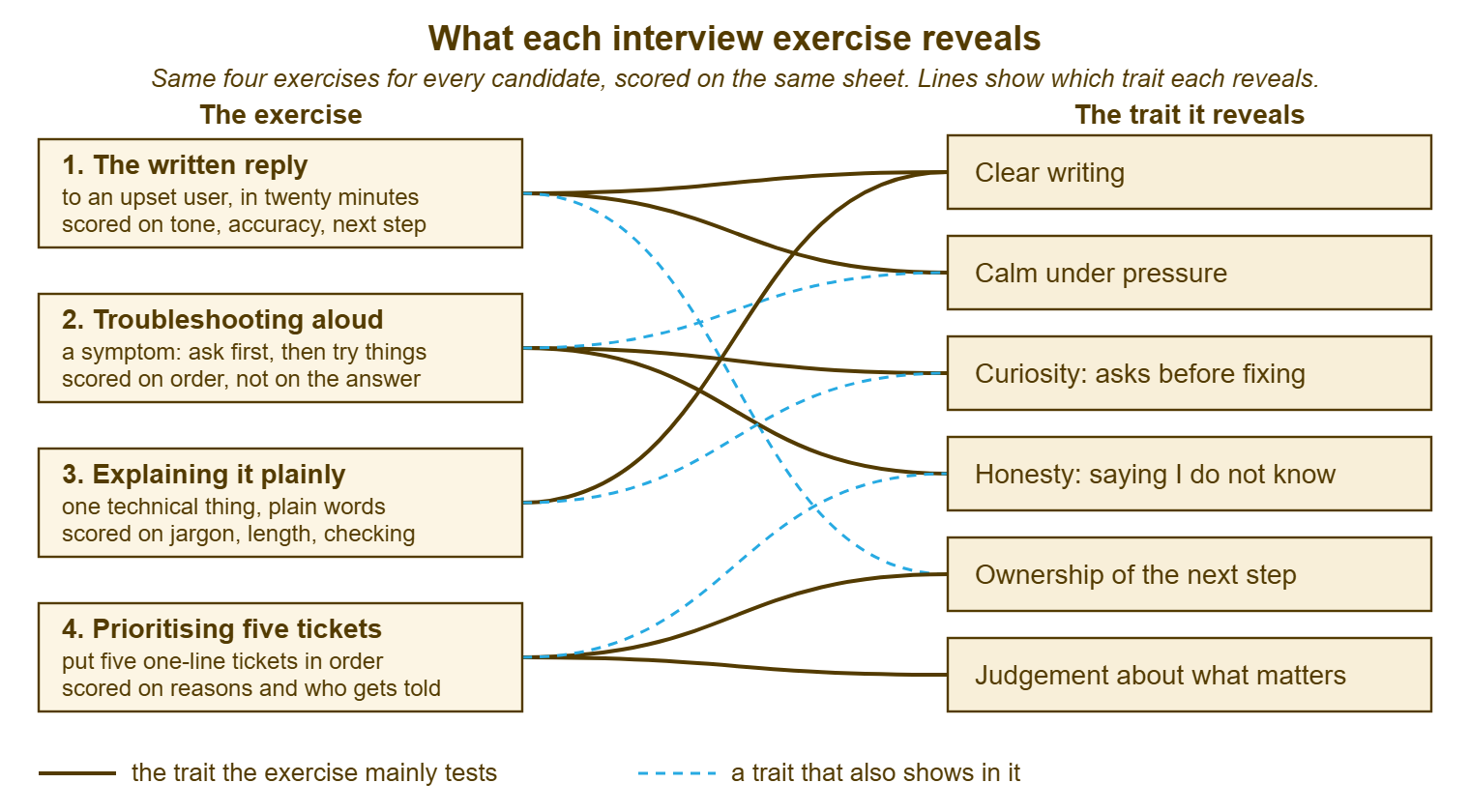
Use the map in the other direction too. If your desk cares about one trait above the others, the map tells you which exercise to weight. If you can only run two exercises in the time you have, keep the written reply and the walk-through. Between them, they touch all five traits. And if a candidate scores well on three exercises and poorly on one, the map tells you which trait to ask about in the decision meeting. In that case, you have the evidence in front of you rather than an impression.
Scoring Without Fooling Yourself
Each exercise gets three or four criteria, each scored one to three, by each interviewer separately, before anyone speaks. The sheet carries a sentence describing what a three looks like and what a one looks like for every criterion. That way, two interviewers who have never met score the same answer the same way. The candidate who was charming is not scored on charm. The table below is the one I use; the anchors are the important part.
| Exercise | Criteria (each 1 to 3) | What a 3 looks like | What a 1 looks like |
|---|---|---|---|
| Written reply | Impact acknowledged; next step and time stated; accurate and blame-free; short enough | Jo would feel heard, know what happens by when, and could read it walking to a viewing; the note tells a colleague what to do next | Generic apology, no time, blames "the system" or a colleague, or three paragraphs; the note says "see above" |
| Walk-through aloud | Questions before actions; cheapest-first order; knows when to hand on; honest about gaps | Asks who and since when before touching anything, checks the simple things first, names the point they would escalate, says "I'd look that up" | Starts with a reinstall or a rebuild, changes several things at once, never escalates, guesses fluently past the missing detail |
| Explain plainly | No unexplained jargon; about three sentences; checks understanding; respectful tone | A finance manager would understand it, could repeat it, and would not feel talked down to; the follow-up question is answered directly | Jargon stacked on jargon, a lecture, no check, or a tone that makes the listener feel stupid for asking |
| Prioritise five | Reasons given; impact and urgency weighed; the security ticket flagged now; who gets told | Each position has a reason in terms of people and time, the phishing click goes to a named person immediately, and waiting requesters are told | Order by rank or by arrival, no reasons, the phishing click worked in turn, nobody told anything |
Score independently, in silence, before the candidate has left the building if you can. Memory of an exercise decays faster than you would believe. The last candidate of the day always seems better or worse than they were. Then compare. Where two interviewers differ by two points on one criterion, talk about what was said, not about what was felt. In that case, change a score only when one of you has remembered something the other missed. The full rubric and the decision meeting belong to Structured Interviews and Fairness. The exercise scores feed it.
Resist the urge to add a column for "overall impression". It will be filled in first and the other columns will be adjusted to agree with it. If you want a place for the feeling, put it in a notes box at the bottom. In that case, add the instruction that whatever is written there must be checked against the scores above it. A feeling is permitted to send you back to the evidence. It is not permitted to overrule it.
Fairness: The Same Exercise, No Tricks, No Live Fire
Every candidate gets the same pack, in the same order, with the same time, in the same kind of room. The exercises are described in the invitation so that nobody is ambushed. Tell them there is a twenty-minute written exercise, a talk-through of a fault, a short explanation and a prioritisation card, and roughly how long each takes. Candidates who know what is coming perform closer to how they will perform on the job, which is what you are trying to see. Candidates who are surprised perform like surprised people. Preparing them is not softening the test. It is removing the part of the test that measured surprise.
No trick questions. A question might have a hidden catch. A fault might be impossible to find because you have left out the one thing that would find it. A scenario might be designed to make the candidate contradict themselves. These test whether the candidate trusts the interviewer. The candidate will not, and they will be right. The missing detail in the walk-through is not a trick, because the candidate is told that asking questions is the point and is rewarded for asking. The difference is whether the candidate can win by behaving well. In a trick, they cannot.
No live-fire exercises. "Here is a broken laptop, fix it while we watch" feels like the most realistic test there is and is the least fair, for three reasons. The fault is different for every candidate, because each one leaves the machine in a different state. The audience changes the task, because nobody on a desk fixes a laptop with three silent people behind their chair. And the only consistent outcome is that a nervous good candidate is humiliated and a confident weak one is not. That is the opposite of what the pack is for. If you want to see hands on a keyboard, give every candidate the same screenshot and ask what they would do next. The screenshot does not change between candidates. Laptops do.
Remember: use the same exercises, in the same order, with the same time, for every candidate. Describe them in advance, and score them on a sheet written before the first interview. No trick questions, nothing done live in front of an audience, and any adjustment offered to one candidate is offered to all through HR.
Adjustments are HR's to define and yours to offer evenly. Some candidates will need more time, a keyboard instead of a pen, a quieter room, or the walk-through done in writing rather than aloud. The organisation's rules say what is available and how it is requested. Ask HR for them before the first invitation goes out. Put the offer in every invitation in the same words. Record what was used on the sheet so the scores can be read in context. This article owns the craft of a good exercise. HR owns the rules about who may be asked what, and about what the organisation must offer. The exercise pack is shown to them before it is used, every time it changes.
Running the Four in an Hour
All four exercises fit in an hour and a quarter, with the candidate's own questions at the end, and the order matters. Start with the written reply, because it is done alone and settles the nerves. The candidate sits with a pen and a problem for twenty minutes, and the interviewers are not in the room. Then run the walk-through aloud for fifteen minutes, the explanation for ten, and the prioritisation card for ten. Then give the candidate fifteen minutes to ask about the desk, which is where curiosity shows last and most honestly. Score during the twenty minutes before the next candidate arrives, separately, in silence.
Keep the exercises out of the conversational part of the interview, which has its own structure and its own sheet, described in the structured interview article. Mixing them produces an hour in which the candidate is never sure whether they are being asked a question or set a task. The interviewers are never sure what they are scoring. Two clearly separate halves, a short break between them, and the candidate told at the start what each half is for, is the shape that works. It is also the shape that is easiest to defend afterwards, because every candidate can be shown to have had the same hour.
A Short War Story: The Live Laptop at Pennant Marine
At Pennant Marine, a boat-builder with a three-person desk, the lead, Carla, built what she called a practical test. A laptop with a deliberately broken network setting was placed in front of each candidate with the words "fix it, we'll watch". Three interviewers were in a row behind the chair. The first candidate half-fixed it and changed a second setting on the way. So the second candidate faced a different fault from the one Carla had set. The third candidate, whose written reply had been the best of the week, froze in front of three silent watchers. The candidate got nowhere in fifteen minutes, and withdrew by e-mail that evening. Pennant hired the candidate who had happened to get the easiest version of the fault. He was a competent technician who could not write a public reply, which the laptop had never tested. He left for a field role within six months, which cost Carla a second hiring round. It also cost her a complaint to HR from one of the other candidates about the test having been different for each person. It had. The withdrawn candidate took a post at a logistics firm two miles away and was leading its desk when Carla next advertised. An exercise that differs for every candidate is not an exercise. It is a lottery with witnesses, and the best ticket in the draw had already gone home.
The Exercise Pack
The pack below is what the interviewers hold and what, in outline, the invitation describes. Print one copy per candidate, and keep the texts identical from the first interview to the last. Score each criterion one to three against the anchors in the table above. The timings are the ones that have worked for me. Change them if you must, but change them for everyone. Show the pack to HR before the first candidate sits it.
THE EXERCISE PACK — SAME FOR EVERY CANDIDATE, SCORED ON THE SAME SHEET
Candidate: ______________   Date: ________   Interviewers: ____________ / ____________
Pack version: ______   Shown to HR on: ________   Adjustments used: ______________

1. THE WRITTEN REPLY (20 minutes, candidate alone, pen or keyboard)
   Ticket text given to the candidate:
     From: Jo (Lettings)   Subject: STILL locked out
     "This is the third time this month the housing system has locked me out.
      I have viewings at 10:40 and need the tenancy details. Nobody called me
      back last time. Can someone actually fix this?"
   Asked for: (a) the reply Jo will read   (b) the internal note for a colleague
   Scores: impact acknowledged __  next step and time __  accurate, blame-free __  length __

2. THE WALK-THROUGH, ALOUD (15 minutes)
   Given: "A user says the printer on the second floor isn't working.
           Talk me through what you'd ask, check and do, in order, and
           where you'd stop to look something up or hand it on."
   Interviewer answers questions from the card; one detail is withheld until asked.
   Scores: questions first __  cheapest-first order __  knows when to hand on __  honest gaps __

3. EXPLAIN IT PLAINLY (10 minutes)
   Given: "Explain to me, as the finance manager, why we ask you to restart
           before we do anything else." Interviewer asks one follow-up in role.
   Scores: no unexplained jargon __  about three sentences __  checks understanding __  tone __

4. PRIORITISE FIVE TICKETS (10 minutes)
   Card: 1 Senior manager's assistant cannot print the board paper; meeting in two hours
         2 Warehouse scanner down; six pickers waiting; shift ends at 14:00
         3 New starter on Monday has no account; it is Thursday afternoon
         4 User clicked a link in a phishing e-mail ten minutes ago
         5 Weekly report "looks wrong" for an analyst who is "not in a hurry"
   Asked for: the order, the reason for each, and who they would tell before starting.
   Scores: reasons given __  impact and urgency weighed __  security flagged now __  who is told __

5. THE CANDIDATE'S QUESTIONS (15 minutes)   Noted, not scored: ______________________

Totals: written __/12   walk-through __/12   explain __/12   prioritise __/12
Scored independently before conferring:  [ ] interviewer 1   [ ] interviewer 2
Sofia's reply to Jo was four sentences long, named a time, asked one question and apologised once. Her internal note told a colleague which two things to check and in which order. Tom hired her. The three candidates from earlier in the week were sent, politely and promptly, the note described in The Job Advert and the First Screen. Tom was privately aware that he had never given them the chance to write to Jo. He re-ran the week's interviews in his head and could not say, for any of the three, whether they could have. That is the cost of a question. An exercise is the refund.
Frequently Asked Questions
Should I send the written exercise to candidates before the interview?
What if a candidate asks about our real systems during the walk-through?
Is it fair to use the same pack for an experienced candidate and a career changer?
How do I stop interviewers scoring the candidate against their own ticket order?
Can I change an exercise halfway through a hiring round if it is not working?
What should the pack say about adjustments?
From the QuerySolv team: we build self-hosted help desk software for Windows. QuerySolv runs as one Windows service on your own network. It takes requests by web form, e-mail, live chat, social messages and REST API. It is licensed once per installation rather than per agent per month. The free trial runs the full product for 30 days.