
After the Decision: Showing the Result Either Way
Friday, 16:50, at Acme. Ravi's third technician, Josh, has been on the desk for four months, and the desk feels different. The morning queue is read by ten, and the oldest ticket is under three weeks old. Ravi has gone home on time for most of a month, which he had stopped expecting. Diane is the operations director who took his one-page case to the finance meeting and argued for it in a room he was not in. She walks past the desk on her way out and says, in passing, "So, did the extra person help?" Ravi says yes, it has, a lot. She says good, and goes. He sits down and realises that is the entire report she has had, four months after spending a salary on his arithmetic. It was one word, in a corridor, from the person who wanted the money.
The follow-up report is the one page the desk sends to whoever made the decision, on the date the case promised. It shows the same numbers the case was built on, before and after. It is the part of the case most desks never write, because the decision felt like the end of the job. It is the part that decides whether the next case takes one meeting or four. This article is part of our Using Ticket Data to Justify Resources series. It closes the series the way the report closes the case: with the same five numbers from Evidence Over Anecdote, measured the same way, whether the decision was yes, no or later.
It covers why the follow-up is part of the case and the before and after in the same numbers, with a picture. Next come dealing honestly with the ramp, checking what else changed, and closing the loop with the person who decided. Then it covers what to send when the result is worse than predicted and the credibility account. It finishes with the ask that was refused and what to measure anyway, a short war story, and the follow-up report to copy.
Why the Follow-Up Is Part of the Case
The case made a prediction, and a prediction nobody checks is a guess that happened to be funded. Every one-pager in this series ends with a promise to report the same numbers back at three months and six months. And the follow-up report is that promise kept. It is not a courtesy and it is not a celebration. It is the only evidence the decision-maker will ever have that the desk's arithmetic describes the world. And it is therefore the only thing that makes the desk's next arithmetic worth reading without a meeting.
Most desks never send it, and the reasons are understandable. The hire starts. The queue improves. The lead is busy with the improvement. And the person who approved the money finds out from nobody, or from a word in a corridor. A year later the same lead asks for something else and is met with "we gave you a person last year". It is said not as a refusal but as a question. The lead cannot answer it on the spot because the answer was never written down. The numbers existed the whole time. Nobody had sent them to the one person who had a reason to want them.
The follow-up also protects the desk when the result is mixed, which it often is. A report the desk sends, on the promised date, saying "the backlog has fallen by less than we predicted and here is why" is a disappointment delivered by a reliable source. The same fact discovered by the director from someone else's complaint is a surprise delivered by nobody. Surprises are what decision-makers remember at the next budget round. Predictions that miss are survivable. Silence is not.
The Before and After, in the Same Numbers
The before and after are the five numbers of the evidence set, and nothing else. They are volume, hours per ticket, backlog at month end, median first response, and the oldest ticket waiting for hours rather than for anyone. The before is the six months on the case page, and it is frozen. Do not recompute it with a better method, because the comparison is only honest if both sides were counted the same way. The way they were counted is the way the case was approved on. The rules for a definition two people would get the same number from are in Defining Each Metric Exactly. The follow-up uses the case's definitions even if the desk has since found better ones. Say so, and change the definitions for the next case.
The after is three settled months, measured after the change has had time to take effect. And the length of the settling period is stated on the case page in advance so that nobody can be accused of choosing it afterwards. For a hire it is the ramp, usually a quarter. For a tool it is the first month's dip. For a protected week it is the month after the week. The picture below is Acme's backlog across twelve months: six before the decision, three of ramp with Josh at about half capacity, and three settled months after. It is one number from the five, chosen because it is the one Diane drew a line under. And the other four are a table beneath it on the page.
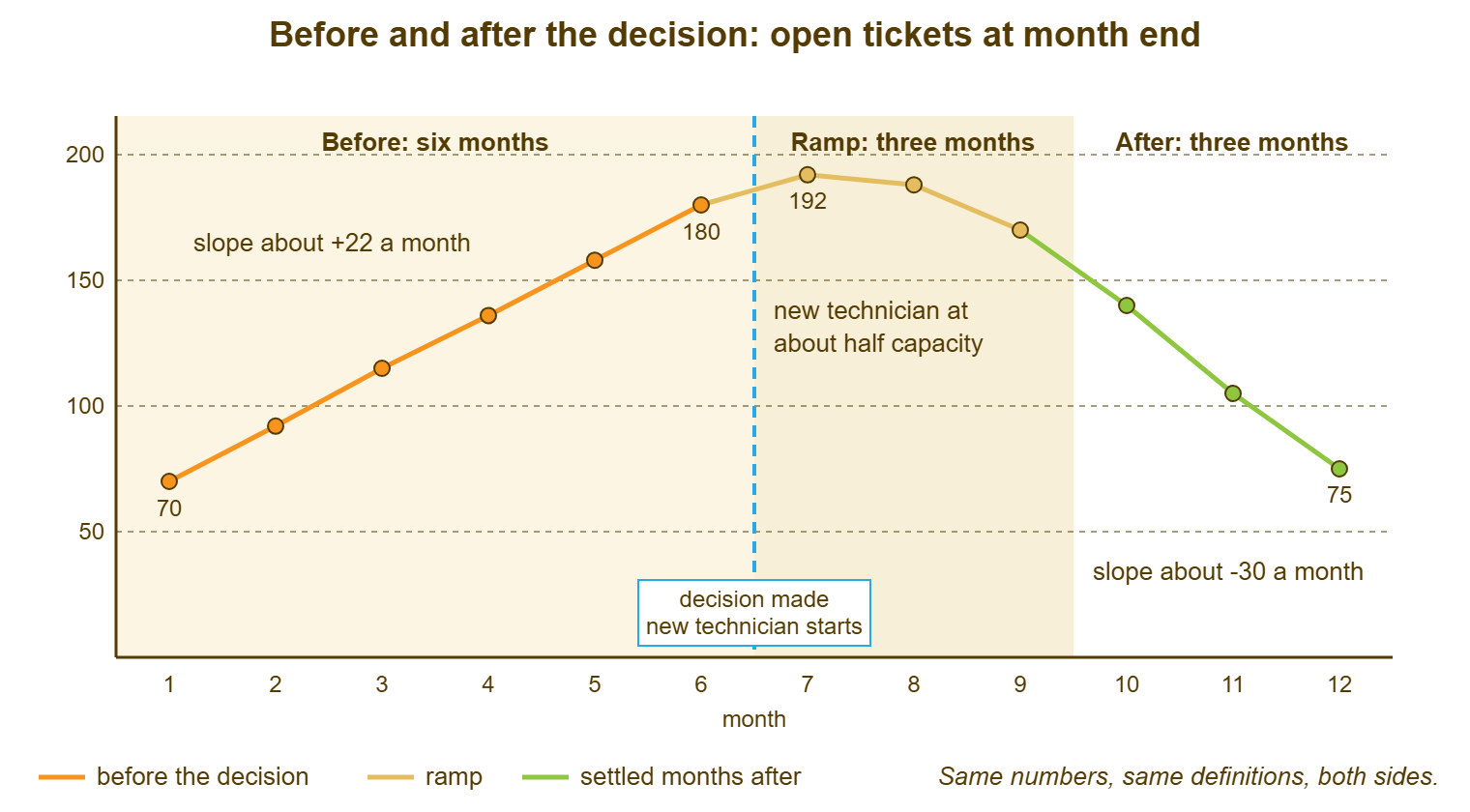
Read it as the director will. The before slope is about twenty-two tickets a month upward, which is the figure the case was built on. The ramp months are worse than the before, and they are on the chart. The after slope is about thirty a month downward. At that rate the backlog reaches the level a desk of this size should carry in about one more month. The case had predicted a surplus of about sixty hours a month after the ramp and a backlog cleared in two to three months; the after shows roughly that, slightly slower, because volume rose a little over the year. That sentence, prediction beside result, is the heart of the report. The chart is there so the sentence can be checked at a glance, and it is the plainest chart that will do that job.
Dealing Honestly With the Ramp
The first report after a hire is the hardest one to send, because the numbers are worse than before the hire. It is the most important one, because the case said they would be. A new technician at half capacity while the existing technicians spend hours teaching them produces a month or two in which the backlog rises faster than it did before. At Acme it went from a hundred and eighty to a hundred and ninety-two in Josh's first month. Ravi sent the three-month report with that figure in the first line, beside the sentence from the case page that had predicted it. Diane's reply was "as expected, thanks", which is the best three words a follow-up report can receive.
A desk that waits until the numbers look good before reporting has turned a prediction into a selection. A director who notices the gap between the decision and the first report will wonder what happened in it. Send the three-month report on the date, whatever it says. If the ramp is taking longer than predicted, say so and say why, from the tickets. The new person may have been given the hard tickets too early, or the handover from the old tool is still eating hours. The ramp is not a failure of the case. It is the part of the case that is easiest to be honest about, because it was written down first.
Never report the new technician's own numbers. The after picture is about the desk. And the question is whether the desk's capacity changed as predicted, not how many tickets Josh closed in his third week. A per-person figure for someone in their first quarter is meaningless as a measure and harmful as a message. The rule that per-technician numbers are for coaching rather than ranking applies with extra force to the person whose arrival the whole report is about. The desk got better. That is the sentence. Who closed what is nobody's business outside the desk.
Remember: the follow-up report shows the same five numbers the case was built on, counted the same way. It covers the six months before and three settled months after, with the ramp or the dip on the chart. It goes to the person who decided, on the date the case promised, whatever it says.
What Else Changed
Before the after figures are credited to the decision, the report says what else happened to the desk in the same months. It uses the same discipline that Deflection Math Without Fooling Yourself applies to a knowledge base article. A drop in a number will accept credit from anyone who offers it, and the desk's job is to make it earn it. Did volume fall, so that the backlog would have shrunk without the hire? At Acme it rose slightly, which strengthens the result and is said. Did another change land in the same quarter, a reset project, a scripted fix, a department moving to another system? If so, the report names it and gives it its share, in a range. Did the desk change how it counts? If so, the comparison is broken and the report says which months are comparable.
The honest version is often less flattering and always more believable. "The backlog fell by about a hundred and fifteen tickets over the three settled months; about ninety of that is the extra capacity, and about twenty-five is the self-service reset project that went live in month eight, which removed roughly thirty-five tickets a month on its own" is a sentence a director can trust about everything else on the page. A report might claim the whole drop for the hire, when the director knows the reset project went live. That report has told them something they know is wrong. They will reread the rest looking for the next one.
If you run QuerySolv, the standard reports on volume, backlog by age and response times are the same reports the case was built from. So the after figures come from exactly the place the before figures did. The "what else changed" check is a matter of reading the same reports for the months in between. In any tool, the principle is the same: the after is counted from the same source, with the same filters, by the same person if possible. The report says so in one line.
Closing the Loop With Whoever Decided
The report goes to the person who made the decision, by name, on the date the case promised, without being asked for. It is one page. It leads with the sentence that answers the question they would ask: "the desk's backlog is falling at about thirty tickets a month and will be at a normal level by month thirteen; the case predicted two to three months after the ramp and it has taken about four". Then comes the chart, then the table of the other four numbers before and after. Next come what else changed and what the surplus hours are being spent on. Then comes one line on what the desk will report next and when. The page follows the format the Reporting to Leadership series sets out for anything a senior reader is expected to finish. This is the one report the desk most needs finished.
Say what the surplus bought, because the case promised it would buy something. At Acme the extra sixty hours a month went, after the backlog, into the two permanent fixes the desk had never had time for. Those hours also went into the morning triage that keeps the first-response median where the case said it would be. A director who sees that the hours are being spent on the things the case named has seen the desk keep two promises, not one. A director who sees a surplus with nothing against it will propose, at the next round, that the surplus be smaller.
Thank the person plainly and once, for the decision rather than for the money, and without flattery. "You argued for this in a room I was not in, and the numbers say you were right to" is a sentence that costs nothing and is remembered. Then stop. The report is not a message about the relationship between the desk and the director. It is a message about whether the desk's arithmetic describes the world. And the warmth it contains should be the warmth of being proved right together.
When the Result Is Worse Than Predicted
Sometimes the after is below the range. The backlog fell but not far enough. The tool saved twenty hours a month and the case said forty to sixty. The training landed and the escalations did not fall because the supplier's contract requires the escalation anyway. The report for this is the same page in the same order. The first sentence says the result plainly, with the prediction beside it: "the case predicted twelve to sixteen hours a month returned and the measured figure is about seven". Then explain why, from the tickets. It is nearly always one of three things: a second cause was hiding behind the first. Or something else changed that the desk did not control, or the estimate was simply wrong. The report says which.
Then what the desk will do about it, which is the part that turns a miss into a plan. If a second cause is visible, there is a second fix with its own time case. If the estimate was wrong, the next case will use the measured figure, and the report says so. That tells the director the desk's numbers get better rather than merely getting defended. The wider craft of a report whose numbers are bad, including what not to do, is in When the Numbers Are Bad. The follow-up version is simpler because the prediction is already on record and the only question is the distance from it.
A prediction that missed, reported by the desk on the promised date, costs less credibility than a prediction that hit and was never reported. I know this because I have done both. The director who received the miss asked for my next case by name. The one who never received the hit asked, a year later, whether the hire had helped. Reliability is the asset. Accuracy is what reliability is made of over time, and a desk that reports its misses is the only kind that can prove its hits.
The Credibility Account
Every kept promise is a deposit, and the desk is saving for the next ask. The first case took a one-pager, an appendix, a meeting and a week of pushback. The second, after a follow-up report that matched its prediction, takes the one-pager and a short conversation. By the third the director is forwarding the desk's reports to their own manager as examples of how a request should look. The desk's arithmetic has become the organisation's way of talking about the desk. None of that is available to a desk that made one good case and went quiet.
The account can be emptied faster than it fills, and the three ways to empty it are over-claiming, gloating and silence. Over-claiming is crediting the hire with the reset project's drop, and it is found out by the first person who knows about the reset project. Gloating is any sentence that begins "as I said in the spring", and it turns a shared success into a private one. Silence is the corridor word, and it is the commonest of the three, because it does not feel like a withdrawal. It is one. The director's credibility was spent too, in the room the desk was not in, and the follow-up report is how it is repaid.
Keep every follow-up report in the same folder as the case it answers, because together they are the desk's record of being right. The stack of them is the appendix to the next case. A new director, reading three cases and three reports, each predicting a range and each landing in it, does not need a meeting. They need a signature, and the stack is why.
The Ask That Was Refused: Measure Anyway
When the answer was no, or "next year", the follow-up report still goes out, on the same schedule, with the same numbers. It is shorter and quieter than the others. The desk may have followed Anticipating the Pushback and agreed a trigger, two numbers that would reopen the decision early. In that case, the monthly report is those two numbers and the date. It is two lines in an e-mail to the person who deferred, with no commentary at all. The numbers are the commentary. A backlog that passes the agreed level says what it says, and a desk that adds "as predicted" has said it twice and lost the dignity of saying it once.
When the trigger trips, the report says so in one sentence, attaches the original case page unchanged, and asks for the decision to be reopened as agreed. Not "I told you so"; "the backlog passed two hundred and fifty in October, which is the figure we agreed would reopen this, and the case from March is attached with the months since added". The director who agreed the trigger will usually honour it, because they set it. Another reason is that a desk that has sent eleven quiet two-line reports has earned the twelfth being read. A desk that sent nothing for a year and then arrives with a grievance has not.
And sometimes the refusal was right, and the desk should be the first to say so. Volume fell because a department moved to a system the desk does not support. The automation ceiling turned out to be higher than the table said. The slow summer the director predicted actually arrived. The report that says "the gap has closed on its own for these reasons and I am withdrawing the ask" is the largest single deposit a desk can make. It tells the director that the desk's reports say what the numbers say, including when the numbers disagree with the desk. The next ask from that desk will be believed before it is read. Which is, when you think about it, the entire point of writing anything down.
A Short War Story: The Silent Hire at Pennant Marine
At Pennant Marine, a desk lead called Ewan made a careful headcount case and got the third technician. He never sent a word about it afterwards, because the desk improved and he was busy enjoying it. The backlog fell from about three hundred to under sixty in five months. The first-response median came back under two hours. The two reports that would have shown this would have taken about an hour each to write from the month-end figures. The following year Ewan made a tooling case, equally careful. The operations director said, not unkindly, "we gave you a person last year and I never heard whether it helped". He deferred the tooling decision until he had. Ewan produced the figures within a week, and they were excellent. The tool was approved the following budget round, a year late. During that year the desk lost roughly five hundred hours to the rework the tooling case had measured. The hire had worked. Nobody who had paid for it had been told, and the untold success cost the desk a year.
The Follow-Up Report
The template below is the one page, used at three months and again at six, for a decision that was yes. Its shortened form is for one that was deferred. Section one is the prediction and the result side by side, and it is the only section a busy reader needs. Section two is the five numbers before and after, from the case's own definitions. Section three is what else changed, and it is not optional. Section four is what the hours bought. Section five is the next report and its date, because the follow-up is a series, not an event. For a deferred ask, send sections two and five only, monthly, with the trigger numbers marked.
THE FOLLOW-UP REPORT — ONE PAGE
To: ______________ (who decided)   From: ______________   Date: ____________
Decision followed up: ______________________________  decided on: ____________
This is the ____-month report promised on the case page.

1. PREDICTION AND RESULT
   The case predicted: ________________________________________________
   Measured, three settled months after the ramp or dip: _________________________
   Inside the predicted range:  yes / no / partly
   Settling period, as stated on the case page: ____ months

2. THE FIVE NUMBERS, SAME DEFINITIONS AS THE CASE
                                      Before (six-month middle)   After (three-month middle)
   Tickets opened a month             ____                        ____
   Median hands-on time               ____ min                    ____ min
   Open at month end, waiting on us   ____                        ____   slope: ____ a month, now ____ a month
   Median first human reply           ____                        ____
   Oldest ticket waiting for hours    #____, ____ days            #____, ____ days
   The ramp or dip months, shown, not skipped: ____ / ____ / ____

3. WHAT ELSE CHANGED IN THESE MONTHS
   ________________________________  share of the result: about ____ to ____
   ________________________________  share of the result: about ____ to ____
   Counting method unchanged since the case:  yes / no (if no: ________________)
   Nothing else changed:  [ ]

4. WHAT THE HOURS BOUGHT
   Surplus a month after the ramp: about ____ h
   Spent on: ______________________________ (as the case said it would be)
   Not yet started: ______________________________

5. NEXT
   Next report: ____________   Trigger numbers agreed, if any: ____________ / ____________
   What the desk will do differently in the next case: ______________________________

For a deferred ask: send section 2 and section 5 only, monthly, trigger numbers marked.
Ravi's three-month report went to Diane on the first of the month with the ramp in the first line and the chart below it. Her reply was two words long. The six-month report went on the first of the month after that, with the backlog at seventy-five and the two permanent fixes named in section four. The following spring Ravi made the tooling case, one page. Diane read it at her desk and said "same shape as last time?" He said yes, and she said "then I don't need the meeting". She still got the follow-up report. Three months later, on the first of the month, with the dip in the first line.
Frequently Asked Questions
The decision-maker has moved on. Who gets the follow-up report?
How long should the settling period be before the "after" months start?
Should the follow-up report include the new technician's ticket counts?
Volume rose after the hire. Does that undermine the result?
What if the deferred ask's trigger never trips?
How often should follow-up reports continue after the six-month one?
From the QuerySolv team: we build self-hosted help desk software for Windows. QuerySolv runs as one Windows service on your own network. It takes requests by web form, e-mail, live chat, social messages and REST API. It is licensed once per installation rather than per agent per month. The free trial runs the full product for 30 days.