
Every Ticket a Teachable Moment: Security in One Sentence
Tuesday, 08:40, at Harbourview Clinic. Dev on reception has locked himself out again, and the waiting room is filling. Priya on the desk unlocks the account in about ninety seconds while he apologises for being a nuisance. As she confirms it is working she speaks in the same tone she used for everything else. "No bother. One thing: if anything ever asks you for your password, by e-mail or on the phone, ring us first. We never ask for it that way." Dev says "right, will do", thanks her, and goes back to the queue of patients. The whole exchange took four seconds longer than it would have without the sentence.
Eleven weeks later Dev rings the desk at 14:10. An e-mail from "the payroll provider" wants him to confirm his password before Friday or lose access to his payslips. He has not clicked anything. "You said to ring," he says, slightly pleased with himself, and he is right to be. Nobody at Harbourview had run a security course that quarter. The only training Dev had received was one sentence, delivered by the person who had just rescued his morning.
A teachable moment is the few seconds after a fix when the person on the other end is grateful and paying attention. They are thinking about exactly the thing you want them to remember. The help desk has more of these than any other part of the organisation, and most desks let them pass. This article is part of our The Helpdesk's Role in Security Culture series. The series is about the desk as the security team's eyes, ears and best teacher. This first article is about the teaching: one sentence, at the right moment, never a lecture.
It covers why the moment after the fix is the one that works, then the three beats of fix, sentence and thank-you. Next come the tickets that carry a natural lesson, how to write the sentence, and why a lecture undoes it. It covers making the habit the desk's rather than one technician's, then the moments when the lesson should stay unsaid. It ends with a short war story and the sheet of lines to copy, in that order.
Why the Moment After the Fix Works
Everyone in your organisation has sat through the annual security module. Forty minutes, a video, a quiz with one question about a prince, completed in October and forgotten by the first week of November. The content is usually fine. The timing is the problem. Nobody watching the module has just been locked out, just found a USB stick in the car park or just received an e-mail that made their stomach turn. They are learning about a situation they are not in, and the human memory is not built to hold that for long.
The moment after a fix has three things the module can never have. The person has just lived the problem, so the lesson is about their morning rather than a hypothetical one. They are on the phone with you and doing nothing else, which is as close to full attention as a working day offers. And you have just helped them. So they are disposed to listen; people take advice from the person who fixed their printer in a way they never take it from a slide. Relevance, attention and gratitude, all at once, for free.
The desk has these moments by the hundred. Picture a desk of three handling around three hundred tickets a month. Perhaps a third of those tickets carry a natural security lesson. That is a hundred lessons a month delivered one to one to a hundred people who were listening. No training programme reaches a hundred attentive people a month at no cost. The annual module reaches everyone once, in the sense that a fire drill reaches everyone once.
The Three Beats: Fix, Sentence, Thank-You
Fix first, always. A person who is locked out is not learning anything until they are back in, and a lesson delivered before the fix sounds like a condition of it. Do the work the ticket asked for, confirm it worked, and only then open your mouth about anything else. The order is not politeness; it is the difference between a sentence that lands and one that is heard as "and whose fault was this?"
Then one sentence, tied to this ticket. Not security in general, not the three things everyone should know, not the policy. The one thing that this ticket makes obvious, said plainly, with the desk as the place to turn. "If anything ever asks for your password, ring us first." "When you change a password, change it on your phone the same day." The sentence belongs to the ticket the way a prescription belongs to the appointment.
Then thank them for calling, and stop. The stop is the hard part. The person has said "oh, right, that makes sense". And the temptation to add a second sentence is enormous, because you know nine more useful things. Every one of them subtracts from the first. The picture below shows the three beats in order. It shows the thirty-second window between the fix landing and the goodbye in which the sentence lives. It also shows the three rules that keep it a sentence.
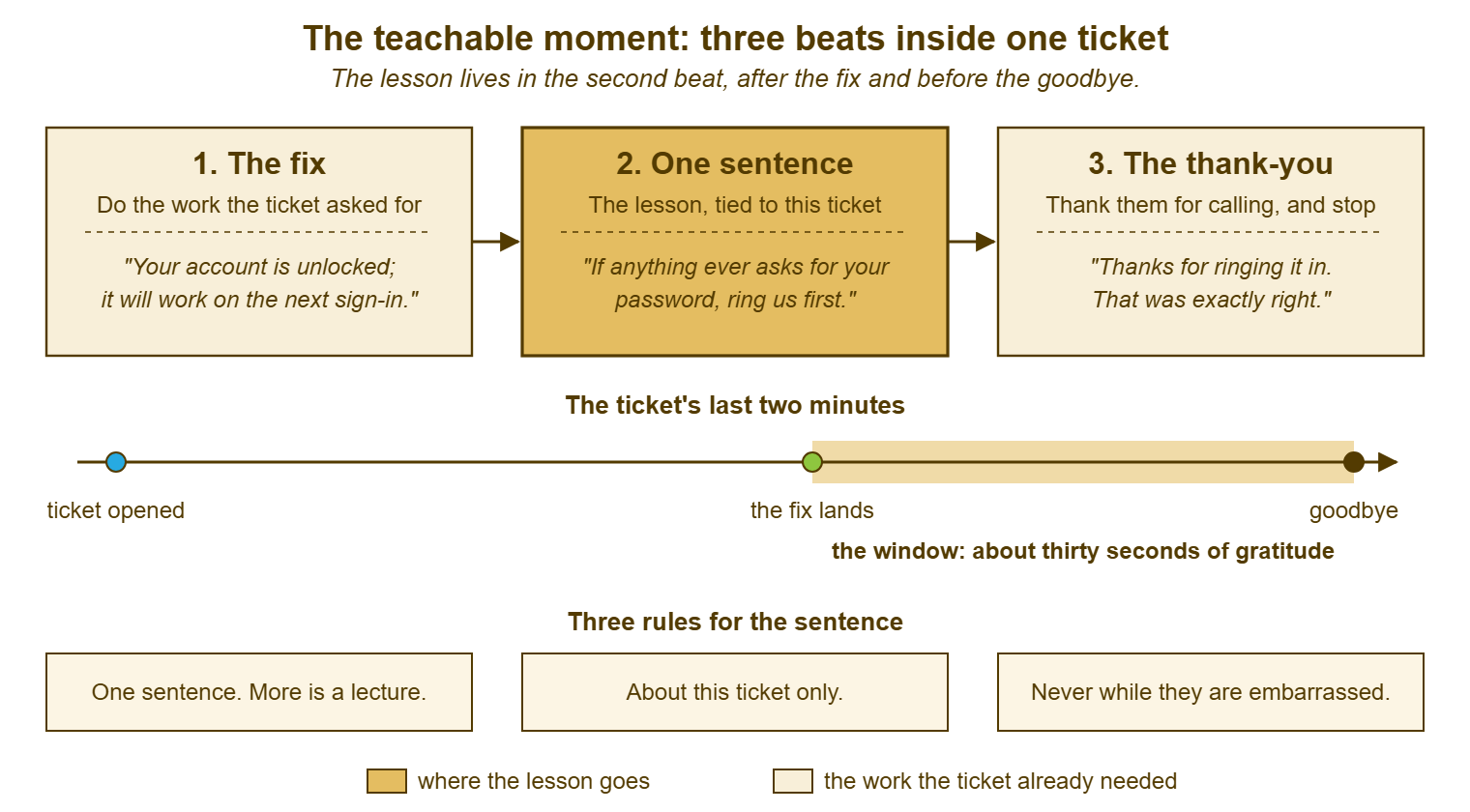
If the window closes before you get there, let it go. The person who says "brilliant, thanks, bye" and hangs up has not been failed. They will ring again, because everyone does, and the next ticket has its own window. A sentence chased down the phone after the goodbye is no longer a teachable moment. It is a callback, and callbacks about security are the thing we are trying to teach people to be suspicious of.
The Tickets That Carry a Lesson
The password reset is the richest moment the desk has, because it is the most common ticket and the one most directly connected to how organisations get broken into. The lesson is where to turn: "if anything ever asks for your password, ring us first; we never ask for it by e-mail." The verification the desk does before the reset is itself a second lesson. It is worth a sentence on its own for the person who grumbles at being checked: "we will always make sure it is you before we reset anything; that check is for your protection." The standard itself lives in Verifying Identity Before You Reset Anything. The sentence is just the standard explained once, kindly, to the person it protects.
The lockout that keeps coming back usually has a stale password on a phone, a saved session or a mapped drive behind it. And the fix is the diagnostic order in The Lockout That Keeps Coming Back. The lesson is one sentence about why it happened: "when you change a password, change it on your phone the same day; the device that remembers the old one is the one that locks you out." People who understand that stop ringing about it, which is the only training outcome that also shortens the queue.
The found USB stick, the free gadget from a conference bag and the cable somebody left in a meeting room all arrive at the desk. They come from people who were not sure what to do and chose to ask. That is the behaviour you want, and the sentence says so: "bringing it to us instead of plugging it in is the right call every time." What the desk then does with the device is in Other Security Tickets the Desk Will See. The person who brought it does not need to hear any of it. They need to hear that they got it right.
The shared account arrives disguised as a favour. "Can you give me the password for the scanning account? Dave used to have it." The fix is to give the person their own access, through the request flow in The Access Request, Done Properly. The lesson explains why that is better for them rather than merely tidier for you. It says: "I will get you your own access; a shared password means nobody can tell who did what, and that protects you as much as it protects us." Said that way, nobody argues. Said as "we don't allow shared accounts", everybody does.
The attachment that will not open is, often enough, an attachment that was never meant to. The person forwards it to the desk asking for help, which is the ideal outcome of the worst kind of e-mail. The sentence tells them so: "when something you were not expecting will not open, that is the moment to send it to us, exactly as you did." The acknowledgement the desk sends to anyone who reports a suspicious message is in The User-Reported Suspicious Email. This sentence is the spoken version, for the person who did not know they were reporting anything.
The new laptop, the desk move and the remote session each carry one habit. On the laptop: "lock the screen when you stand up; it is one keypress and it is the single habit that matters most." On the remote session, as you ask permission to connect: "we will always ask before we connect, and you can end the session whenever you like; anyone who connects without asking is not us." That second sentence does double duty, because it teaches the person what a legitimate support session looks like. That is the only defence most people have against an illegitimate one. The consent routine itself belongs to Consent, Every Time.
Managers get teachable moments too, and the leaver's account is the classic. "Can you leave Sam's account open for a week in case anything comes in?" The fix is to disable the account today and give the manager what they actually need, which is the mailbox. The reasoning is in Why Offboarding Is a Security Ticket First. The sentence is the reasoning compressed: "we will keep the mailbox readable for you; the account itself is disabled today, because an open account that nobody is watching is how the bad weeks start." Managers remember that one. It has a plot.
Writing the Sentence
A good sentence is one sentence, about what just happened, in plain words, and it says what to do rather than what to avoid. "Ring us first" is a thing a person can do on a Tuesday afternoon. "Never click suspicious links" asks them to be suspicious of everything, which nobody can sustain, and gives them nowhere to go when they are unsure. The best sentences end with the desk as the destination, because the lesson under every lesson is the same. When you are not sure, this is who you tell, and nobody here will mind.
The test is whether the person could repeat it to a colleague a week later. Try your draft on that standard and most of them fail. They are two sentences wearing a comma, or they contain a term the person has never heard, or they describe a threat instead of an action. Cut until one idea is left and the idea is something to do. A sentence with "furthermore" in it has stopped being a sentence and become a policy.
| What the lecture sounds like | What the sentence sounds like | Why the sentence wins |
|---|---|---|
| "You should never share your password with anyone, including IT, and you should be careful about e-mails that ask for it, because attackers often impersonate..." | "If anything ever asks for your password, ring us first." | One action, one place to turn; it survives a week |
| "The reason you keep getting locked out is that the credential cached on your mobile device is attempting authentication with the old..." | "When you change a password, change it on your phone the same day." | Names the thing they can do; no vocabulary to learn |
| "Please be aware that unknown removable media is a significant risk vector and policy requires..." | "Bringing it to us instead of plugging it in is the right call every time." | Praises the behaviour you want, so it repeats |
| "We cannot provide shared credentials as this contravenes our access control standard." | "I'll get you your own access; a shared password means nobody can tell who did what, and that protects you too." | Gives the person a reason that is about them |
| "Going forward, always lock your workstation when leaving it unattended, even briefly, as per the acceptable use policy." | "Lock the screen when you stand up; it's one keypress." | Small, specific, and it mentions the cost: one keypress |
Write the sentences in your own voice, not in the voice of the document they came from. The sheet at the end of this article gives one or two lines per ticket type, but what the desk is standardising is the meaning, not the wording. Priya says "ring us first"; her colleague says "give us a shout before you do anything"; both are the same lesson and both sound like a person. The desk's general voice, and how five people keep one without sounding like a recording, is the subject of One Voice Across Five People.
Never a Lecture
A lecture is anything longer than one sentence, or anything that begins "you should always". It is anything that reviews what the person did last time, or anything delivered before the fix. People recognise a lecture within three words and stop listening at the fourth, which they signal with "I know, I know". If you hear that, you have gone past the sentence. Stop, laugh it off, and thank them for calling.
The person who has just clicked a link is not having a teachable moment. They are having a bad quarter of an hour. What they need from the desk is calm facts, the containment steps in When Someone Clicked: The First Hour, and the clear statement that reporting it was the right thing. The lesson comes later, in the outcome message once the account is safe and the embarrassment has faded. It is the same one sentence everyone else gets. A lesson delivered to someone who is already mortified teaches them to hide the next one.
The sentence is said colleague to colleague, not teacher to pupil, and the whole of Patience Without Condescension applies to it. The person who locked themselves out three times this month is not slow. They have a phone, a laptop and a tablet that each remember a different password, and nobody told them that until you did. If a sentence would make you wince to receive it, it is not a sentence. It is a verdict with a smile on it.
Remember: fix first. Then one sentence, about this ticket, that tells the person what to do next time and where to turn. Then thank them, and stop. Never before the fix, never while they are embarrassed, never more than one.
Making It the Desk's Habit, Not One Technician's
Write the lines down, because a habit that lives in one person's head is a coin toss for every user who gets a different technician. The sheet at the end of this article is the form. It is one page, one or two lines per common ticket, in the desk's own words, kept where every technician reads it. A new technician reads it in their first week alongside the other desk standards, and hears the lines used before they are asked to use them. If you run QuerySolv, a knowledge base article visible to agents only is the natural home for it. In that case, it sits beside the verification standard and the other things the desk says the same way every time.
Record the lesson, briefly, in the ticket. A last line in the resolution note, "lesson given: ring us first", or a tag the desk agrees on, is enough. It costs five seconds and it turns the habit into something the desk can count. That is how the final article in this series, Measuring Security Culture From the Desk, shows that the teaching is happening at all. A desk that cannot say how many lessons it delivered last month is relying on everyone's good intentions, and good intentions do not survive a busy Wednesday.
Rotate the lines for the people who ring often. A requester who hears "ring us first" on the first Monday of every month has stopped hearing it by March. So the sheet carries a second line for the common tickets and the technician picks the one the person has not had. Share the lines that land in the weekly team catch-up, the one that The Weekly Huddle and the Ticket of the Week describes. A technician who found a phrasing that made a user laugh and remember has done something worth copying.
Written tickets get the written version. For a request that arrived and was resolved by e-mail, the sentence goes as the last line of the resolving reply, above the sign-off. It is on its own line so it is seen. One line. If the desk uses response templates, the line is in the template for that ticket type, so nobody has to remember it at the end of a long day. The library itself belongs to Templates and Canned Responses. Chat is nearly as good as the phone, because the person is still there; the sentence goes immediately after "that should be working now".
When the Lesson Stays Unsaid
The angry requester gets the fix, an honest acknowledgement, and no lesson. Somebody who has waited three days for a reset and lost a morning's work is not in a window of gratitude. In that case, a sentence about passwords, however kind, will be heard as the desk defending itself. Fix, apologise where the desk owes one, and stop. The conversation itself is the subject of Working With Frustrated Users. The teachable moment comes next time, if the desk earns a next time.
The outage the desk caused is not a teachable moment for anyone but the desk. Forty people locked out by a change nobody announced do not need a sentence about passwords; they need the thing fixed and a straight account of why it happened. Save the sentence for a ticket the person raised about their own situation. Teaching people during an incident you created is a particular kind of nerve, and they notice.
The executive in a hurry still gets the sentence, because it fits. One sentence takes four seconds, and the people who can approve payments are exactly the people the most convincing fakes are written for. Pick the line about where to turn ("if anything about money or passwords looks odd, ring us; we would rather hear about ten false alarms"). Say it, and let them go. In my experience senior people are the most grateful audience for brevity the desk has, having spent the rest of the day being briefed.
The walk-up is the best moment of all, and the easiest to waste. The person is standing at the desk, the fix is done, they have said thank you and they have not yet turned around. Say the sentence there. Then log the walk-up as a ticket with the lesson in the note, because the hallway is a channel like any other and its lessons count the same.
A Short War Story: The Two Halves at Tollgate Foods
Tollgate Foods ran a desk of two, Marta and Jon, who split the password resets roughly evenly and had never once compared what they said while doing them. Marta had ended every reset for years with "if anything ever asks for your password, ring us first". She had picked up the habit from a previous job and never thought of it as training. Jon ended his with "all done, have a good one", which was friendly, correct and complete. Nobody had written either habit down, because nobody knew there were two. Over a year the desk logged eleven reports of suspicious e-mails from people whose resets Marta had done and one from Jon's half. The single click that reached a mailbox was in Jon's half, found on day six. It cost about thirty hours of desk time and a week of the finance team telling suppliers which invoices were real. The lesson Tollgate drew was not about Jon, who had done every reset by the book. It was that a sentence worth saying had been one person's habit when it should have been the desk's. A habit that lives in one person is a coin toss for everyone who rings.
The Teachable-Moment Lines
The sheet below is the one Tollgate wrote the following week. Fill the header and rewrite every line in your desk's own words so it sounds like a person and not a policy. Keep it to one page, and put it where every technician reads it. The rules at the top are the whole method; the lines are the examples. Add a ticket type only when the desk sees it often enough to have a window worth using.
THE TEACHABLE-MOMENT LINES — ONE PER COMMON TICKET
Desk: ______________________   Sheet owner: ______________________   Last reviewed: ____________

RULES
  Fix first. One sentence. About this ticket. Thank them. Stop.
  Say where to turn ("ring us", "send it to us"), not only what to avoid.
  Never before the fix. Never while the person is embarrassed. Never two.
  Record it: resolution note ends "Lesson given: ____" or the agreed tag.

PASSWORD RESET
  "If anything ever asks for your password, ring us first. We never ask for it by e-mail."
  Alternative: "We will always check it is you before a reset. That check is for your protection."

LOCKOUT THAT KEEPS COMING BACK
  "When you change a password, change it on your phone the same day; the device that
   remembers the old one is the one that locks you out."

SUSPICIOUS E-MAIL REPORTED, NOTHING CLICKED
  "Sending it to us was exactly right. Do that every time, even if it turns out to be real."

FOUND USB STICK, FREE GADGET, UNKNOWN DEVICE
  "Bringing it to us instead of plugging it in is the right call every time."

SHARED ACCOUNT OR "GIVE ME HIS PASSWORD"
  "I will get you your own access. A shared password means nobody can tell who did what,
   and that protects you as much as it protects us."

ATTACHMENT THAT WILL NOT OPEN
  "When something you were not expecting will not open, that is the moment to send it to
   us, exactly as you did."

NEW LAPTOP OR DESK MOVE
  "Lock the screen when you stand up. It is one keypress and it is the habit that matters most."

REMOTE SUPPORT SESSION, SAID WHILE ASKING TO CONNECT
  "We will always ask before we connect, and you can end the session whenever you like.
   Anyone who connects without asking is not us."

MANAGER ASKING TO KEEP A LEAVER'S ACCOUNT OPEN
  "We will keep the mailbox readable for you. The account itself is disabled today, because
   an open account nobody is watching is how the bad weeks start."

ACCESS REQUEST
  "Ask for the folder you need rather than the whole drive. Smaller access means fewer
   things that can go wrong under your name."

ANYONE WHO APPROVES PAYMENTS
  "If anything about money or passwords looks odd, ring us. We would rather hear ten false alarms."

WHEN NOT TO USE THE SHEET
  The angry requester. The outage the desk caused. The person who has just clicked: facts
  and calm now; the sentence goes in the outcome message later.
Priya's sentence to Dev was on no sheet; she said it because someone had once said it to her. Harbourview wrote the sheet after his call, mostly so that the next receptionist would hear it whoever picked up the phone. The sentence has not changed. Only the odds have.
Frequently Asked Questions
Isn't security awareness the security team's job, not the help desk's?
What if the requester is in a hurry and clearly wants to hang up?
Should the sentence go in the written reply as well as being said on the phone?
How do we keep the lines from sounding scripted?
The requester has just clicked a phishing link. Is that the moment for the lesson?
How do we know whether any of this is working?
From the QuerySolv team: we build self-hosted help desk software for Windows. QuerySolv runs as one Windows service on your own network. It takes requests by web form, e-mail, live chat, social messages and REST API. It is licensed once per installation rather than per agent per month. The free trial runs the full product for 30 days.