
The Hallway Request, Handled Well in Twenty Seconds
Thursday, 14:10, at Harbourview Clinic. Jonah is carrying a monitor along the corridor to the physiotherapy room. Imogen from reception steps out of the door and says the sentence every technician knows by its first three words. "Can you just, the appointment screen keeps freezing when I open the afternoon list, it's done it twice since lunch." Jonah has a monitor in both hands, a ticket waiting in physiotherapy, and about twenty seconds before Imogen goes back to a waiting room with nine people in it. What he says in those twenty seconds will decide whether this request becomes a ticket, a promise, or a grievance.
A hallway request is a request for support made in person, to a technician, outside the routes that create tickets. Handling it well means three things done in the time it takes to say them. Say yes, log it yourself on the spot, and hand back a number. The previous article in this series counted what the hallway costs. This one is about the twenty seconds in which most of that cost is either incurred or avoided. It is part of our The Walk-Up & Drive-By Culture series, which is about running the hallway as a channel instead of suffering it as a habit.
This article covers the twenty seconds and the three replies a technician can give. Next comes why "send me a ticket" is a brush-off and what to say instead. Then come logging it yourself there and then, and what twenty seconds of logging actually captures. We cover why the number is the point, the request you fix on the spot and still log, and the promise you must never make without a ticket. Next come handling the request that lands while you are mid-ticket and the script in its common variations. A short war story and the hallway script to copy finish the article.
The Twenty Seconds and the Three Replies
There are three replies to "can you just", and only one of them produces a ticket. The first is the promise: "sure, I'll have a look later." It is warm, it is quick, and it creates a piece of work that exists in two memories and no list. The second is the brush-off: "can you put a ticket in?" It is correct about the process and it sends the person away with the work still theirs. The third is the one this article teaches: "Yes. I'm logging it now so it doesn't get lost; you'll get a number in a minute." It is as warm as the first, as correct as the second, and it ends with a ticket.
The third reply works because it changes who does the paperwork. The requester asked for help and got it; the desk needed a record and made one; nobody was sent anywhere. The sentence is short enough to say with a monitor in both hands. The logging it promises takes about as long as the sentence, which is the whole trick. The hallway request is not a problem of attitude. It is a problem of who holds the keyboard for twenty seconds.
Everything else in this article is detail on that reply. It covers why the brush-off fails, how the logging is done in twenty seconds rather than three minutes, and why the number matters more than the fix. It also covers what to do when the request is a two-minute fix you can make right there. The culture changes one reply at a time, and this is the reply.
Why "Send Me a Ticket" Is a Brush-Off
"Can you put a ticket in?" is heard as "no", however it is meant. The requester asked a person for help and was told to go and ask a form instead. That is the same as being told that the person would rather not. The technician meant something reasonable, that the queue is where work is tracked. The requester heard that the technician is too busy for them and that the desk is a place that makes you fill things in. Both readings are honest. Only one of them gets a ticket, and it is not the technician's.
The brush-off also hands the work back to the person least equipped to do it. The requester now has to find the form, guess the category, describe a problem they do not understand in words a technician will, and submit it. Every one of those steps is a place to give up. Many do. The request that would have been a ticket in twenty seconds of the technician's time becomes nothing, or becomes an e-mail three days later beginning "I mentioned this to Jonah". That is the invisible backlog growing by one.
It fails on trust too, and trust is the thing the queue needs most. A requester who was brushed off once will walk up less. That sounds like success until you notice that they are not filing either. They have gone to the colleague who knows a bit about computers, or they are living with the fault. The desk has not won a convert to the queue. It has lost a user. The fifth article in this series, on redirecting without alienating people, is about asking people to use the queue in a way they can hear. The short version is that the request in front of you is never the moment to teach the process. Log this one. Teach later.
Log It Yourself, There and Then
The technician logs the hallway request, not the requester, and does it before the conversation ends. On the phone in a pocket, on the laptop under the arm, on the nearest signed-in machine, on the reception desk's own screen with Imogen watching: whichever is closest. A help desk that can be reached from any browser makes this a thirty-second job from anywhere in the building. A desk that accepts a one-line e-mail from a technician's phone to its intake address makes it a twenty-second one. The route does not matter. What matters is that the ticket exists before Jonah has walked ten more paces.
Twenty seconds of logging captures four things and no more: who, what in five or ten words, where, and the fact that it came from the hallway. "Imogen, reception. Appointment screen freezes opening the afternoon list, twice since lunch. Source: walk-up." No category, no priority, no diagnosis. Those are triage, and triage is a different job done at a different moment. The discipline of sorting new tickets at fixed times rather than at the moment they arrive is in First-Touch Discipline. A hallway ticket joins that sort like any other. The technician who tries to triage in the corridor turns twenty seconds into three minutes and stops doing it by Wednesday.
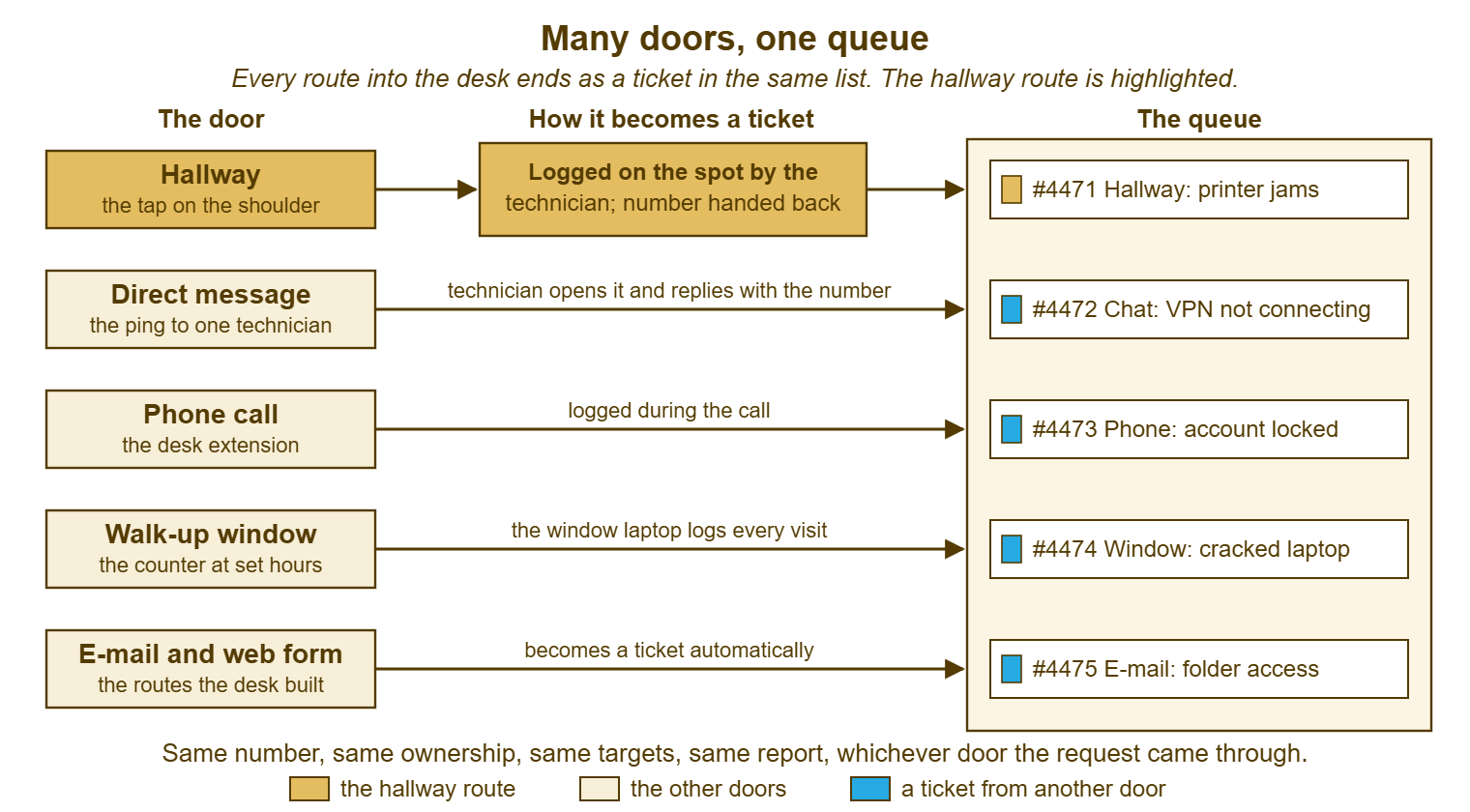
The picture below shows where the hallway ticket goes, which is the same place as every other one. The web form, the mailbox, live chat and the phone each have a route into the queue, most of them automatic. The hallway's route is the technician, logging the request on the spot. Once it is in, there is no difference. The hallway ticket has a number in the same sequence, an owner by the same rules, and the same targets. It has the same place in the same report as a ticket that arrived by form. Every channel into QuerySolv lands in that one queue. So the ticket Jonah types on his phone in the corridor sits beside the ones from the form and the mailbox. Nothing marks it out except its source, which is exactly the point.
Logging after the fact is allowed and should say so. If Jonah genuinely cannot type for the next two minutes, the request is logged the moment he can, with "walk-up, logged afterwards" in the note. Nobody is harmed by the delay as long as the delay is minutes and not days. What is not allowed is logging it "at the end of the day". That is because the end of the day is when the eleven things since lunch have pushed it out. Twenty seconds now or two minutes at the next keyboard. Never later than that.
The Number Is the Point
The ticket number is what turns a request into a thing that exists. The technician's job is to make sure the requester gets it. A request with a number has an owner, a place in the queue, a clock, and a way for the requester to chase it without finding a person. A request without one is a hope. "You'll get a number in a minute" is the sentence that tells Imogen her request has become real. The acknowledgement that lands in her mailbox a minute later is the proof.
The number also gives the technician a graceful way to leave. "It's logged, you've got the number, I'll be with you after physio" is a sentence a person can walk away from without anyone feeling dismissed. Compare it with "I'll have a look later", which cannot be walked away from, because nothing has happened yet. The number closes the conversation by opening the ticket.
And the number is what makes the rest of the series possible. A hallway request with a number can be counted, which is how the first article's census becomes the sixth article's measurement. It can be chased by the requester with a reply rather than a second walk-up. It can be found by whoever covers for Jonah on Friday. Every later improvement in the hallway channel rests on the request having a number, and the number costs twenty seconds. There are few better exchange rates in support.
The One You Fix on the Spot, and Still Log
Some hallway requests are two-minute fixes made by a technician who can see the screen. Those should be fixed on the spot and logged anyway. Imogen's frozen list might be a browser tab that needs closing; Jonah can do that at the reception desk in less time than the ticket would take to triage. He does it. Then he logs it, in one line, with "fixed on the spot" in the note. That is because the fix that was never recorded is a fix the desk cannot count, cannot learn from, and cannot see happen again next week.
The on-the-spot fix is the hallway at its best, and the record is what makes it a strength rather than a leak. A one-line ticket that says "appointment list froze; closed the stuck tab; third time this month at reception" is the start of a pattern the desk can act on. Three such tickets is a problem record. The same fix, unlogged three times, is three happy minutes and no knowledge at all. The counting side of this, and why the unlogged fix distorts the desk's first contact figure in both directions at once, is in Measuring First Contact Resolution Honestly. The practical side is one line, after the fact, every time.
The limit on the on-the-spot fix is time and honesty. If the fix is genuinely two minutes, do it. If it turns out to be twenty, stop, log where you got to, give the number, and come back to it from the queue. That is because the ticket in physiotherapy is also a person and they filed properly. The same rule for the add-on that arrives while you are already at someone's desk, and the point at which "while you're here" stops being two minutes, is the subject of The Two-Minute Rule and Its Limits in the companion series. The hallway version is identical, with fewer chairs.
Remember: the technician logs the hallway request, on the spot, in twenty seconds, and the requester gets a number before the conversation ends. Fixed, promised or redirected, it is a ticket first.
The Promise You Must Not Make
"Leave it with me" without a ticket is the most expensive sentence in support. It should never be said on its own. It feels generous; it is the technician taking the burden off the requester. What it actually does is move the request from a place where it could have been written down to a place where it cannot. That is the technician's memory, on a Thursday, with nine other things in it. The requester now believes the matter is in hand. The desk has no idea the matter exists.
The fix is not to stop saying it but to make it true. "Leave it with me" followed by twenty seconds of logging is a promise with a number. A promise with a number is a ticket. It will be seen at the next triage, it will age visibly if it is not picked up, and it will be covered if Jonah is away. The sentence is fine. The sentence without the ticket is the problem.
If logging is impossible right now, because the technician's hands are full and the phone is in the other jacket, there is a fallback. In that situation, ask for one line rather than a ticket. "Send me one line by e-mail with 'appointment list' in it and I'll turn it into a ticket when I'm back at the desk" asks the requester for ten seconds, not a form. It puts the technician on the hook to convert it. Most tools can turn an e-mail into a ticket in a click or by forwarding it to the intake address. The mechanics are in How a Mailbox Becomes a Queue. The fallback is for the monitor-in-both-hands moment. It is not a way of life.
When the Request Lands Mid-Ticket
The hardest hallway request is the one that arrives while the technician is inside something else. The discipline is to log it before going back. Jonah at his desk, twenty minutes into a tricky certificate problem, is a different person from Jonah in the corridor. He is holding a lot in his head, and the request is going to knock some of it out. The temptation is to say "two minutes" and keep typing. That usually means the requester stands there, the certificate problem leaks anyway, and nothing gets logged. The alternative is to turn, say the twenty-second reply, log it, and then go back, having lost a minute and kept the request.
Logging first is what makes the interruption survivable. A sticky note is not a system. The back of the hand is not a system. "I'll remember" is the system that failed last week. The ticket is the only place the request can go that will still be there after the certificate problem has had its way with the technician's memory. The cost of that minute, and why a day of these is so much more tiring than a day of long tickets, is set out in The Interruption Load. The only defence that is entirely in the technician's hands is to make each interruption leave a ticket behind it. That way, at least the reload does not include wondering what was asked.
There is one honest exception. A technician in the middle of a live incident, a server down or a clinic system unavailable, can say "there's an outage on, I can't take this now, please send one line to the desk address and it'll be picked up" and mean it. That is because the fallback is in play and the outage is public. That is not a brush-off. It is a desk with a bigger problem being honest about it, and most people take it well. (They take it better if the outage is also the reason their own screen is frozen, which it often is.)
The Script in Its Variations
The twenty-second reply has a handful of variations, and the table gives the common ones. The core is always the same: yes, logged now, number coming. What changes is the first and last sentence. That depends on whether the thing can be fixed on the spot, whether the person is passing at speed, and whether the request is a question rather than a job. Say them in your own words; the script is a shape, not a recitation.
| The situation | What to say | What to log |
|---|---|---|
| A request you cannot do now | "Yes. I'm logging it now so it doesn't get lost; you'll get a number in a minute and I'll be on it after this." | Who, what in ten words, where, source: walk-up |
| A fix you can make in two minutes, right there | "Let me look. [Fix.] Done. I'll log that so we can see if it comes back." | One line, "fixed on the spot", and what the fix was |
| The drive-by at walking speed | "Send me one line with 'laptop noise' in it and I'll make it a ticket, or I'll log it now if you've got ten seconds." | Whatever arrives; convert the e-mail the same hour |
| A question with a one-word answer | Answer it. "Yes, bay three is down, there's a ticket on it already, number 5120 if you want to follow it." | Nothing new; add the person to the existing ticket if they want updates |
| Mid-ticket, at your desk | "Give me twenty seconds." [Turn, log it.] "Logged, number's coming. I'll come and find you once I'm out of this." | The usual four things; log before returning to the ticket |
| During a live outage | "There's an outage on. Send one line to the desk address and it'll be picked up as soon as this is contained." | Convert the e-mail when the outage is over; note that it arrived during it |
The table has no row for "can you put a ticket in?" because there is no situation in which it is the first sentence. It may be the last sentence, kindly, after the ticket is logged: "next time, the form on the intranet gets to us faster than finding me, and you'll get the number straight away." That is a redirect, it is a different skill, and it comes after the request has been handled, never instead.
A Short War Story: The Leave-It-With-Me at Redbrook Engineering
Redbrook Engineering is a design office of about ninety. A senior engineer called Beatrix stopped the desk's one technician, Kwame, in the car park one Tuesday. She told him that the licence for the drafting software on her workstation would expire at the end of the month. She also told him she had a deadline the week after. Kwame said "leave it with me", meant it, and walked into a day that contained a failed backup, a visiting auditor and fourteen tickets. None of those was Beatrix's licence, because Beatrix's licence was not a ticket. The licence expired on a Friday. Beatrix lost most of a Monday. The deadline was missed by two days. The engineering director asked the desk why a request made three weeks earlier had not been actioned. The queue could not answer that question because the queue had never heard of it. Kwame's manager did not discipline him, because the desk had no rule. The desk wrote one that afternoon. The rule was that no promise leaves the technician's mouth without a ticket number following it inside a minute. The cost was two days of an engineer's time, a missed client deadline, and the one thing a solo technician cannot afford. That is a director who now wonders what else is in his head and not in the system. A promise without a number is a ticket that will be opened at the worst possible moment by the person you made it to.
The Hallway Script
The script below is the reply and the log, in the order they happen. It includes the four fields the twenty seconds capture and the three variations that come up most. Print it small and keep it where the phone lives, for the first fortnight. After that it is a habit and the card is for the next technician. The line in the last section is the one that keeps the record honest when the logging happens a few minutes late. It is the one most often left out.
THE HALLWAY SCRIPT — THE TWENTY-SECOND REPLY AND THE LOG
Technician: ______________   Where I log from: phone / laptop / nearest machine / e-mail to ________@example.com

1. THE REPLY (say it, in your own words)
   "Yes. I'm logging it now so it doesn't get lost.
    You'll get a number in a minute, and I'll be on it ________."
   Never first: "can you put a ticket in?"
   Never alone: "leave it with me" / "I'll have a look later"

2. THE LOG (twenty seconds, four things, nothing else)
   Who: ______________________   Where: ______________________
   What, in ten words: ______________________________________________
   Source: walk-up / drive-by / found me at ______________
   (No category. No priority. No diagnosis. That is triage, later.)

3. THE NUMBER
   [ ] Requester told a number is coming
   [ ] Acknowledgement sent (automatic, or one line from me)
   [ ] If I fixed it on the spot: logged anyway, note says "fixed on the spot" and what the fix was

4. IF I CANNOT LOG RIGHT NOW
   "Send one line to ________@example.com with ________ in it; I'll make it a ticket within the hour."
   [ ] Converted within the hour    [ ] Note says "walk-up, logged afterwards"

5. IF I WAS MID-TICKET
   [ ] Logged the hallway request BEFORE returning to the ticket
   [ ] Added one line to the interrupted ticket saying where I had got to

6. THE REDIRECT, ONLY AFTER THE TICKET EXISTS
   "Next time the form at ________ reaches us faster than finding me, and you get the number straight away."
Jonah's reply to Imogen, in the corridor with the monitor, was close enough to the script to count: "Yes, I'll log it now, you'll have a number before I get to physio." He typed four lines on his phone against the wall. The acknowledgement reached reception while he was still in the corridor. The appointment list turned out to be the third report of the same fault that month. Nobody had known that because the first two had been fixed on the spot and never written down. The twenty seconds did not fix the list. They made the list a thing the desk could fix.
Frequently Asked Questions
Does logging the request for someone teach them never to use the form?
What is the minimum a hallway ticket needs to contain?
Should I log a question I answered in one word?
How do I log from the corridor if the help desk is only on my desktop?
The person walking up is my manager. Does the script change?
What if I fixed it on the spot and it is embarrassing to log a thirty-second fix?
From the QuerySolv team: we build self-hosted help desk software for Windows. QuerySolv runs as one Windows service on your own network. It takes requests by web form, e-mail, live chat, social messages and REST API. It is licensed once per installation rather than per agent per month. The free trial runs the full product for 30 days.